Lockheed L-1049 Super Constellation
The L-1049 Super Constellation is the enlarged branch of the Constellation family. The archive documents the L-1049C and L-1049G passenger variants.
- Length
- 34.62 m113 ft 7 in on the first stretched L-1049.
- Engine options
- Wright R-3350The original 1049-54 is listed with four Wright 975C18CB-1 engines.
Identification
- Stretched fuselage
- In a side view, compare the long cabin to the earlier Model 49. The first L-1049 stretch added more than 18 ft to the fuselage.
- Three vertical fins
- Three rounded vertical fins stand across the tail. The near fin is at the left edge of this view.
The photo illustrates the L-1049 branch with a preserved G. Use the aircraft record to distinguish the C and G.
Compare models
Comparing Lockheed L-1049C Super Constellation with Lockheed L-1049G Super Constellation.
| Specification | Lockheed L-1049C Super Constellation | Lockheed L-1049G Super Constellation |
|---|---|---|
| Length | Unavailable | 34.75 m114 ft in the museum record for CF-TGE. |
| Wingspan | Unavailable | 37.62 m123.42 ft in the museum record for CF-TGE. |
| Maximum take-off weight | 60.33 t133,000 lb with autofeathering and dump valves. Note 12 permits 135,400 lb with specified modifications. | 62.37 t137,500 lb with autofeathering and dump valves. |
| Maximum payload | Unavailable | Unavailable |
| Fuel tank capacity | 24,794 L6,550 US gal listed across the wing and centre tanks. The usable fuel limit depends on the configuration. | 29,405 L7,768 US gal across the listed tanks with the optional 609-US-gal tanks at both wingtips. |
| Engine options | Wright R-3350Four Wright Compound 972TC18DA1 engines are the baseline. The FAA also lists the 972TC18DA3, 988TC18EA3 and 988TC18EA6 as eligible. | Wright R-3350The museum lists four engines at 3,250 hp each for CF-TGE. The exact installed suffix is unreported. |
| Typical two-class seats | Unavailable | Unavailable |
| Published range | Unavailable | Unavailable |
A dash indicates that a verified figure is unavailable. Figures follow the configuration specified by each source.
Comparison sources
- FAA Aircraft Specification 6A5 · Revision 25Section IV, p. 5 · Model 1049C-55 engine eligibility
- FAA Aircraft Specification 6A5 · Revision 25Section IV, pp. 6–7 and Notes 7 and 12, p. 28 · Model 1049C-55
- The Museum of Flight · Lockheed L-1049G CF-TGE, c/n 4544CF-TGE museum aircraft dimensions and power plant
- U.S. Federal Aviation Agency · Lockheed 1049G ground operationsLockheed 1049G · General description
- FAA Aircraft Specification 6A5 · Revision 25Section VI, pp. 10–11 · Model 1049G-82
Variants
Lockheed L-1049C Super Constellation
The L-1049C was a passenger variant of the Super Constellation. Lockheed delivered construction number 4544 to Trans-Canada Air Lines in this configuration in 1954.
Lockheed L-1049G Super Constellation
The L-1049G, known as the Super G, was a later Super Constellation variant. The Museum of Flight preserves CF-TGE, construction number 4544, in its former Trans-Canada Air Lines colors.
Design & cabins
Wright R-3350 installation
See the engine encyclopedia for ratings and aircraft applications.
Featured components & design
Rectangular windows and reinforced outer wings
The production L-1049 introduced rectangular cabin windows. Its outer wings and fuselage were also strengthened. The cabin window shape can help distinguish the passenger configuration from an earlier Constellation.
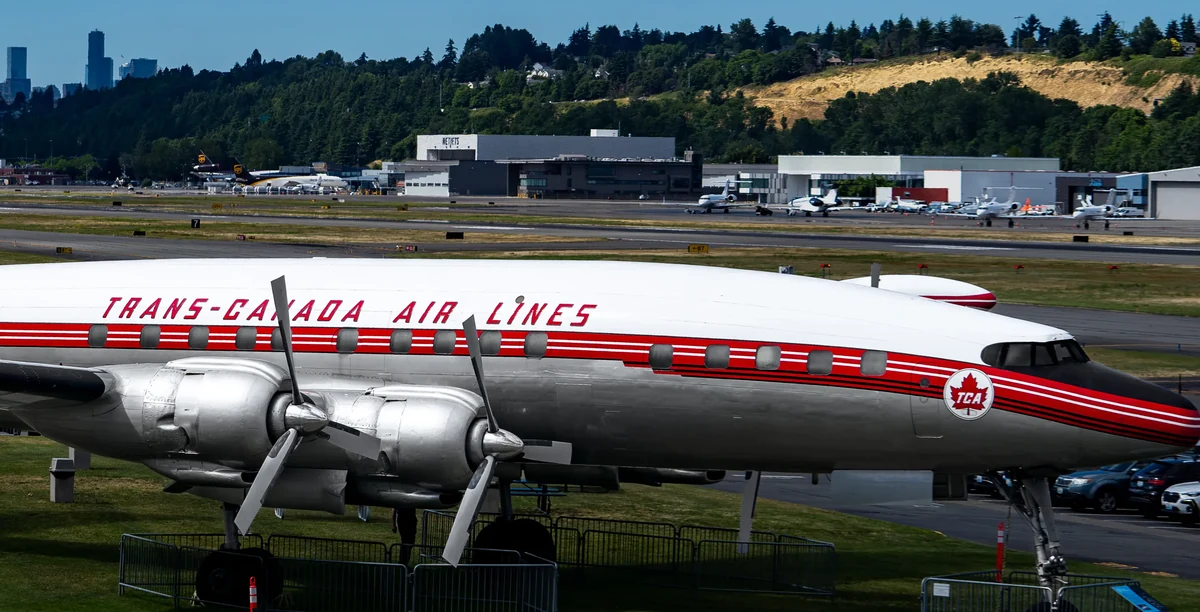
Museum of Flight L-1049G CF-TGE · rectangular windowsAdmin · detail crop
Technical notes
Design notes
- The L-1049 introduced a longer fuselage. Later versions included passenger and cargo configurations.
Limitations
- The Super Constellation name covers multiple L-1049 variants. Use the aircraft's construction record or documented conversion history to establish the subtype.
Variant Technical Profile
Lockheed L-1049 Super Constellation is a specific configuration within Lockheed Constellation, developed to cover a defined capacity, range, payload, or mission requirement inside the wider family.
Lockheed L-1049 Super Constellation is positioned as a capacity/range-specific solution within the narrowbody segment, serving routes better matched than sibling variants.
Technical features
- Lockheed L-1049 Super Constellation: Single-aisle fuselage efficiency · structure. A narrow fuselage reduces structural weight and airport footprint for high-frequency short and medium routes.
- Lockheed L-1049 Super Constellation: High-cycle operating design · maintenance. Doors, landing gear, brakes, and systems are optimized for repeated daily sectors and quick turnarounds.
- Lockheed L-1049 Super Constellation: Wing and high-lift devices · aerodynamics. Flaps, slats, and wingtip devices balance runway performance with cruise efficiency.
- Lockheed L-1049 Super Constellation: Engine generation changes · engine. Engine nacelle, thrust rating, fuel burn, and noise standards define each production generation.
- Lockheed L-1049 Super Constellation: Fleet commonality · operational_efficiency. Common flight decks and maintenance practices reduce training and support cost across subfleets.
Advantages
- Provides a more precise capacity or range match within the family.
- Retains training, maintenance, and parts commonality with sibling variants.
- Lets operators tune engine, cabin, and payload choices to route needs.
Weaknesses
- Configuration identification complexity. Visually similar aircraft can differ materially by engine, weight standard, cabin layout, and conversion status.
- Generation-dependent economics. Older generations usually trail newer designs in fuel burn, noise, avionics, or maintenance intervals.
- Market-fit limits. Every variant has an ideal capacity and range band; outside it, load factor, range, or cost can become limiting.
Markets
- Network airline trunk or feeder markets
- Leasing and fleet replacement markets
- Regional, domestic, or international airline markets
Operators
- Full-service network airlines
- Low-cost or leisure airlines
- Cargo, government, or special-mission operators
Routes and missions
- High-frequency short or medium-haul trunk routes
- Medium-density long-haul or cross-regional routes
- Fleet replacement, supplementation, or special missions
Sibling comparison
- smaller sibling variants. Usually provides more seats, cargo volume, or thrust demand, but can be harder to fill on thinner routes.
- larger or longer-range sibling variants. Usually has lower acquisition and operating exposure, but less range, payload, or growth margin.
From the archive
Loading photographs…