Home/Encyclopedia/Lockheed/Lockheed Constellation

Lockheed Constellation

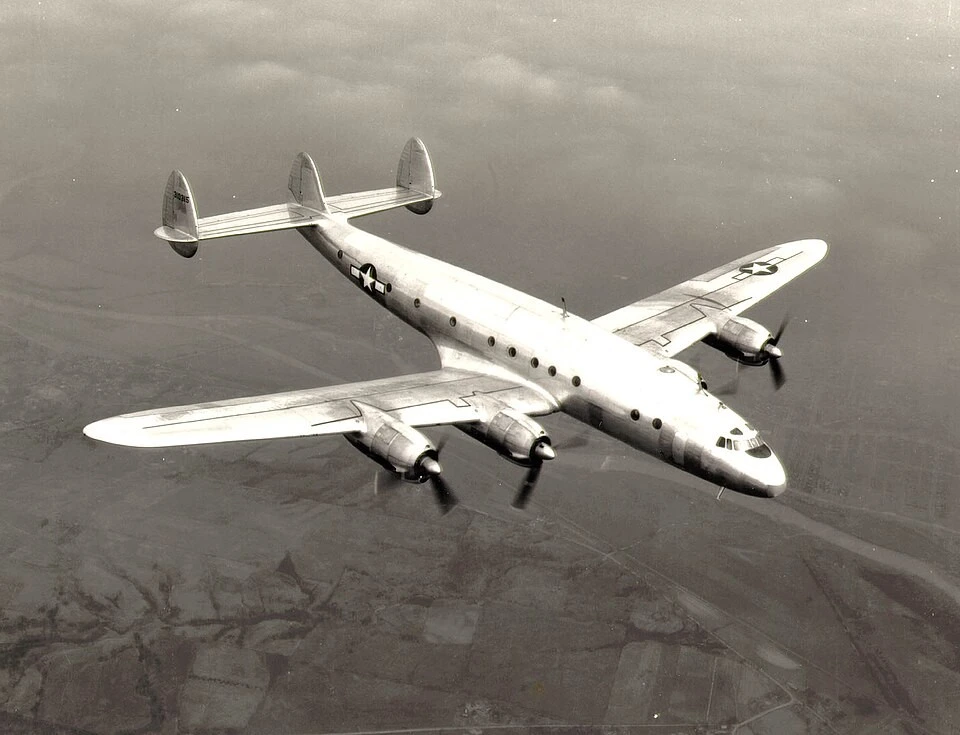
The Constellation is Lockheed's family of four-engine piston transports. The original Model 49 first flew in January 1943. Lockheed later enlarged the design into the L-1049 Super Constellation.

Models at a glance

Lockheed L-1049 Super Constellation

The L-1049 Super Constellation is the enlarged branch of the Constellation family. The archive documents the L-1049C and L-1049G passenger variants.

Length
34.62 m113 ft 7 in on the first stretched L-1049.
Wingspan
Unavailable
Engine options
Wright R-3350The original 1049-54 is listed with four Wright 975C18CB-1 engines.
Main landing gear
Unavailable
Lockheed L-1049 Super Constellation variants

Lockheed L-1049C Super Constellation

The L-1049C was a passenger variant of the Super Constellation. Lockheed delivered construction number 4544 to Trans-Canada Air Lines in this configuration in 1954.

Length
Unavailable
Wingspan
Unavailable
Engine options
Wright R-3350Four Wright Compound 972TC18DA1 engines are the baseline. The FAA also lists the 972TC18DA3, 988TC18EA3 and 988TC18EA6 as eligible.
Main landing gear
Unavailable
Sources

Lockheed L-1049G Super Constellation

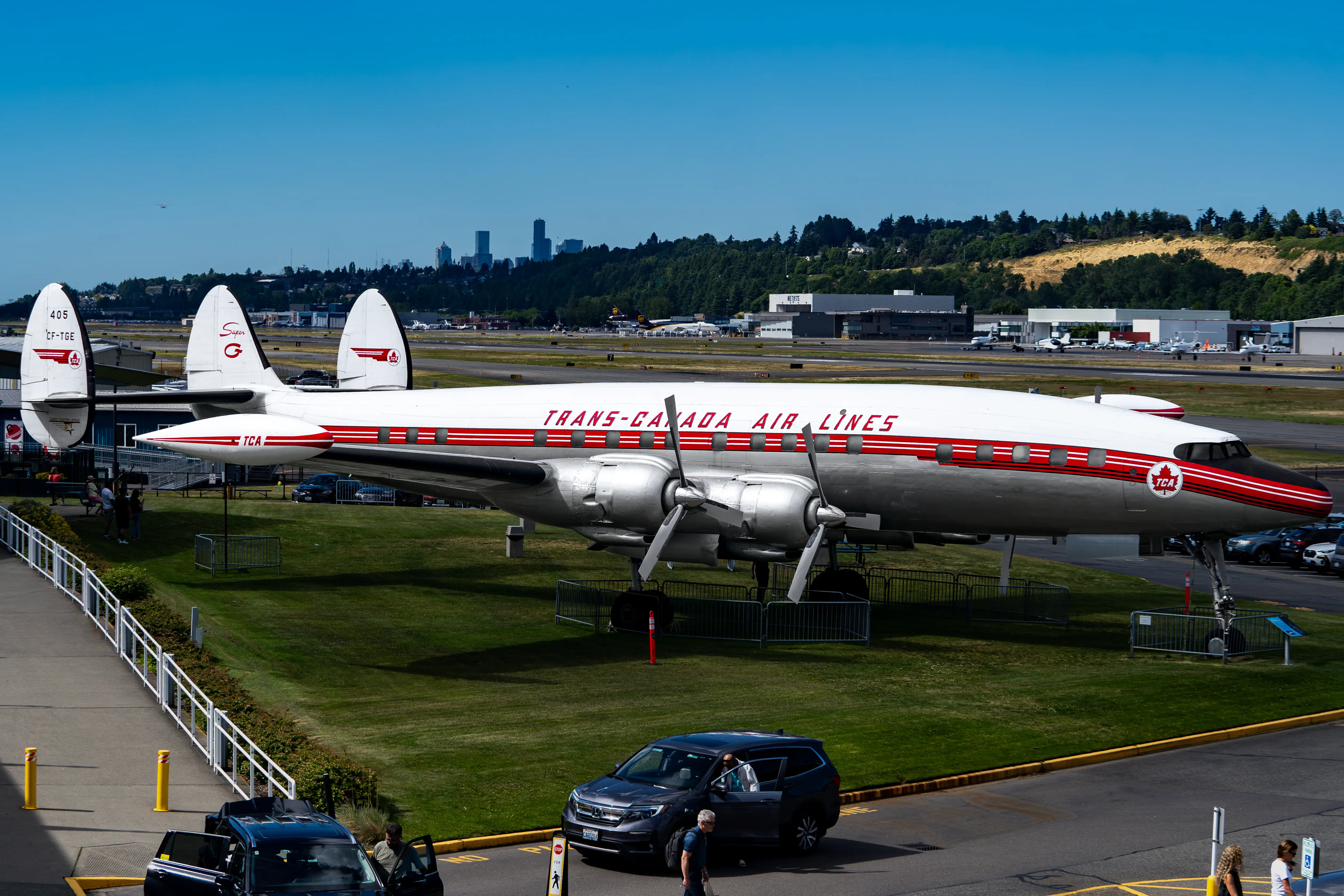
The L-1049G, known as the Super G, was a later Super Constellation variant. The Museum of Flight preserves CF-TGE, construction number 4544, in its former Trans-Canada Air Lines colors.

Length
34.75 m114 ft in the museum record for CF-TGE.
Wingspan
37.62 m123.42 ft in the museum record for CF-TGE.
Engine options
Wright R-3350The museum lists four engines at 3,250 hp each for CF-TGE. The exact installed suffix is unreported.
Main landing gear
Retractable tricycle landing gear, with nosewheel steering
Sources

Identification

Three vertical fins
Three rounded vertical fins stand across the tail. The near fin is at the left edge of this view.
Four radial engines
The two engines on the nearer wing show the nacelles and propellers of the four-engine installation.

The photograph shows CF-TGE in its preserved L-1049G configuration. The family traits alone do not identify a subtype.

Design & cabins

Technical notes

Design notes

  • The Model 49 was developed to meet requirements from Transcontinental and Western Air. Wartime production included the C-69 transport, and civilian airliners followed after the war.
Family Technical Profile

Lockheed Constellation is one of Aircraft manufacturer's platforms in its market segment, balancing capacity, range, airport compatibility, maintenance economics, and mission flexibility.

Lockheed Constellation serves the narrowbody market with family commonality and multiple configurations.

Technical features

  • Lockheed Constellation: Single-aisle fuselage efficiency · structure. A narrow fuselage reduces structural weight and airport footprint for high-frequency short and medium routes.
  • Lockheed Constellation: High-cycle operating design · maintenance. Doors, landing gear, brakes, and systems are optimized for repeated daily sectors and quick turnarounds.
  • Lockheed Constellation: Wing and high-lift devices · aerodynamics. Flaps, slats, and wingtip devices balance runway performance with cruise efficiency.
  • Lockheed Constellation: Engine generation changes · engine. Engine nacelle, thrust rating, fuel burn, and noise standards define each production generation.
  • Lockheed Constellation: Fleet commonality · operational_efficiency. Common flight decks and maintenance practices reduce training and support cost across subfleets.

Advantages

  • One platform can cover several capacity and mission bands.
  • Family design reduces training, maintenance, and spares complexity.
  • Engine, wingtip, avionics, or structural upgrades can extend lifecycle value.

Weaknesses

  • Configuration identification complexity. Visually similar aircraft can differ materially by engine, weight standard, cabin layout, and conversion status.
  • Generation-dependent economics. Older generations usually trail newer designs in fuel burn, noise, avionics, or maintenance intervals.
  • Market-fit limits. Every variant has an ideal capacity and range band; outside it, load factor, range, or cost can become limiting.

Markets

  • Network airline trunk or feeder markets
  • Leasing and fleet replacement markets
  • Regional, domestic, or international airline markets

Operators

  • Full-service network airlines
  • Low-cost or leisure airlines
  • Cargo, government, or special-mission operators

Routes and missions

  • High-frequency short or medium-haul trunk routes
  • Medium-density long-haul or cross-regional routes
  • Fleet replacement, supplementation, or special missions

Development & service

  • The Constellation is Lockheed's family of four-engine piston transports. The original Model 49 first flew in January 1943. Lockheed later enlarged the design into the L-1049 Super Constellation.

Sources