Douglas DC-3

The civil DC-3 carried day passengers, sleepers or freight in layouts selected for each operation. Cathay Pacific began flying with a converted DC-3 named Betsy.

Length
19.65 m
Wingspan
28.96 m

Identification

Civil DC-3 airframe
Look for two radial engines on a low wing and a tailwheel under the aft fuselage. Betsy is a preserved Cathay Pacific example.
C-47 cargo entrance
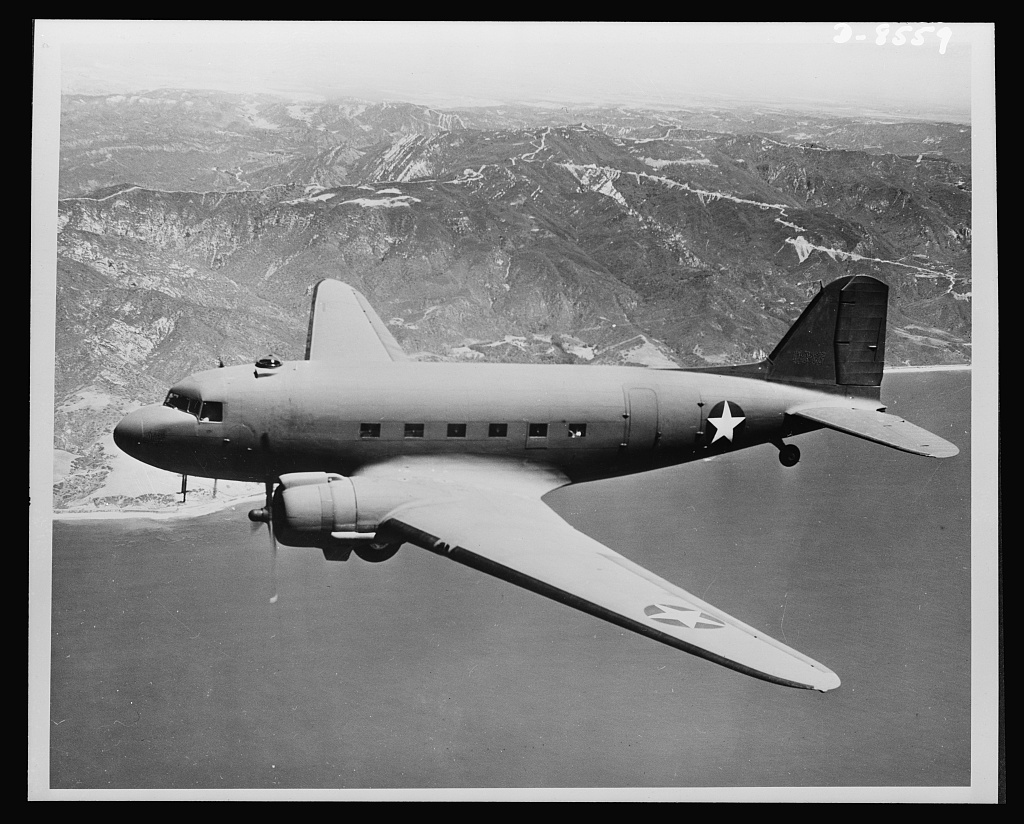
On the illustrated C-47, the broad port-side door is aft of the cabin windows. Boeing’s series diagram shows the cargo and passenger door positions.
Verify surviving aircraft
Restored liveries and civil conversions can share external details. Identify the configuration from the aircraft record as well as the door and wheel arrangement.

Select a circle to see the marked area up close.

Betsy (VR-HDB) · restored DC-3
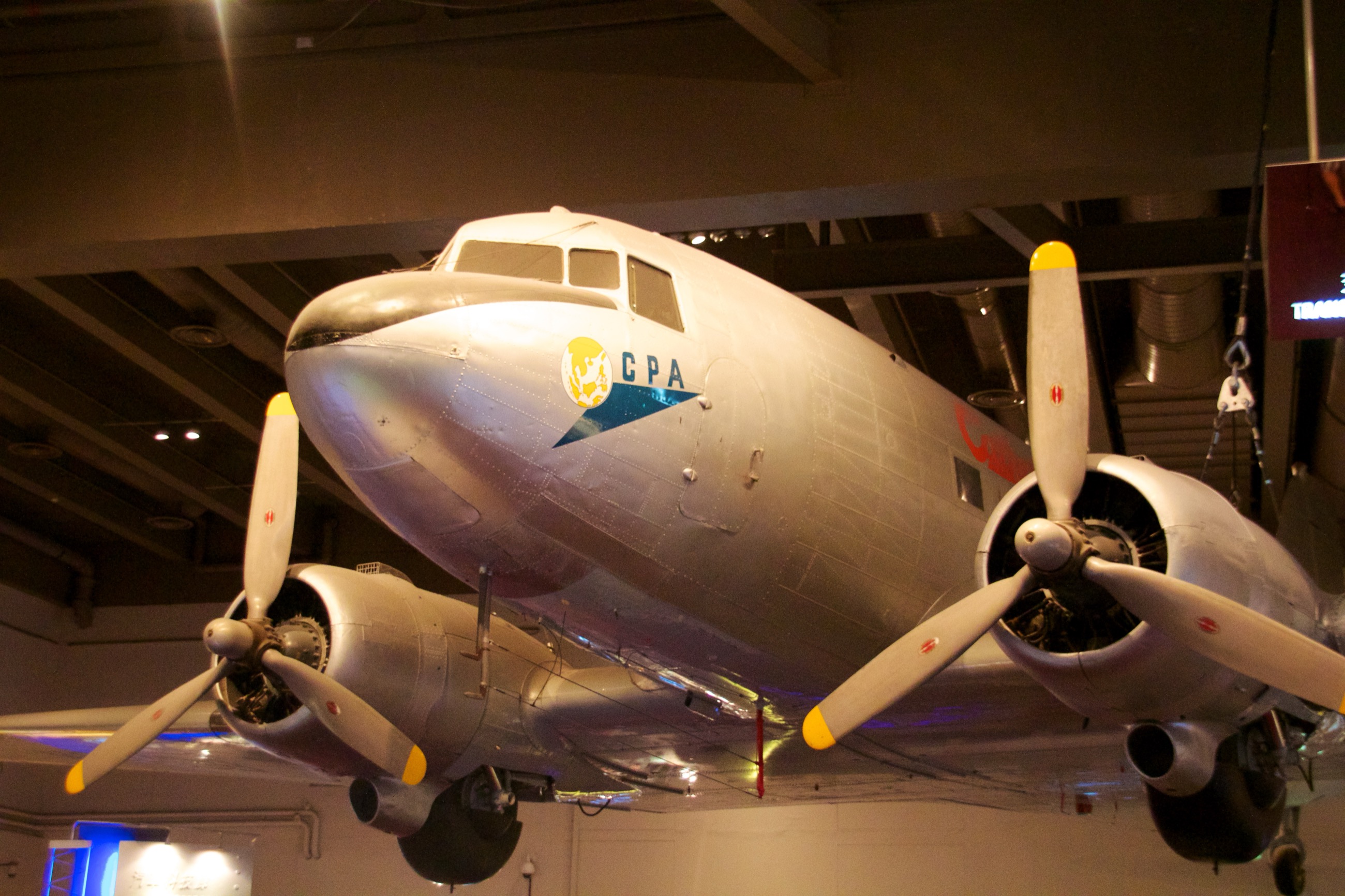
This view shows the restored Cathay Pacific aircraft on display at the Hong Kong Science Museum. Image resized for display.
This view shows the restored Cathay Pacific aircraft on display at the Hong Kong Science Museum. Image resized for display.Photo by Photograph by Mike Peel (www.mikepeel.net)
Photo sourceCC BY-SA 4.0

U.S. Army Air Forces C-47 · port side

The Library of Congress image shows the left side in flight. The cargo door outline appears immediately ahead of the star insignia.
The Library of Congress image shows the left side in flight. The cargo door outline appears immediately ahead of the star insignia.Photo by Office of War Information · Library of Congress, Prints & Photographs Division, FSA/OWI Collection
Photo sourcePublic domain

Compare models

Current aircraftDouglas DC-3
Compare with

Comparing Douglas DC-3 with Douglas C-47 Skytrain.

SpecificationDouglas DC-3Douglas C-47 Skytrain
Length19.65 m19.65 m
Wingspan28.96 m28.96 m
Maximum take-off weightUnavailable11.79 tPublished U.S. Air Force museum C-47D figure.
Maximum payloadUnavailable2.72 tPublished cargo payload · U.S. Air Force museum’s 6,000 lb cargo example.
Fuel tank capacityUnavailableUnavailable
Engine optionsUnavailablePratt & Whitney R-1830
Typical two-class seatsUnavailableUnavailable
Published rangeUnavailableUnavailable

A dash indicates that a verified figure is unavailable. Figures follow the configuration specified by each source.

Comparison sources

Design & cabins

Technical notes

Design notes

  • Boeing's Douglas history lists 14 berths in the early sleeper layout and 21 to 28 seats for day service. Freighter conversions and surviving examples may differ.
  • Two radial piston engines drive propellers on the low wing. The original model used Wright radial engines in Boeing's published example. Check the individual airframe before assigning an engine model.

Limitations

  • The numbers describe published historical examples and can differ between engines and cabin layouts.
Variant Technical Profile

Douglas DC-3 is a specific configuration within Douglas DC-3 / C-47 Family, developed to cover a defined capacity, range, payload, or mission requirement inside the wider family.

Douglas DC-3 is positioned as a capacity/range-specific solution within the narrowbody segment, serving routes better matched than sibling variants.

Technical features

  • Douglas DC-3: Single-aisle fuselage efficiency · structure. A narrow fuselage reduces structural weight and airport footprint for high-frequency short and medium routes.
  • Douglas DC-3: High-cycle operating design · maintenance. Doors, landing gear, brakes, and systems are optimized for repeated daily sectors and quick turnarounds.
  • Douglas DC-3: Wing and high-lift devices · aerodynamics. Flaps, slats, and wingtip devices balance runway performance with cruise efficiency.
  • Douglas DC-3: Engine generation changes · engine. Engine nacelle, thrust rating, fuel burn, and noise standards define each production generation.
  • Douglas DC-3: Fleet commonality · operational_efficiency. Common flight decks and maintenance practices reduce training and support cost across subfleets.

Advantages

  • Provides a more precise capacity or range match within the family.
  • Retains training, maintenance, and parts commonality with sibling variants.
  • Lets operators tune engine, cabin, and payload choices to route needs.

Weaknesses

  • Configuration identification complexity. Visually similar aircraft can differ materially by engine, weight standard, cabin layout, and conversion status.
  • Generation-dependent economics. Older generations usually trail newer designs in fuel burn, noise, avionics, or maintenance intervals.
  • Market-fit limits. Every variant has an ideal capacity and range band; outside it, load factor, range, or cost can become limiting.

Markets

  • Network airline trunk or feeder markets
  • Leasing and fleet replacement markets
  • Regional, domestic, or international airline markets

Operators

  • Full-service network airlines
  • Low-cost or leisure airlines
  • Cargo, government, or special-mission operators

Routes and missions

  • High-frequency short or medium-haul trunk routes
  • Medium-density long-haul or cross-regional routes
  • Fleet replacement, supplementation, or special missions

Sibling comparison

  • smaller sibling variants. Usually provides more seats, cargo volume, or thrust demand, but can be harder to fill on thinner routes.
  • larger or longer-range sibling variants. Usually has lower acquisition and operating exposure, but less range, payload, or growth margin.

VR-HDB · Cathay Pacific Betsy

Betsy was Cathay Pacific’s first aircraft. Cathay sold it in 1955, later bought it back from its operators in Australia, and restored its early livery before donating it to the Hong Kong Science Museum. The exhibit carries the historic registration VR-HDB.

Sources