Douglas C-47 Skytrain

The C-47 was developed from the DC-3 for military transport. A wide aft side door and a strengthened cabin floor allowed bulky freight to be loaded into the cabin.

Length
19.65 m
Wingspan
28.96 m
Engine options
Pratt & Whitney R-1830

Identification

Civil DC-3 airframe
Look for two radial engines on a low wing and a tailwheel under the aft fuselage. Betsy is a preserved Cathay Pacific example.
C-47 cargo entrance
On the illustrated C-47, the broad port-side door is aft of the cabin windows. Boeing’s series diagram shows the cargo and passenger door positions.
Verify surviving aircraft
Restored liveries and civil conversions can share external details. Identify the configuration from the aircraft record as well as the door and wheel arrangement.

Select a circle to see the marked area up close.

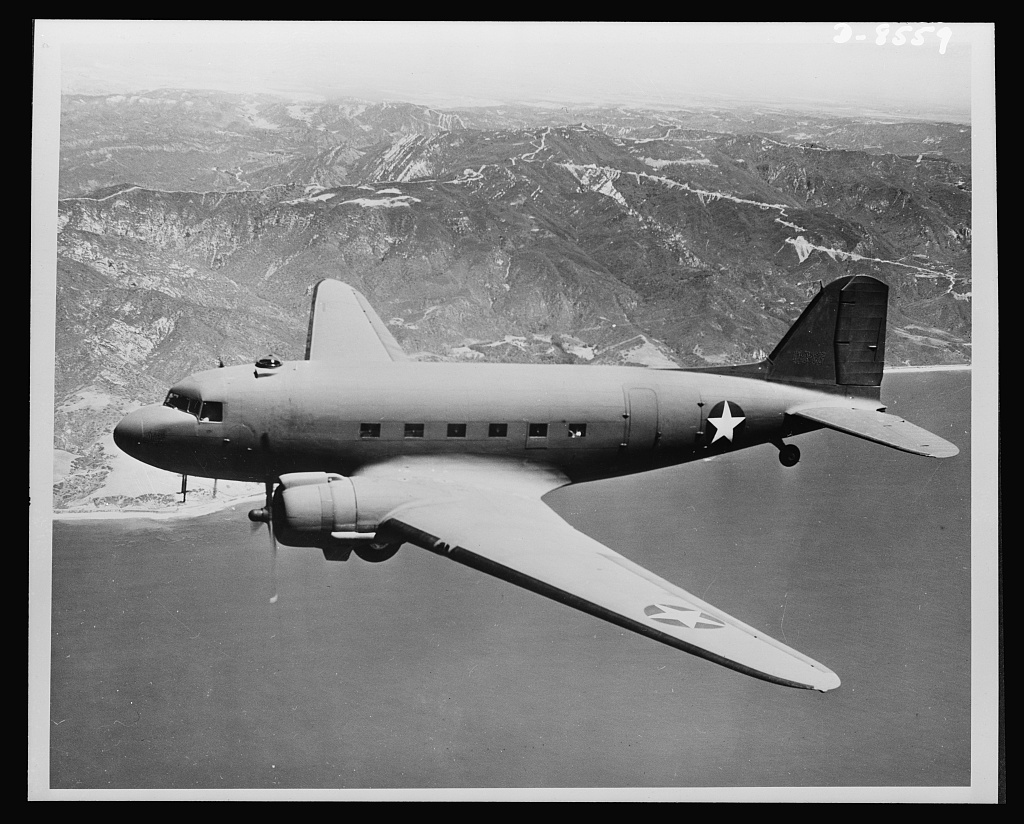
U.S. Army Air Forces C-47 · port side

The Library of Congress image shows the left side in flight. The cargo door outline appears immediately ahead of the star insignia.
The Library of Congress image shows the left side in flight. The cargo door outline appears immediately ahead of the star insignia.Photo by Office of War Information · Library of Congress, Prints & Photographs Division, FSA/OWI Collection
Photo sourcePublic domain

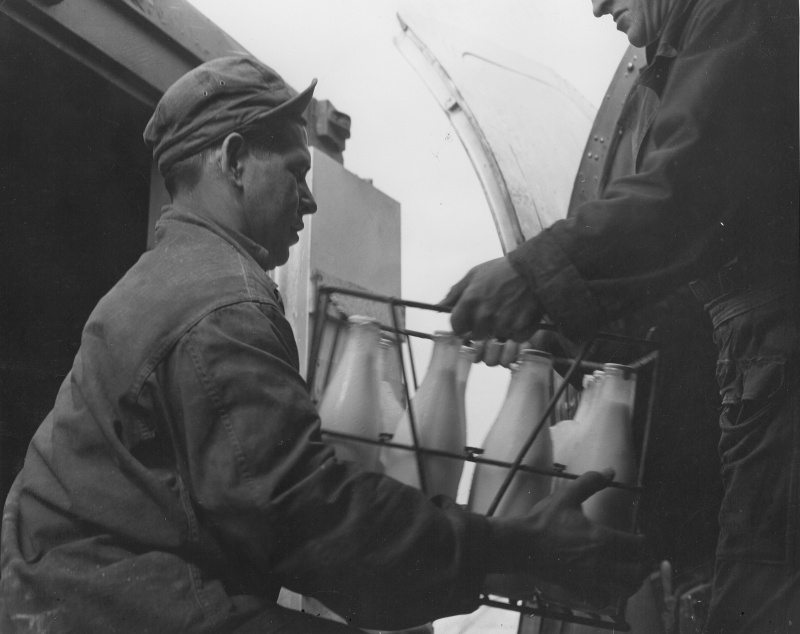
Loading a C-47 during the Berlin Airlift

Supplies go through the open doorway on the C-47 at Wiesbaden on 18 August 1948.
Supplies go through the open doorway on the C-47 at Wiesbaden on 18 August 1948.Photo by Byers · Joint Export Import Agency, Frankfurt · Harry S. Truman Library & Museum
Photo sourcePublic domain

Compare models

Current aircraftDouglas C-47 Skytrain
Compare with

Comparing Douglas C-47 Skytrain with Douglas DC-3.

SpecificationDouglas C-47 SkytrainDouglas DC-3
Length19.65 m19.65 m
Wingspan28.96 m28.96 m
Maximum take-off weight11.79 tPublished U.S. Air Force museum C-47D figure.Unavailable
Maximum payload2.72 tPublished cargo payload · U.S. Air Force museum’s 6,000 lb cargo example.Unavailable
Fuel tank capacityUnavailableUnavailable
Engine optionsPratt & Whitney R-1830Unavailable
Typical two-class seatsUnavailableUnavailable
Published rangeUnavailableUnavailable

A dash indicates that a verified figure is unavailable. Figures follow the configuration specified by each source.

Comparison sources

Design & cabins

  • Pratt & Whitney R-1830

Technical notes

Design notes

  • The U.S. Air Force museum records configurations for 28 passengers, 18 to 22 equipped paratroopers, freight or stretcher transport. Boeing's DC-3 series diagram marks the side cargo entrance separately from the cabin door.
  • The museum's C-47D example used two 1,200 hp Pratt & Whitney R-1830 radial engines.

Limitations

  • The door outline is a useful clue. Surviving aircraft may have been converted to other uses, including civilian passenger service.
Variant Technical Profile

Douglas C-47 Skytrain is a specific configuration within Douglas DC-3 / C-47 Family, developed to cover a defined capacity, range, payload, or mission requirement inside the wider family.

Douglas C-47 Skytrain is positioned as a capacity/range-specific solution within the narrowbody segment, serving routes better matched than sibling variants.

Technical features

  • Douglas C-47 Skytrain: Single-aisle fuselage efficiency · structure. A narrow fuselage reduces structural weight and airport footprint for high-frequency short and medium routes.
  • Douglas C-47 Skytrain: High-cycle operating design · maintenance. Doors, landing gear, brakes, and systems are optimized for repeated daily sectors and quick turnarounds.
  • Douglas C-47 Skytrain: Wing and high-lift devices · aerodynamics. Flaps, slats, and wingtip devices balance runway performance with cruise efficiency.
  • Douglas C-47 Skytrain: Engine generation changes · engine. Engine nacelle, thrust rating, fuel burn, and noise standards define each production generation.
  • Douglas C-47 Skytrain: Fleet commonality · operational_efficiency. Common flight decks and maintenance practices reduce training and support cost across subfleets.

Advantages

  • Provides a more precise capacity or range match within the family.
  • Retains training, maintenance, and parts commonality with sibling variants.
  • Lets operators tune engine, cabin, and payload choices to route needs.

Weaknesses

  • Configuration identification complexity. Visually similar aircraft can differ materially by engine, weight standard, cabin layout, and conversion status.
  • Generation-dependent economics. Older generations usually trail newer designs in fuel burn, noise, avionics, or maintenance intervals.
  • Market-fit limits. Every variant has an ideal capacity and range band; outside it, load factor, range, or cost can become limiting.

Markets

  • Network airline trunk or feeder markets
  • Leasing and fleet replacement markets
  • Regional, domestic, or international airline markets

Operators

  • Full-service network airlines
  • Low-cost or leisure airlines
  • Cargo, government, or special-mission operators

Routes and missions

  • High-frequency short or medium-haul trunk routes
  • Medium-density long-haul or cross-regional routes
  • Fleet replacement, supplementation, or special missions

Sibling comparison

  • smaller sibling variants. Usually provides more seats, cargo volume, or thrust demand, but can be harder to fill on thinner routes.
  • larger or longer-range sibling variants. Usually has lower acquisition and operating exposure, but less range, payload, or growth margin.
Sources