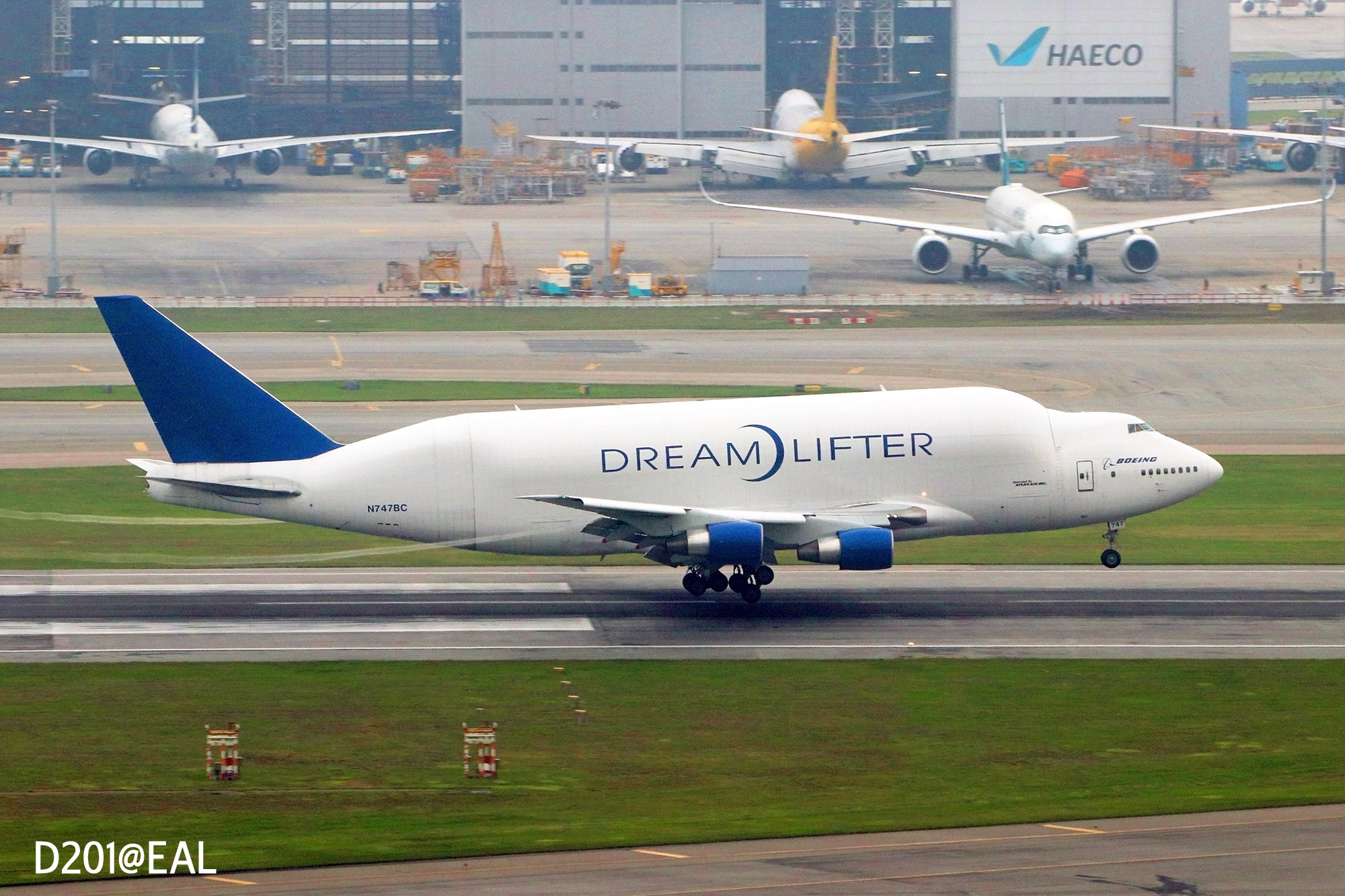
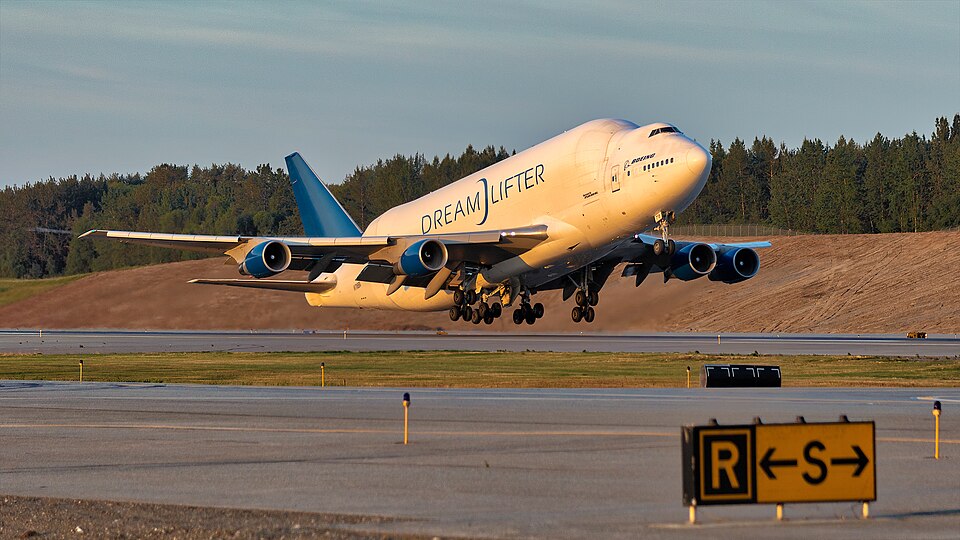
747-400LCF Dreamlifter

The Boeing Dreamlifter is a 747-400 passenger airframe converted to carry oversized Boeing 787 assemblies between production sites. Its enlarged upper fuselage holds the parts, and its aft fuselage swings sideways for loading. The flight-plan type designator is BLCF.

At a glance

747-400 model line

Compare models

Current aircraft747-400
Compare with

Comparing 747-400LCF Dreamlifter with 747-400.

Specification747-400LCF Dreamlifter747-400
Length71.69 mFAA airport-planning dimension · 235.2 ft70.68 m
Wingspan64.92 mFAA ACD planning figure without winglets · 213 ft64.44 m
Maximum take-off weight364.24 t803,000 lb in the FAA airport-planning database396.89 t
Maximum payloadUnavailable67.46 tRolls-Royce RB211 higher zero-fuel weight option
Fuel tank capacityUnavailable216,847 LPratt & Whitney or Rolls-Royce configuration with horizontal stabilizer tank
Engine optionsUnavailableCF6-80C2 · PW4000 · RB211-524
Typical two-class seatsUnavailable408KLM passenger aircraft example · 35 World Business and 373 Economy, including Economy Comfort
Published rangeUnavailable7,204 nmiBoeing published range · at the cited 875,000 lb design weight

A dash indicates that a verified figure is unavailable. Figures follow the configuration specified by each source.

Comparison sources

Identification

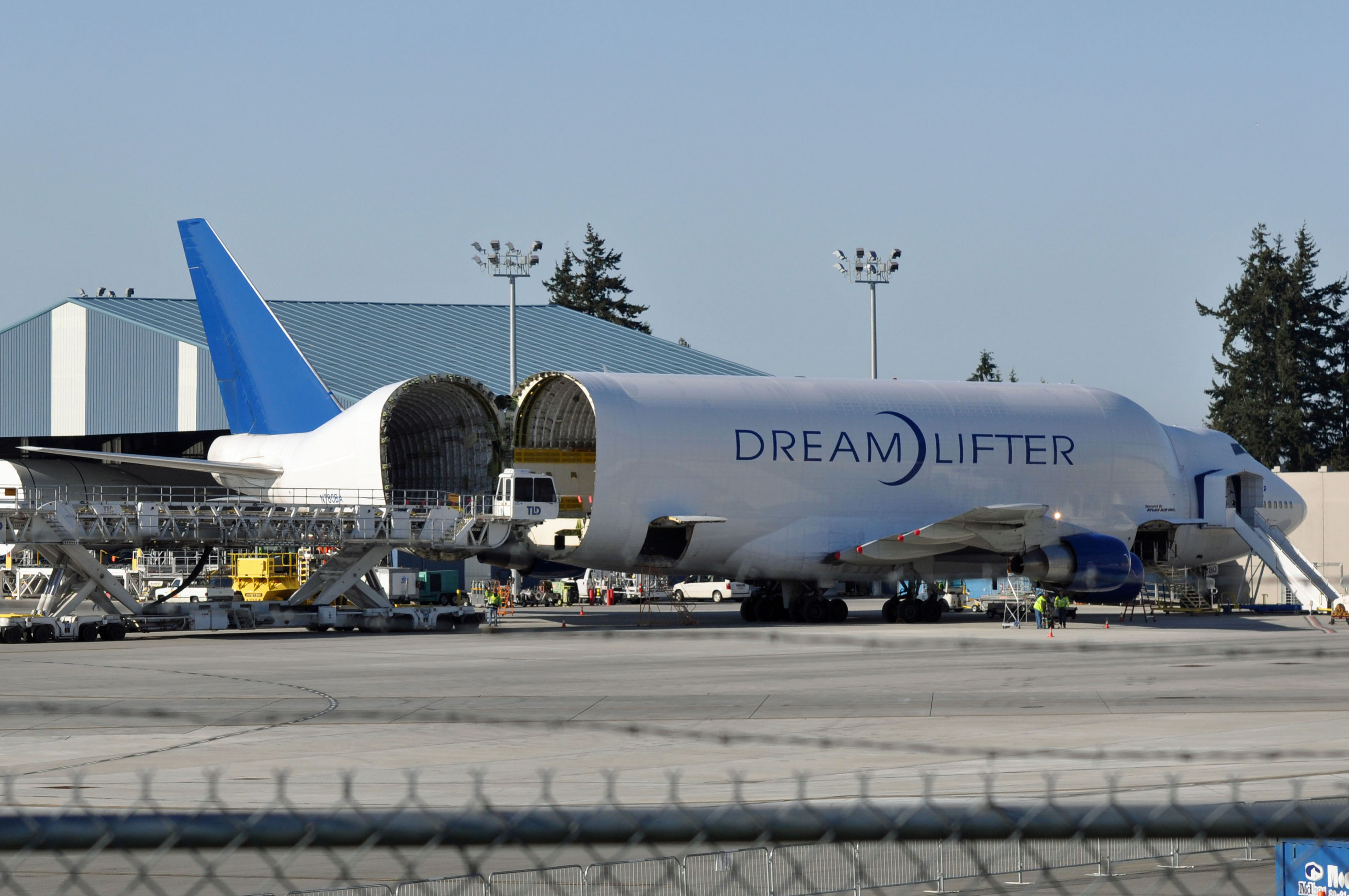
Side-opening tail
Look for a joint ahead of the tail. The aft fuselage and attached tail surfaces pivot together to expose the rear cargo opening. The factory 747-400F loads through its hinged nose.
Raised cargo fuselage
The deep upper fuselage continues well behind the flight deck. BelugaXL has a comparably oversized hold, but it has two engines and a low flight deck beneath its front cargo door.
Tall fin and plain wingtips
The conversion extended the vertical stabilizer and removed the donor's winglets. Check the fuselage and tail together because the 747-400D also lacks winglets.

Select a circle to see the marked area up close.

N780BA with the tail open

747-409LCF N780BA at Paine Field, Everett · 9 April 2015
747-409LCF N780BA at Paine Field, Everett · 9 April 2015Photo by Eric Salard
Photo sourceCC BY-SA 2.0

Design & cabins

Technical notes

Design notes

  • FAA A20WE §XIV records the conversion under Boeing Service Bulletin 747-00-2084. The aircraft remains a 747-400 series airframe on the type certificate. The eligible donors were two 747-409s, one 747-4H6 and one 747-4J6.
  • The work included a new fuselage crown, strengthened cargo-floor beams and a 5 ft (1.52 m) extension to the vertical stabilizer. The donor winglets were removed.
  • Oversized cargo passes directly through the rear opening. On the factory-built 747-400F, the hinged nose provides the axial loading opening. The A330-based BelugaXL instead loads through a forward cargo door above its lowered flight deck.
  • The first Dreamlifter flew on 9 September 2006. The FAA approved the major design change on 2 June 2007. Boeing reported the fourth and final conversion entering service in February 2010.

Advantages

  • Boeing quotes 65,000 ft³ (about 1,841 m³) of cargo volume for large structures such as 787 wings and fuselage sections.

Limitations

  • The approved operation covers Boeing business cargo. The aircraft has no passenger seating approval.
Variant Technical Profile

747-400LCF Dreamlifter is a specific configuration within 747-400, developed to cover a defined capacity, range, payload, or mission requirement inside the wider family.

747-400LCF Dreamlifter is positioned as a capacity/range-specific solution within the widebody segment, serving routes better matched than sibling variants.

Technical features

  • 747-400LCF Dreamlifter: Wide-body fuselage · structure. Twin-aisle cabin and lower-deck cargo volume support long-haul passenger comfort and belly-freight revenue.
  • 747-400LCF Dreamlifter: High-bypass turbofan integration · engine. Large engines are matched to long-range payload needs, ETOPS rules, and airline maintenance strategy.
  • 747-400LCF Dreamlifter: Long-range fuel and payload balance · range_payload. Wing fuel capacity, MTOW growth, and cabin density determine whether the aircraft favors range, seats, or cargo.
  • 747-400LCF Dreamlifter: Advanced flight deck · avionics. Glass-cockpit avionics and modern flight-management systems reduce crew workload on long sectors.
  • 747-400LCF Dreamlifter: Cabin systems for long sectors · cabin. Pressurization, air conditioning, galleys, crew rest, and cargo holds are sized for extended missions.

Advantages

  • Provides a more precise capacity or range match within the family.
  • Retains training, maintenance, and parts commonality with sibling variants.
  • Lets operators tune engine, cabin, and payload choices to route needs.

Weaknesses

  • Configuration identification complexity. Visually similar aircraft can differ materially by engine, weight standard, cabin layout, and conversion status.
  • Generation-dependent economics. Older generations usually trail newer designs in fuel burn, noise, avionics, or maintenance intervals.
  • Market-fit limits. Every variant has an ideal capacity and range band; outside it, load factor, range, or cost can become limiting.

Markets

  • Network airline trunk or feeder markets
  • Leasing and fleet replacement markets
  • Regional, domestic, or international airline markets

Operators

  • Full-service network airlines
  • Low-cost or leisure airlines
  • Cargo, government, or special-mission operators

Routes and missions

  • High-frequency short or medium-haul trunk routes
  • Medium-density long-haul or cross-regional routes
  • Fleet replacement, supplementation, or special missions

Sibling comparison

  • smaller sibling variants. Usually provides more seats, cargo volume, or thrust demand, but can be harder to fill on thinner routes.
  • larger or longer-range sibling variants. Usually has lower acquisition and operating exposure, but less range, payload, or growth margin.
Key terms
Swing tail

The aft fuselage and attached tail surfaces swing sideways together so large assemblies can be loaded along the fuselage axis.

  • This system is part of the A330 operating architecture and interacts with flight-control, electrical, hydraulic, engine, or environmental systems.
  • Exact configuration varies across A330ceo, A330neo, freighter, and military derivatives.

Advantages. Improves operational reliability, economics, or mission flexibility. Uses a mature wide-body systems architecture to reduce operational risk.

Limitations. System complexity increases maintenance, training, and troubleshooting demands. Airline configuration and engine choice can change real-world performance.

Sources