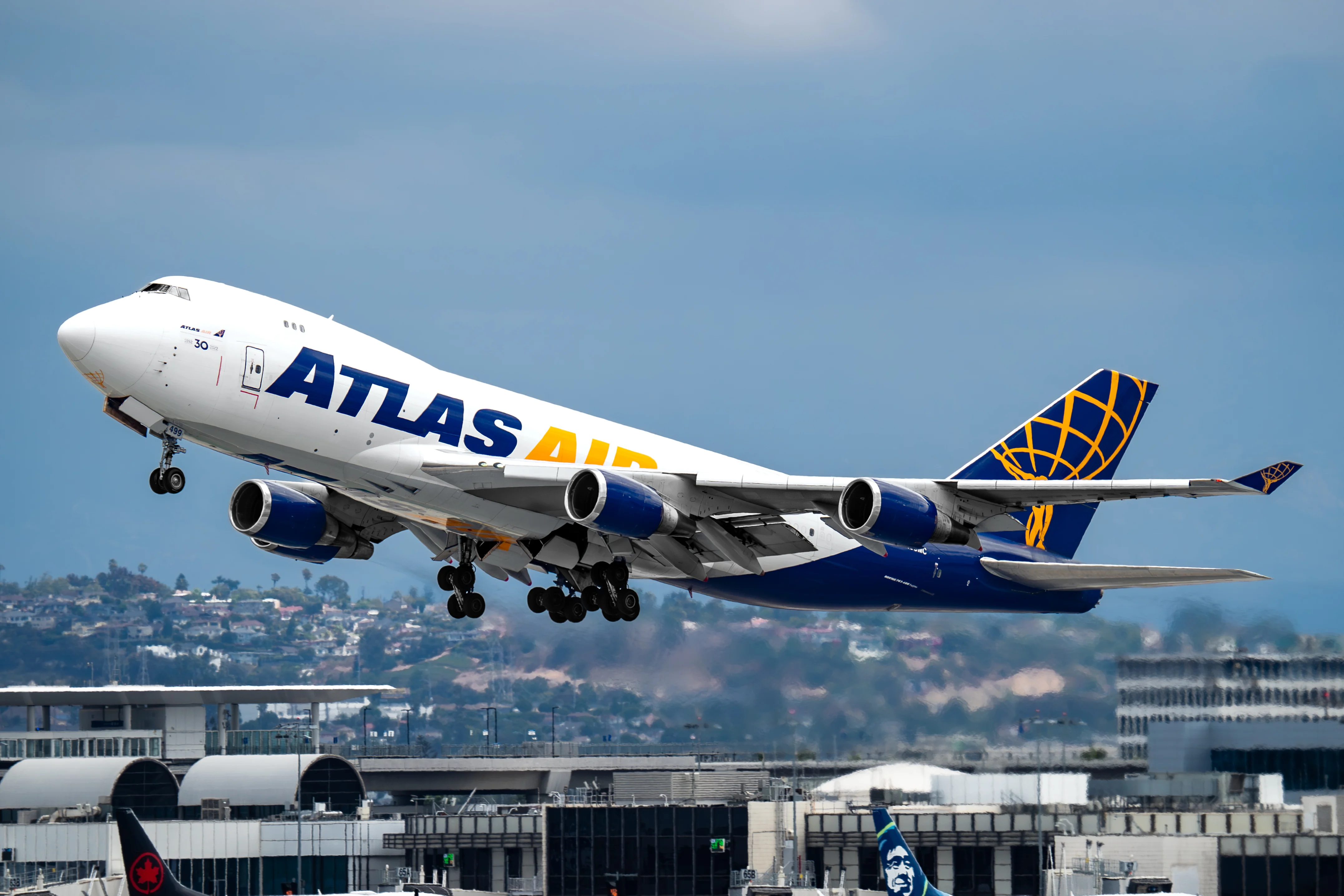
747-400F

The 747-400F was built as a freighter with a short upper deck and nose loading. Its main deck was designed for large pallets and containers.

At a glance

747-400F

Entered service
1993Cargolux
Length
70.68 m
Wingspan
64.44 m
Published range
4,455 nmAt 112.99 t net revenue payload · GE configuration
Maximum cargo payload
113 tCargolux maximum revenue payload
Engine options
CF6-80C2 · PW4000-94 · RB211-524
Main landing gear
Two 4-wheel wing gears + two 4-wheel body gears
Sources
747-400 model line

Compare models

Current aircraft747-400
Compare with

Comparing 747-400F with 747-400.

Specification747-400F747-400
Length70.68 m70.68 m
Wingspan64.44 m64.44 m
Maximum take-off weight396.89 t396.89 t
Maximum payload113 tPublished cargo payload · Cargolux maximum revenue payload67.46 tRolls-Royce RB211 higher zero-fuel weight option
Fuel tank capacity203,522 LGE engine example · standard usable fuel without optional tail fuel216,847 LPratt & Whitney or Rolls-Royce configuration with horizontal stabilizer tank
Engine optionsCF6-80C2 · PW4000-94 · RB211-524CF6-80C2 · PW4000 · RB211-524
Typical two-class seatsUnavailable408KLM passenger aircraft example · 35 World Business and 373 Economy, including Economy Comfort
Published range4,455 nmiAt 112.99 t net revenue payload · GE configuration7,204 nmiBoeing published range · at the cited 875,000 lb design weight

A dash indicates that a verified figure is unavailable. Figures follow the configuration specified by each source.

Comparison sources

Identification

Upper deck
Look for the short hump behind the flight deck. Passenger-origin converted freighters commonly retain an extended upper deck.
Nose cargo door
From a low front quarter, look for the nose door outline, or an open nose during loading. Use the upright winglets as a second check for the -400 generation.

The 747-400ERF has the same basic exterior. Check aircraft records for the weight variant.

Design & cabins

Engine references
PW4000-94 · CF6-80C2
Technical notes

Design notes

  • Family context: The Boeing 747 is a four-engine wide-body aircraft known for its upper deck and very high capacity. It served as a flagship long-haul passenger aircraft and remains important in heavy cargo operations.
  • Exact airline configuration can change seat count, galley arrangement, cargo capability, and operating range.
  • Engine reference: 747-400F uses PW4000-94; 747-400F uses CF6-80C2.
  • Cabin configuration should be treated as airline-specific: the same variant may be high-density, full-service, or premium-heavy.

Advantages

  • Excellent payload-volume capability.
  • Nose-loading freighter versions are valuable for outsized cargo.
  • Iconic long-haul passenger capability.

Limitations

  • Four-engine fuel burn is disadvantaged against modern twins on many passenger routes.
  • Large size requires suitable airport gates, ramps, and market demand.
Variant Technical Profile

747-400F is a specific configuration within 747-400, developed to cover a defined capacity, range, payload, or mission requirement inside the wider family.

747-400F is positioned as a capacity/range-specific solution within the freighter segment, serving routes better matched than sibling variants.

Technical features

  • 747-400F: Cargo door and floor loading · structure. Main-deck doors, reinforced floors, and cargo loading systems define usable freight capability.
  • 747-400F: Payload-volume balance · range_payload. The aircraft must balance container volume, structural payload, and range for express or general cargo.
  • 747-400F: Freighter conversion economics · maintenance. Passenger-to-freighter variants depend on feedstock price, engine life, and structural condition.
  • 747-400F: Belly and main-deck logistics · operational_efficiency. ULD compatibility, loading height, and turnaround flow shape cargo network efficiency.
  • 747-400F: Engine maintenance sensitivity · engine. Cargo operators often prioritize durable engines and predictable maintenance cost over passenger cabin features.

Advantages

  • Provides a more precise capacity or range match within the family.
  • Retains training, maintenance, and parts commonality with sibling variants.
  • Lets operators tune engine, cabin, and payload choices to route needs.

Weaknesses

  • Configuration identification complexity. Visually similar aircraft can differ materially by engine, weight standard, cabin layout, and conversion status.
  • Generation-dependent economics. Older generations usually trail newer designs in fuel burn, noise, avionics, or maintenance intervals.
  • Market-fit limits. Every variant has an ideal capacity and range band; outside it, load factor, range, or cost can become limiting.

Markets

  • Network airline trunk or feeder markets
  • Leasing and fleet replacement markets
  • Regional, domestic, or international airline markets

Operators

  • Full-service network airlines
  • Low-cost or leisure airlines
  • Cargo, government, or special-mission operators

Routes and missions

  • High-frequency short or medium-haul trunk routes
  • Medium-density long-haul or cross-regional routes
  • Express and general air-cargo networks

Sibling comparison

  • smaller sibling variants. Usually provides more seats, cargo volume, or thrust demand, but can be harder to fill on thinner routes.
  • larger or longer-range sibling variants. Usually has lower acquisition and operating exposure, but less range, payload, or growth margin.
Key terms
Engine configuration

The exact engine family and thrust standard installed on a specific model or production block.

  • Connects model suffixes, airline maintenance strategy, and performance limits.
  • Important for aircraft identification and fleet comparison.

Advantages. Helps explain range, payload, noise, and fuel-burn differences.

Limitations. Public data may omit thrust derates or later engine swaps.

Cabin configuration

The airline-selected layout of cabins, seats, galleys, lavatories, crew rest, and monuments.

  • Can change the same aircraft type from premium-heavy to high-density.
  • Affects range, payload, passenger experience, and turnaround flow.

Advantages. Lets airlines tailor the aircraft to route economics.

Limitations. Seat-map examples vary over time and by subfleet.

Fleet commonality

Boeing families often preserve handling, maintenance, and cockpit continuity across generations where practical.

  • This system is part of the A330 operating architecture and interacts with flight-control, electrical, hydraulic, engine, or environmental systems.
  • Exact configuration varies across A330ceo, A330neo, freighter, and military derivatives.

Advantages. Improves operational reliability, economics, or mission flexibility. Uses a mature wide-body systems architecture to reduce operational risk.

Limitations. System complexity increases maintenance, training, and troubleshooting demands. Airline configuration and engine choice can change real-world performance.

Sources