Home/Encyclopedia/Other manufacturers/Aero Spacelines Super Guppy

Aero Spacelines Super Guppy

The Super Guppy is a family of aircraft developed by Aero Spacelines on the Boeing 377 and C-97 lineage to transport exceptionally bulky components. The round enlarged fuselage and side-opening nose provide space and access for airframe and spaceflight hardware.

Models at a glance

Super Guppy Turbine

The Super Guppy Turbine is the later, four-turboprop configuration. NASA's aircraft N941NA was the fourth Turbine and joined NASA in 1997. NASA publishes a 25-foot diameter, 111-foot long cargo bay and an opening angle of 110 degrees for the hinged nose.

Length
43.84 m
Wingspan
47.63 m
Published range
1,700 nmNASA published range · load not stated
Engine options
4 × Allison 501-D22C
Main landing gear
Unavailable
Sources

Identification

Side-hinged nose
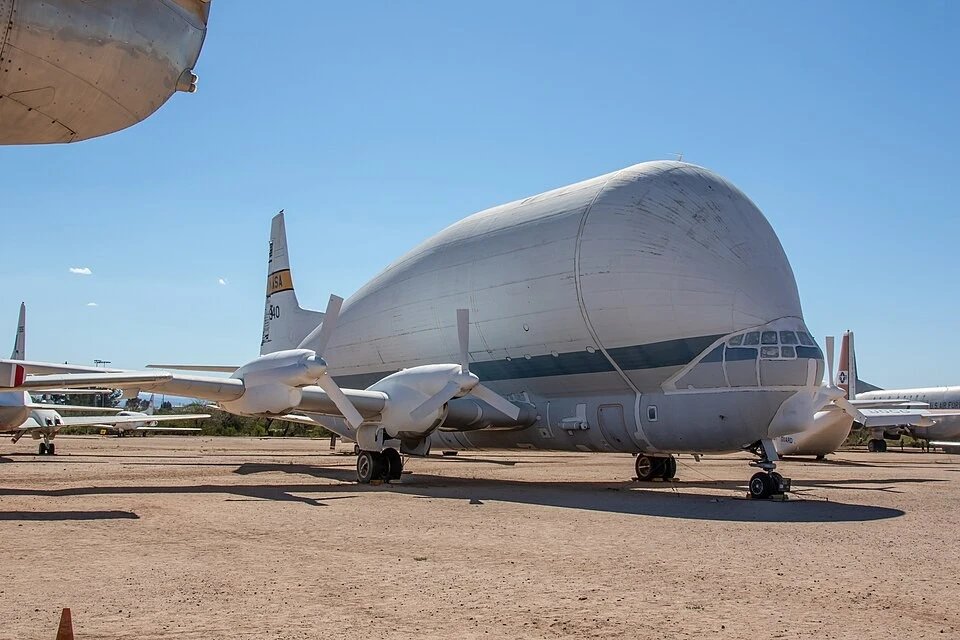
Look for an almost circular joint across the enlarged body ahead of the wing. The whole nose with the cockpit swings aside, exposing the front of the hold.
Oversize round body
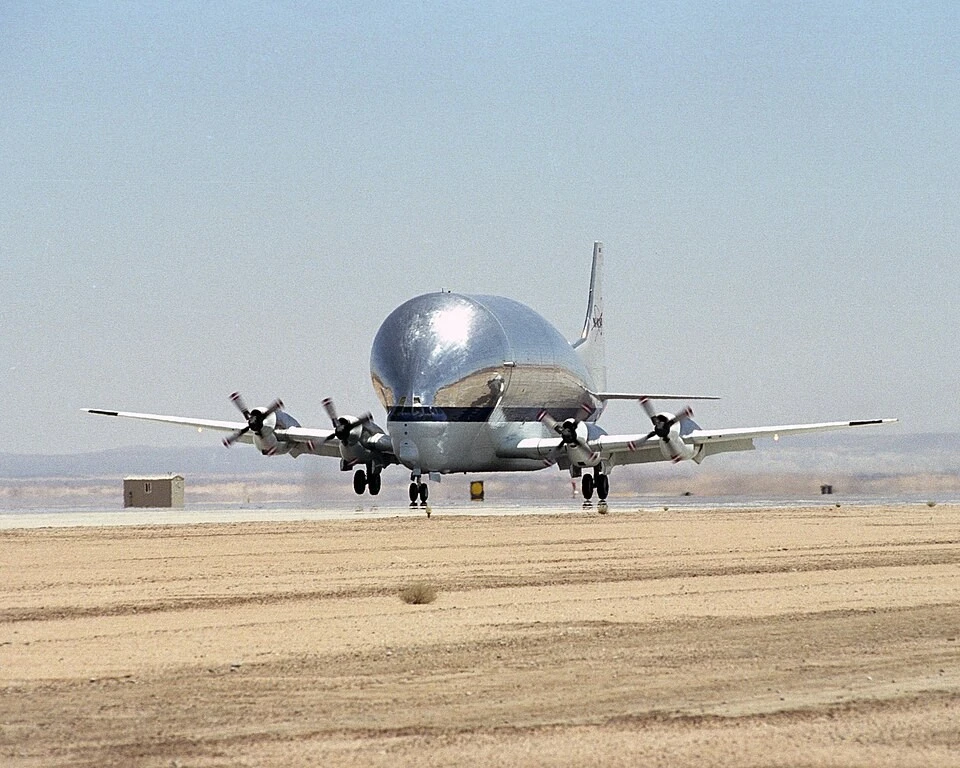
Look at how far the raised fuselage extends above the four turboprop nacelles. The round hold was designed to carry large airframe and spacecraft components.
Compare the openings
BelugaXL has an upper forward cargo door above its lowered cockpit. Dreamlifter opens at the rear, moving the tail aside. The Guppy swings the entire nose sideways.

These examples document NASA’s Super Guppy Turbine N941NA. Confirm the particular airframe and Guppy generation from the registration and aircraft records.

Select a circle to see the marked area up close.

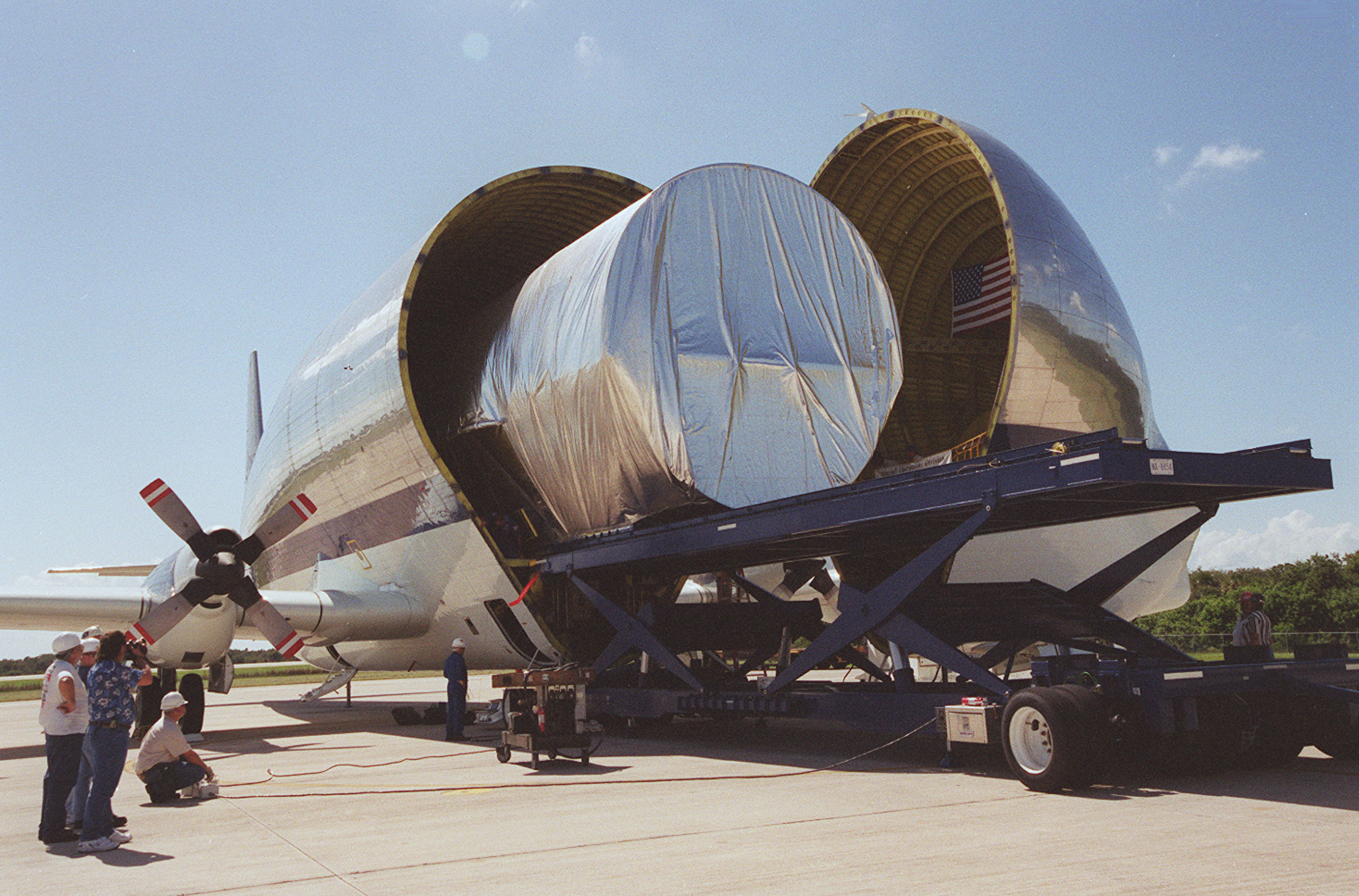
N941NA unloading the ISS Quest airlock

NASA Super Guppy Turbine N941NA · Kennedy Space Center · 13 September 2000
NASA Super Guppy Turbine N941NA · Kennedy Space Center · 13 September 2000Photo by NASA
Photo sourceUS public domain

Design & cabins

Technical notes

Design notes

  • NASA distinguishes the earlier Super Guppy from the later Super Guppy Turbine. Airbus used four Turbines to ferry fuselage sections to its assembly sites.
  • The nose section swings sideways as a unit. The BelugaXL opens its upper forward cargo door above a lowered cockpit, while the 747 Dreamlifter swings its aft fuselage aside.

Advantages

  • The circular cross-section accommodates wide components such as complete airframe sections and spacecraft modules.

Limitations

  • Compare cargo cross-section, length and allowable weight for the actual Guppy model when assessing a load.
Family Technical Profile

Aero Spacelines Super Guppy is one of Aircraft manufacturer's platforms in its market segment, balancing capacity, range, airport compatibility, maintenance economics, and mission flexibility.

Aero Spacelines Super Guppy serves the narrowbody market with family commonality and multiple configurations.

Technical features

  • Aero Spacelines Super Guppy: Single-aisle fuselage efficiency · structure. A narrow fuselage reduces structural weight and airport footprint for high-frequency short and medium routes.
  • Aero Spacelines Super Guppy: High-cycle operating design · maintenance. Doors, landing gear, brakes, and systems are optimized for repeated daily sectors and quick turnarounds.
  • Aero Spacelines Super Guppy: Wing and high-lift devices · aerodynamics. Flaps, slats, and wingtip devices balance runway performance with cruise efficiency.
  • Aero Spacelines Super Guppy: Engine generation changes · engine. Engine nacelle, thrust rating, fuel burn, and noise standards define each production generation.
  • Aero Spacelines Super Guppy: Fleet commonality · operational_efficiency. Common flight decks and maintenance practices reduce training and support cost across subfleets.

Advantages

  • One platform can cover several capacity and mission bands.
  • Family design reduces training, maintenance, and spares complexity.
  • Engine, wingtip, avionics, or structural upgrades can extend lifecycle value.

Weaknesses

  • Configuration identification complexity. Visually similar aircraft can differ materially by engine, weight standard, cabin layout, and conversion status.
  • Generation-dependent economics. Older generations usually trail newer designs in fuel burn, noise, avionics, or maintenance intervals.
  • Market-fit limits. Every variant has an ideal capacity and range band; outside it, load factor, range, or cost can become limiting.

Markets

  • Network airline trunk or feeder markets
  • Leasing and fleet replacement markets
  • Regional, domestic, or international airline markets

Operators

  • Full-service network airlines
  • Low-cost or leisure airlines
  • Cargo, government, or special-mission operators

Routes and missions

  • High-frequency short or medium-haul trunk routes
  • Medium-density long-haul or cross-regional routes
  • Fleet replacement, supplementation, or special missions
Sources