L-1011-500
L-1011-500 is a widebody passenger derivative within L-1011 TriStar family. Market positioning: Short-fuselage long-range variant.
- Length
- 50.04 m
- Wingspan
- 47.35 / 50.04 mStandard / extended wing per FAA
- Engine options
- RB211-524B-02 · RB211-524B3-02 · RB211-524B4-02 · RB211-524B4-D-02
- Published range
- 5,000 nmiLockheed hot-day example · up to 25.4 t payload at this distance
Identification
Use these features to recognise the L-1011 TriStar family. Check the aircraft or programme record for the L-1011-500 designation.
- Centre intake
- Look ahead of the fin for the centre intake fitted into the top of the fuselage. Two more engine pods hang beneath the wings.
- Tailcone exhaust
- From a rear quarter, follow the centre engine to the tailcone. The curved inlet duct places the exhaust low in the tail, below the corresponding DC-10 nacelle.
Compare models
Comparing L-1011-500 with L-1011-250.
| Specification | L-1011-500 | L-1011-250 |
|---|---|---|
| Length | 50.04 m | 54.15 mFAA standard-length TriStar geometry, retained by Delta's L-1011-250 conversion |
| Wingspan | 47.35 / 50.04 mStandard / extended wing per FAA | Unavailable |
| Maximum take-off weight | 231.33 tFAA 510,000 lb extended-wing configuration | 231.33 tDelta airframe N740DA · 510,000 lb |
| Maximum payload | 42 tStructural limit for the Lockheed study aircraft | Unavailable |
| Fuel tank capacity | 120,704 LApproximate usable volume at FAA reference density of 6.7 lb/US gal | 100,771 LApproximate usable volume at FAA reference density of 6.7 lb/US gal |
| Engine options | RB211-524B-02 · RB211-524B3-02 · RB211-524B4-02 · RB211-524B4-D-02 | RB211-524B4Delta -250 fleet |
| Typical two-class seats | 241Delta (1979) · 24 first + 217 coach | 280Delta (1987) · 12 first + 268 coach |
| Published range | 5,000 nmiLockheed hot-day example · up to 25.4 t payload at this distance | Unavailable |
A dash indicates that a verified figure is unavailable. Figures follow the configuration specified by each source.
Comparison sources
- FAA AC 150/5300-13 · Historical aircraft dimensionsAppendix 12 Figure A12-70 · 500 and 500 EX. WING
- FAA A23WE · Lockheed L-1011 type certificateRevision 19 §IV and Note 5(c) · L-1011-385-3
- Lockheed / NASA · Advanced fuel system study (1985)§3.2.1 and Fig. 7 · base aircraft, hot-day chart
- Delta Air Lines · December 1979 system timetableExplanation of reference marks · L15
- FAA A23WE · Lockheed L-1011 type certificateRevision 19 · §IV p. 16 and Note 35 · L-1011-385-3
- Delta Flight Museum · L-1011 fleet listp. 2 · six former L-1011-1 airframes converted to -250
- Delta Air Lines · February 1987 system timetableExplanation of reference marks · L14
- FAA historical airport design guide · Lockheed L-1011 TriStarFigure 2-46 · standard-length TriStar dimensions, paired with Delta Flight Museum fleet records identifying the -250 converted airframes
- NTSB · N740DA aircraft record, LAX97FA276p. 12 · N740DA, S/N 193C-1244, L-1011-385-1-15
- FAA A23WE · Lockheed L-1011 type certificateRevision 19 · §III p. 13 · L-1011-385-1-15 as registered for N740DA
Design & cabins
RB211-524B-02 installation
See the engine encyclopedia for ratings and aircraft applications.
RB211-524B3-02 installation
See the engine encyclopedia for ratings and aircraft applications.
RB211-524B4-02 installation
See the engine encyclopedia for ratings and aircraft applications.
RB211-524B4-D-02 installation
See the engine encyclopedia for ratings and aircraft applications.
Passenger seating
Explore airline cabin configurations. J denotes business class and Y denotes economy.
Full-service carriers1 layout
- Delta Air Lines
L-1011-500
Frequently Flying vintage seat mapF12 / J40 / Y189241 seats
Featured components & design
Landing gear
Two four-wheel main bogies and two independent nose wheels. Lockheed lists 61 ft 8 in wheelbase and 36 ft main gear tread.
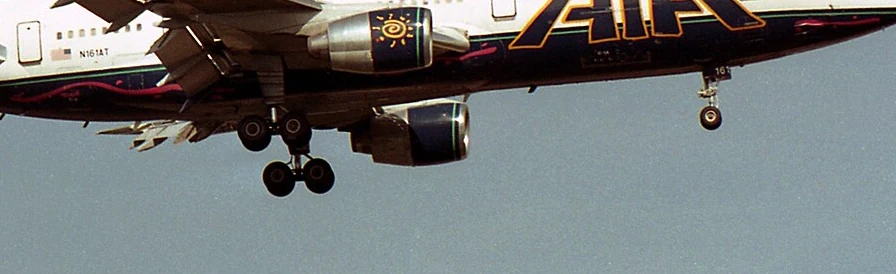
Main landing gear extended · ATA L-1011-500 N161ATKambui · detail crop · WebP · CC BY 2.0

Technical notes
Design notes
- Engine configuration: 3 × RB211-524B / -524B4.
- Market positioning: Short-fuselage long-range variant.
- Status: retired.
Advantages
- Long range
- Good low-density long-haul
Limitations
- Fewer seats → high unit cost
- Small fleet
Variant Technical Profile
L-1011-500 is a specific configuration within L-1011 TriStar family, developed to cover a defined capacity, range, payload, or mission requirement inside the wider family.
L-1011-500 is positioned as a capacity/range-specific solution within the narrowbody segment, serving routes better matched than sibling variants.
Technical features
- L-1011-500: Single-aisle fuselage efficiency · structure. A narrow fuselage reduces structural weight and airport footprint for high-frequency short and medium routes.
- L-1011-500: High-cycle operating design · maintenance. Doors, landing gear, brakes, and systems are optimized for repeated daily sectors and quick turnarounds.
- L-1011-500: Wing and high-lift devices · aerodynamics. Flaps, slats, and wingtip devices balance runway performance with cruise efficiency.
- L-1011-500: Engine generation changes · engine. Engine nacelle, thrust rating, fuel burn, and noise standards define each production generation.
- L-1011-500: Fleet commonality · operational_efficiency. Common flight decks and maintenance practices reduce training and support cost across subfleets.
Advantages
- Provides a more precise capacity or range match within the family.
- Retains training, maintenance, and parts commonality with sibling variants.
- Lets operators tune engine, cabin, and payload choices to route needs.
Weaknesses
- Configuration identification complexity. Visually similar aircraft can differ materially by engine, weight standard, cabin layout, and conversion status.
- Generation-dependent economics. Older generations usually trail newer designs in fuel burn, noise, avionics, or maintenance intervals.
- Market-fit limits. Every variant has an ideal capacity and range band; outside it, load factor, range, or cost can become limiting.
Markets
- Network airline trunk or feeder markets
- Leasing and fleet replacement markets
- Regional, domestic, or international airline markets
Operators
- Full-service network airlines
- Low-cost or leisure airlines
- Cargo, government, or special-mission operators
Routes and missions
- High-frequency short or medium-haul trunk routes
- Medium-density long-haul or cross-regional routes
- Fleet replacement, supplementation, or special missions
Sibling comparison
- smaller sibling variants. Usually provides more seats, cargo volume, or thrust demand, but can be harder to fill on thinner routes.
- larger or longer-range sibling variants. Usually has lower acquisition and operating exposure, but less range, payload, or growth margin.
From the archive
Loading photographs…