Fokker 70
Certified as F28 Mark 0070, the Fokker 70 is 4.623 m shorter than the Fokker 100. A side view shows its compressed passenger fuselage and the same characteristic rear-engine layout.
- Length
- 30.91 m
- Wingspan
- 28.08 m
- Engine options
- 2 × Rolls-Royce Tay 620-15
Identification
- Two rear-mounted engines
- Both nacelles sit along the aft fuselage, like the Boeing 717 and CRJ. Check the broadside proportions and the tail and wing geometry to separate these families.
- Length from a broadside view
- The 30.91 m fuselage is about 4.62 m shorter than the Fokker 100. Most of the difference is visible in the length of the passenger cabin.
Confirm F28 Mark 0070 in the aircraft record.
Compare models
Comparing Fokker 70 with Fokker 100.
| Specification | Fokker 70 | Fokker 100 |
|---|---|---|
| Length | 30.91 m | 35.53 m |
| Wingspan | 28.08 m | 28.08 m |
| Maximum take-off weight | 36.74 tFirst certified weight option listed in the TCDS. Other weights are approved. | 41 tFirst certified weight option listed in the TCDS. Other weights are approved. |
| Maximum payload | Unavailable | Unavailable |
| Fuel tank capacity | 9,640 LUsable fuel in two wing tanks. Integral centre wing tank excluded. | 12,820 LUsable fuel with standard bag tanks and no auxiliary tank. |
| Engine options | 2 × Rolls-Royce Tay 620-15 | 2 × Rolls-Royce Tay 620-15 · 2 × Rolls-Royce Tay 650-15 |
| Typical two-class seats | Unavailable | Unavailable |
| Published range | Unavailable | Unavailable |
A dash indicates that a verified figure is unavailable. Figures follow the configuration specified by each source.
Comparison sources
- BFU AX001-0/04 · Fokker 70 maintenance manual three-view, attachment 6Manufacturer drawings from the investigation attachment
- EASA.A.037 · Fokker F28 type certificate, Issue 8Section 3.II.1, p. 26
- EASA.A.037 · Fokker F28 type certificate, Issue 8Section 3.II.3 and 10, pp. 26–27
- Swedish Accident Investigation Authority RL 2017:03e · Fokker 100 flight manual drawing, figure 2Manufacturer drawings from the investigation attachment
- EASA.A.037 · Fokker F28 type certificate, Issue 8Section 3.I.1, p. 22
- EASA.A.037 · Fokker F28 type certificate, Issue 8Section 3.I.3 and 10, pp. 22–23
Design & cabins
2 × Rolls-Royce Tay 620-15
Passenger seating
Explore airline cabin configurations. J denotes business class and Y denotes economy.
Full-service carriers1 layout
- Alliance Airlines
Fokker 70
Alliance Airlines · FY2026 interim fleet report, p. 7Y8080 seats
Featured components & design
Two rear-mounted engines
Both nacelles sit along the aft fuselage, like the Boeing 717 and CRJ. Check the broadside proportions and the tail and wing geometry to separate these families.
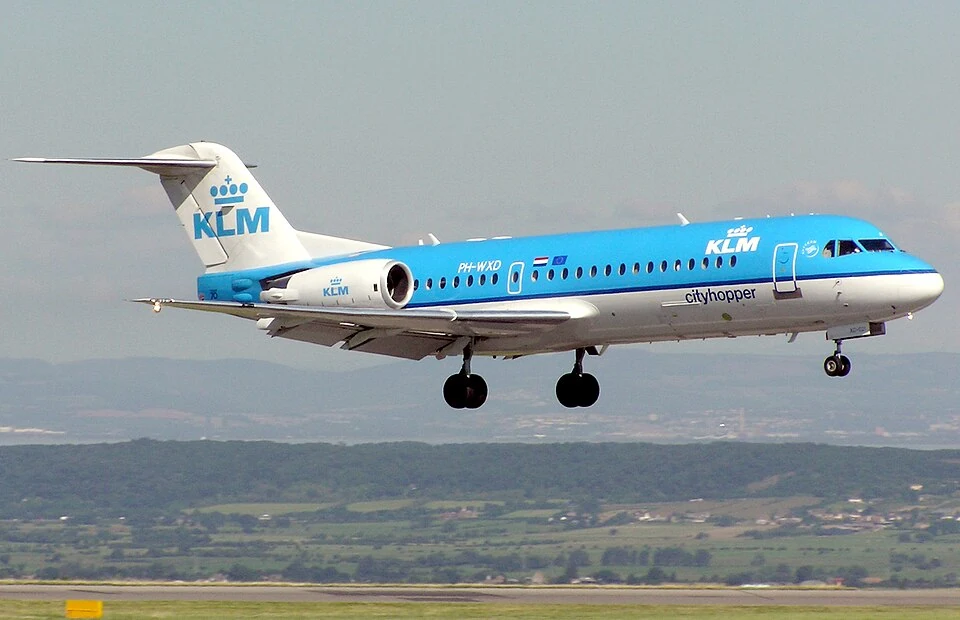
KLM Cityhopper Fokker 70 PH-WXD · aft-mounted Tay nacelleArpingstone · resized and converted to WebP · Public domain Length from a broadside view
The 30.91 m fuselage is about 4.62 m shorter than the Fokker 100. Most of the difference is visible in the length of the passenger cabin.
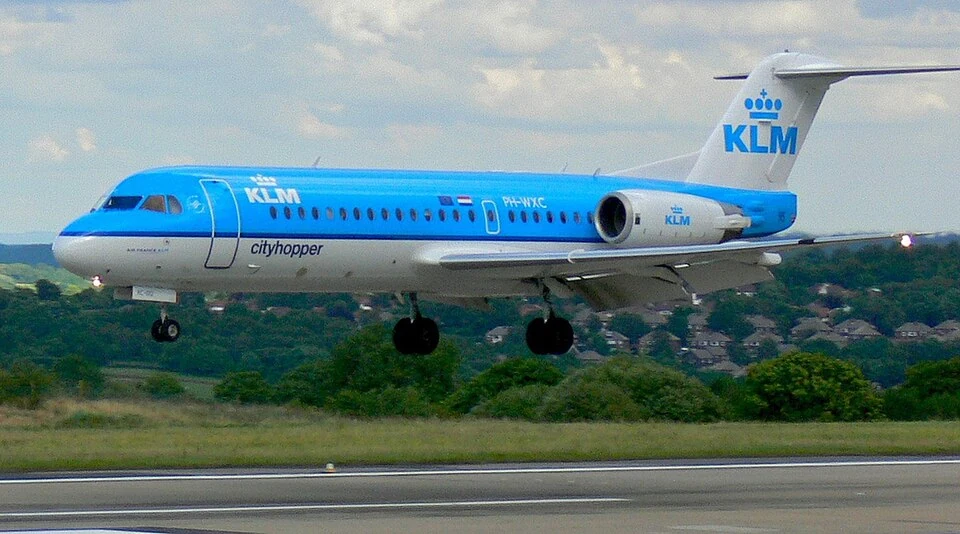
KLM Cityhopper Fokker 70 PH-WXC · shorter passenger cabin54north · resized and converted to WebP · CC BY-SA 3.0 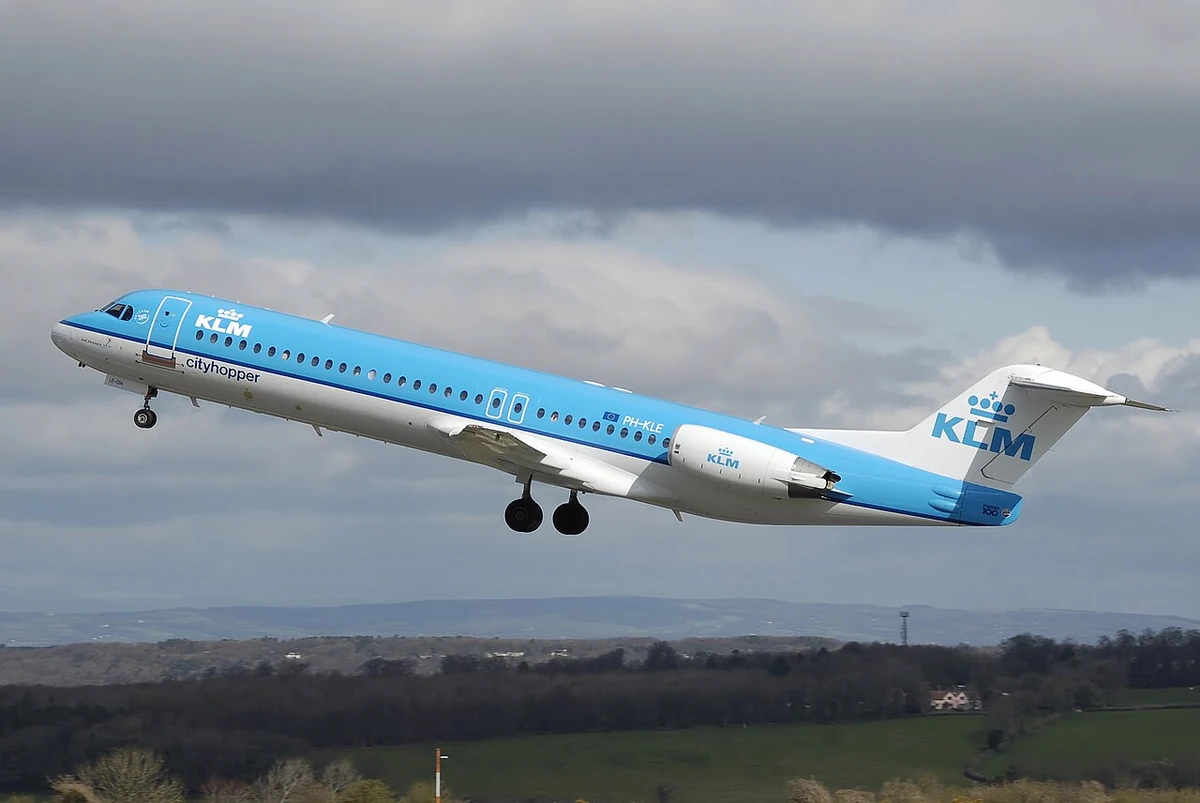
KLM Cityhopper Fokker 100 PH-KLE · longer passenger cabinArpingstone · resized and converted to WebP · Public domain


Technical notes
Design notes
- EASA lists two Rolls-Royce Tay 620-15 turbofans. The model was certified on 14 October 1994.
- Fokker's maintenance manual gives a 30.905 m overall length and a 28.076 m wingspan.
Variant Technical Profile
Fokker 70 is a specific configuration within Fokker F28 Family, developed to cover a defined capacity, range, payload, or mission requirement inside the wider family.
Fokker 70 is positioned as a capacity/range-specific solution within the narrowbody segment, serving routes better matched than sibling variants.
Technical features
- Fokker 70: Single-aisle fuselage efficiency · structure. A narrow fuselage reduces structural weight and airport footprint for high-frequency short and medium routes.
- Fokker 70: High-cycle operating design · maintenance. Doors, landing gear, brakes, and systems are optimized for repeated daily sectors and quick turnarounds.
- Fokker 70: Wing and high-lift devices · aerodynamics. Flaps, slats, and wingtip devices balance runway performance with cruise efficiency.
- Fokker 70: Engine generation changes · engine. Engine nacelle, thrust rating, fuel burn, and noise standards define each production generation.
- Fokker 70: Fleet commonality · operational_efficiency. Common flight decks and maintenance practices reduce training and support cost across subfleets.
Advantages
- Provides a more precise capacity or range match within the family.
- Retains training, maintenance, and parts commonality with sibling variants.
- Lets operators tune engine, cabin, and payload choices to route needs.
Weaknesses
- Configuration identification complexity. Visually similar aircraft can differ materially by engine, weight standard, cabin layout, and conversion status.
- Generation-dependent economics. Older generations usually trail newer designs in fuel burn, noise, avionics, or maintenance intervals.
- Market-fit limits. Every variant has an ideal capacity and range band; outside it, load factor, range, or cost can become limiting.
Markets
- Network airline trunk or feeder markets
- Leasing and fleet replacement markets
- Regional, domestic, or international airline markets
Operators
- Full-service network airlines
- Low-cost or leisure airlines
- Cargo, government, or special-mission operators
Routes and missions
- High-frequency short or medium-haul trunk routes
- Medium-density long-haul or cross-regional routes
- Fleet replacement, supplementation, or special missions
Sibling comparison
- smaller sibling variants. Usually provides more seats, cargo volume, or thrust demand, but can be harder to fill on thinner routes.
- larger or longer-range sibling variants. Usually has lower acquisition and operating exposure, but less range, payload, or growth margin.
Development & service
- EASA lists two Rolls-Royce Tay 620-15 turbofans. The model was certified on 14 October 1994.
From the archive
Loading photographs…