Fokker 100
Certified as F28 Mark 0100, the Fokker 100 lengthens the Fellowship airframe and introduces a larger wing, Tay engines and a digital flight deck.
- Length
- 35.53 m
- Wingspan
- 28.08 m
- Engine options
- 2 × Rolls-Royce Tay 620-15 · 2 × Rolls-Royce Tay 650-15
Identification
- Two rear-mounted engines
- Both nacelles sit along the aft fuselage, like the Boeing 717 and CRJ. Check the broadside proportions and the tail and wing geometry to separate these families.
- Length from a broadside view
- The 35.53 m fuselage is about 4.62 m longer than the Fokker 70. Most of the difference is visible in the length of the passenger cabin.
Confirm F28 Mark 0100 in the aircraft record.
Compare models
Comparing Fokker 100 with Fokker F28 Fellowship.
| Specification | Fokker 100 | Fokker F28 Fellowship |
|---|---|---|
| Length | 35.53 m | 27.4 mShort airframes, Marks 1000 and 3000. Marks 2000 and 4000 are about 29.6 m. |
| Wingspan | 28.08 m | Unavailable |
| Maximum take-off weight | 41 tFirst certified weight option listed in the TCDS. Other weights are approved. | 25.72 tBaseline Mark 1000. Later modifications and other Marks have different limits. |
| Maximum payload | Unavailable | Unavailable |
| Fuel tank capacity | 12,820 LUsable fuel with standard bag tanks and no auxiliary tank. | 9,640 LMark 1000 wing tank quantity, pressure refuelling. Optional centre tank excluded. |
| Engine options | 2 × Rolls-Royce Tay 620-15 · 2 × Rolls-Royce Tay 650-15 | 2 × Rolls-Royce Spey RB.183 Mk 555 series |
| Typical two-class seats | Unavailable | Unavailable |
| Published range | Unavailable | Unavailable |
A dash indicates that a verified figure is unavailable. Figures follow the configuration specified by each source.
Comparison sources
- Swedish Accident Investigation Authority RL 2017:03e · Fokker 100 flight manual drawing, figure 2Manufacturer drawings from the investigation attachment
- EASA.A.037 · Fokker F28 type certificate, Issue 8Section 3.I.1, p. 22
- EASA.A.037 · Fokker F28 type certificate, Issue 8Section 3.I.3 and 10, pp. 22–23
- ICAO Doc 9137 Part 1, 4th edition · Aircraft length tables, Appendix 2Appendix 2 · Airport categories 5–6
- EASA.A.037 · Fokker F28 type certificate, Issue 8Section 2, pp. 5–14 · Engine installations
- EASA.A.037 · Fokker F28 type certificate, Issue 8Section 2 chapter I, pp. 5–6 · Mark 1000 benchmark
Design & cabins
2 × Rolls-Royce Tay 620-15
2 × Rolls-Royce Tay 650-15
Passenger seating
Explore airline cabin configurations. J denotes business class and Y denotes economy.
Full-service carriers1 layout
- Alliance Airlines
Fokker 100
Alliance Airlines · FY2026 interim fleet report, p. 7Y100100 seats
Featured components & design
Two rear-mounted engines
Both nacelles sit along the aft fuselage, like the Boeing 717 and CRJ. Check the broadside proportions and the tail and wing geometry to separate these families.
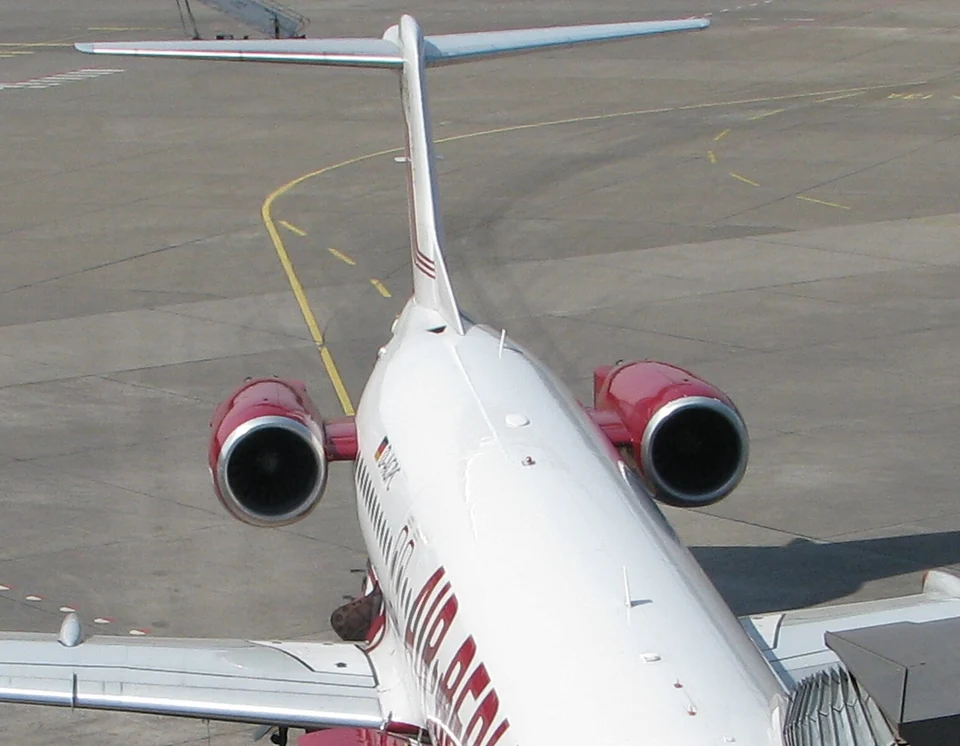
Elevated view of a Fokker 100 in Munich showing both engines attached to the rear fuselage below the T-tail.Netopýr / Netopyr · cropped and resized · CC BY-SA 3.0 Length from a broadside view
The 35.53 m fuselage is about 4.62 m longer than the Fokker 70. Most of the difference is visible in the length of the passenger cabin.
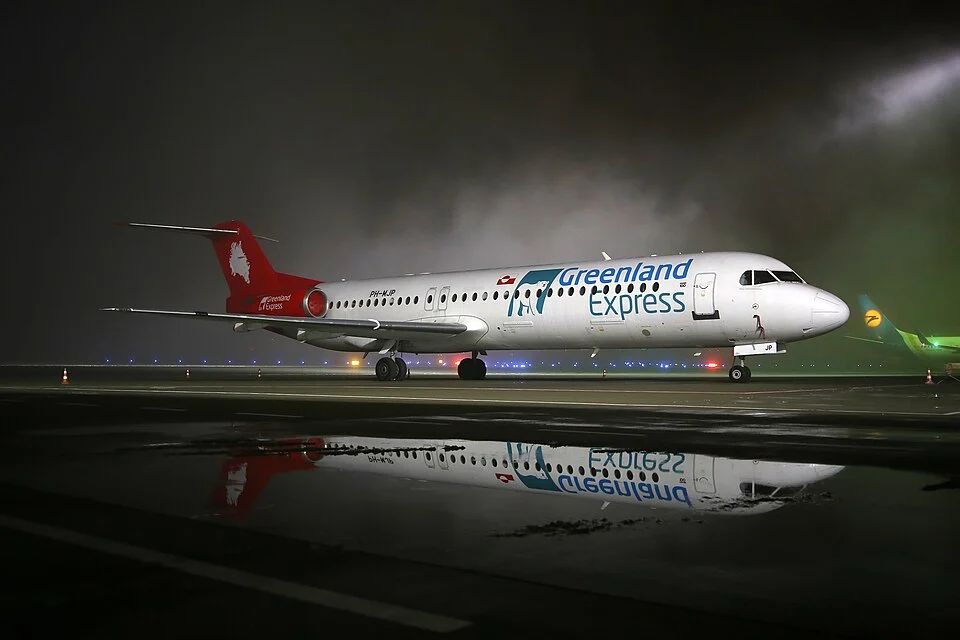
Broadside Fokker 100 fuselage · Greenland ExpressOleg Volkov · resized for display · CC BY-SA 4.0


Technical notes
Design notes
- EASA lists Rolls-Royce Tay 620-15 or 650-15 turbofans. The model was certified on 20 November 1987.
- The flight manual three-view gives a 35.53 m overall length and a 28.08 m wingspan.
Variant Technical Profile
Fokker 100 is a specific configuration within Fokker F28 Family, developed to cover a defined capacity, range, payload, or mission requirement inside the wider family.
Fokker 100 is positioned as a capacity/range-specific solution within the narrowbody segment, serving routes better matched than sibling variants.
Technical features
- Fokker 100: Single-aisle fuselage efficiency · structure. A narrow fuselage reduces structural weight and airport footprint for high-frequency short and medium routes.
- Fokker 100: High-cycle operating design · maintenance. Doors, landing gear, brakes, and systems are optimized for repeated daily sectors and quick turnarounds.
- Fokker 100: Wing and high-lift devices · aerodynamics. Flaps, slats, and wingtip devices balance runway performance with cruise efficiency.
- Fokker 100: Engine generation changes · engine. Engine nacelle, thrust rating, fuel burn, and noise standards define each production generation.
- Fokker 100: Fleet commonality · operational_efficiency. Common flight decks and maintenance practices reduce training and support cost across subfleets.
Advantages
- Provides a more precise capacity or range match within the family.
- Retains training, maintenance, and parts commonality with sibling variants.
- Lets operators tune engine, cabin, and payload choices to route needs.
Weaknesses
- Configuration identification complexity. Visually similar aircraft can differ materially by engine, weight standard, cabin layout, and conversion status.
- Generation-dependent economics. Older generations usually trail newer designs in fuel burn, noise, avionics, or maintenance intervals.
- Market-fit limits. Every variant has an ideal capacity and range band; outside it, load factor, range, or cost can become limiting.
Markets
- Network airline trunk or feeder markets
- Leasing and fleet replacement markets
- Regional, domestic, or international airline markets
Operators
- Full-service network airlines
- Low-cost or leisure airlines
- Cargo, government, or special-mission operators
Routes and missions
- High-frequency short or medium-haul trunk routes
- Medium-density long-haul or cross-regional routes
- Fleet replacement, supplementation, or special missions
Sibling comparison
- smaller sibling variants. Usually provides more seats, cargo volume, or thrust demand, but can be harder to fill on thinner routes.
- larger or longer-range sibling variants. Usually has lower acquisition and operating exposure, but less range, payload, or growth margin.
Development & service
- EASA lists Rolls-Royce Tay 620-15 or 650-15 turbofans. The model was certified on 20 November 1987.
From the archive
Loading photographs…