Home/Encyclopedia/Embraer/Embraer E-Jets E2 Family

Embraer E-Jets E2 Family

The second-generation E-Jet program comprises the E175-E2, E190-E2, and E195-E2, with new wings, engines, and flight-control updates.

Models at a glance

E175-E2

The E175-E2 is Embraer's compact E2-family design. Its geared engines and redesigned wing distinguish it from the first-generation E175.

Entered service
Unavailable
Length
32.37 m
Wingspan
31.39 m
Published range
2,000 nmEmbraer design figure at full passenger load; 100 kg per passenger
Typical two-class seats
Unavailable
Published seating
80–90
Maximum passenger seats
Unavailable
Engine options
PW1714GManufacturer E175-E2 design specification
Main landing gear
Unavailable
Sources

E190-E2

The E190-E2 retains the E190 size category with a revised wing and PW1900G geared turbofans. It forms the middle-size model in the E2 design family.

Entered service
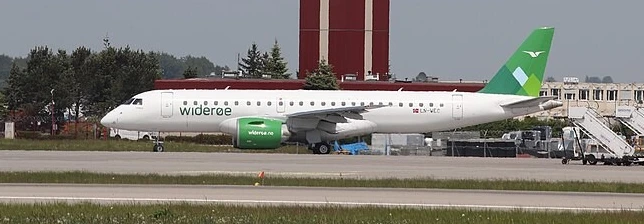
2018First airline service with Widerøe
Length
36.24 m
Wingspan
33.72 m
Published range
2,950 nmCurrent Embraer full-passenger figure with typical reserves
Typical two-class seats
108Air Astana's original 12 Business and 96 Economy layout
Published seating
97–114
Maximum passenger seats
114
Engine options
PW1919G · PW1922G · PW1919G-RC
Main landing gear
1 axle · 2 wheels per side
Sources

E195-E2

The E195-E2 is the longest member of the E2 generation. Its larger cabin and PW1900G engines distinguish it from the original CF34-powered E195.

Length
41.6 m
Wingspan
35.12 m
Published range
3,000 nmCurrent Embraer full-passenger figure with typical reserves
Typical two-class seats
136KLM Cityhopper Business and Economy example
Published seating
120–146
Maximum passenger seats
146
Engine options
PW1921G · PW1921G-RC · PW1923G · PW1923G-A
Main landing gear
1 axle · 2 wheels per side
Sources

Identification

Nacelles and wingtips
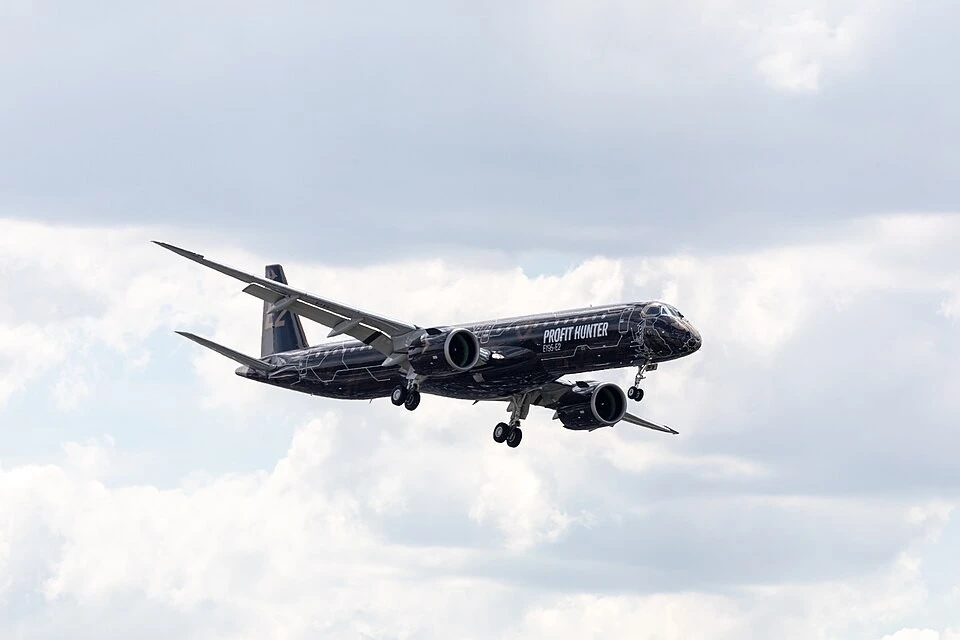
Look for the larger underwing nacelles and the long tapered wingtip outline. Compare both features with the more upright tip on many first-generation E-Jets.
E190-E2 or E195-E2
Compare side profiles at the same scale. The E195-E2 has a visibly longer cabin than the E190-E2.

Design & cabins

  • Model-specific high-aspect-ratio wings

    Embraer redesigned the wings for E2, with planforms sized to the individual models. The E195-E2's high-aspect-ratio wing is a prominent change from E1.

  • PW1900G and PW1700G geared turbofans

    PW1900G powers the E190-E2 and E195-E2. PW1700G is the published engine for the E175-E2 programme.

  • Fourth-generation full fly-by-wire

    Embraer's full fly-by-wire system is integrated with the new aerodynamic design. The control architecture is one of the main E1-to-E2 changes.

More aircraft systems
  • Airframe and aerodynamics

    The E2 combines the familiar fuselage cross-section with revised wings, structure and model-specific dimensions.

  • Flight controls and avionics

    The cockpit follows the E-Jet lineage with changes in the display and equipment standards.

  • Cabin and cargo

    Cabin and lower-hold details depend on the aircraft length and customer options.

  • Landing gear and braking

    The landing gear and ground dimensions reflect the larger engine and revised wing installations.

Technical notes

Design notes

  • E2 model names must remain distinct from first-generation E170/E175/E190/E195 designations.
  • The E195-E2 is the largest E2 member; operator configuration and certification status should be checked per model.

Advantages

  • Updated aerodynamics and propulsion target improved fuel efficiency in the small narrow-body segment.

Limitations

  • Do not apply a single E2 model's capacity or performance figures to the entire family.
Family Technical Profile

Embraer E-Jets E2 Family is one of Embraer's platforms in its market segment, balancing capacity, range, airport compatibility, maintenance economics, and mission flexibility.

Embraer E-Jets E2 Family serves the regional_jet market with family commonality and multiple configurations.

Technical features

  • Embraer E-Jets E2 Family: Right-sized cabin · cabin. Smaller cross-sections and lower trip cost support thin routes that cannot fill larger mainline jets.
  • Embraer E-Jets E2 Family: Regional engine thrust class · engine. Engines are sized for lower passenger counts and frequent short sectors rather than heavy long-haul payload.
  • Embraer E-Jets E2 Family: Airport access · airport_compatibility. Runway, ramp, and gate compatibility are optimized for secondary airports and regional networks.
  • Embraer E-Jets E2 Family: High-utilization systems · maintenance. Maintenance access and dispatch reliability are important because regional aircraft fly many cycles.
  • Embraer E-Jets E2 Family: Scope and network fit · operational_efficiency. Seat count and range often reflect airline scope clauses, feeder networks, and right-sizing strategy.

Advantages

  • One platform can cover several capacity and mission bands.
  • Family design reduces training, maintenance, and spares complexity.
  • Engine, wingtip, avionics, or structural upgrades can extend lifecycle value.

Weaknesses

  • Configuration identification complexity. Visually similar aircraft can differ materially by engine, weight standard, cabin layout, and conversion status.
  • Generation-dependent economics. Older generations usually trail newer designs in fuel burn, noise, avionics, or maintenance intervals.
  • Market-fit limits. Every variant has an ideal capacity and range band; outside it, load factor, range, or cost can become limiting.

Markets

  • Network airline trunk or feeder markets
  • Leasing and fleet replacement markets
  • Regional, domestic, or international airline markets

Operators

  • Full-service network airlines
  • Low-cost or leisure airlines
  • Cargo, government, or special-mission operators

Routes and missions

  • High-frequency short or medium-haul trunk routes
  • Medium-density long-haul or cross-regional routes
  • Fleet replacement, supplementation, or special missions
Sources