Home/Encyclopedia/Embraer/Mitsubishi SpaceJet Family

Mitsubishi SpaceJet Family

Mitsubishi's regional-jet programme began as the MRJ. The MRJ90 flew in 2015 and was renamed SpaceJet M90 in 2019, when Mitsubishi also announced the proposed M100. Mitsubishi stopped SpaceJet development in February 2023.

Models at a glance

Mitsubishi MRJ70 proposal

The MRJ70 was the 70-seat-class proposal in Mitsubishi's original MRJ plan. The 2014 development publication places it at 33.4 m, compared with 35.8 m for the MRJ90.

First flight
Unavailable
Programme status
Development proposal
Length
33.4 m2014 proposed airframe length
Wingspan
29.2 m2014 proposed wingspan
Range at stated payload
820 nmMRJ70STD design range at full passenger payload.
Published seating
782014 design target, typical single class.
Main landing gear
Unavailable

SpaceJet M90 / MRJ90

The M90 is the flight-tested MRJ90 configuration. It has two underwing PW1217G geared turbofans and a conventional low-wing regional-jet profile.

First flight
11 November 2015
Programme status
Development discontinued in 2023
Length
35.8 m2014 design publication
Wingspan
29.2 m2014 design publication
Range at stated payload
900 nmMRJ90STD design range at full passenger payload.
Published seating
922014 design target, typical single class.
Main landing gear
Unavailable

SpaceJet M100 proposal

Mitsubishi announced the M100 concept in 2019 for regional markets including North America. It proposed a three-class cabin for 65–76 seats, or up to 88 in a single class for other markets.

Programme status
Development proposal
Length
Unavailable
Wingspan
Unavailable
Published seating
65–76Three class, North American configuration. Separate proposed single-class maximum of 88.
Engine options
Unavailable
Main landing gear
Unavailable

Identification

Underwing geared turbofans
Look for two large underwing nacelles on the low wing. The Embraer E2 has a similar layout but uses PW1900G family engines on the comparable E190-E2/E195-E2 line.
Prototype markings
Use the MRJ or SpaceJet markings and the visible registration. The photographed aircraft represent the test programme.

The reference photographs show MRJ90 test aircraft. MRJ70 and M100 were design proposals.

Select a circle to see the marked area up close.

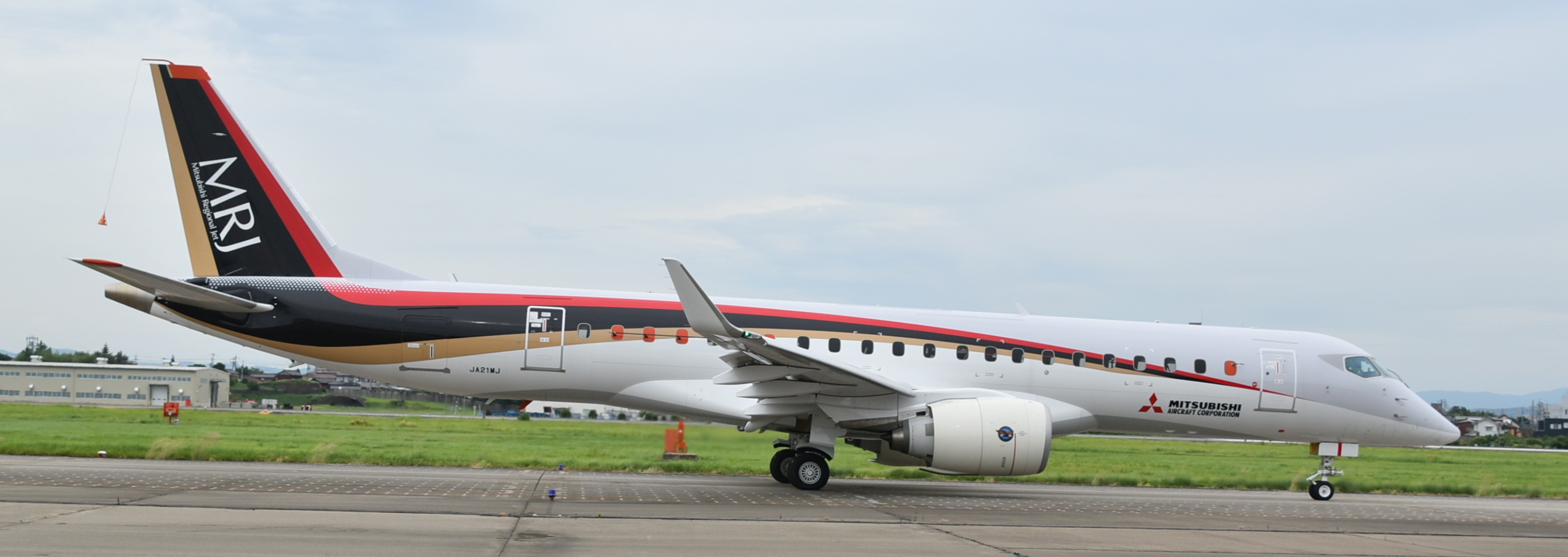
MRJ90 test aircraft JA21MJ

MRJ test aircraft JA21MJ photographed at Nagoya Komaki Airport on 15 September 2016.
MRJ test aircraft JA21MJ photographed at Nagoya Komaki Airport on 15 September 2016.Photo by Alec Wilson
Photo sourceCC BY-SA 2.0

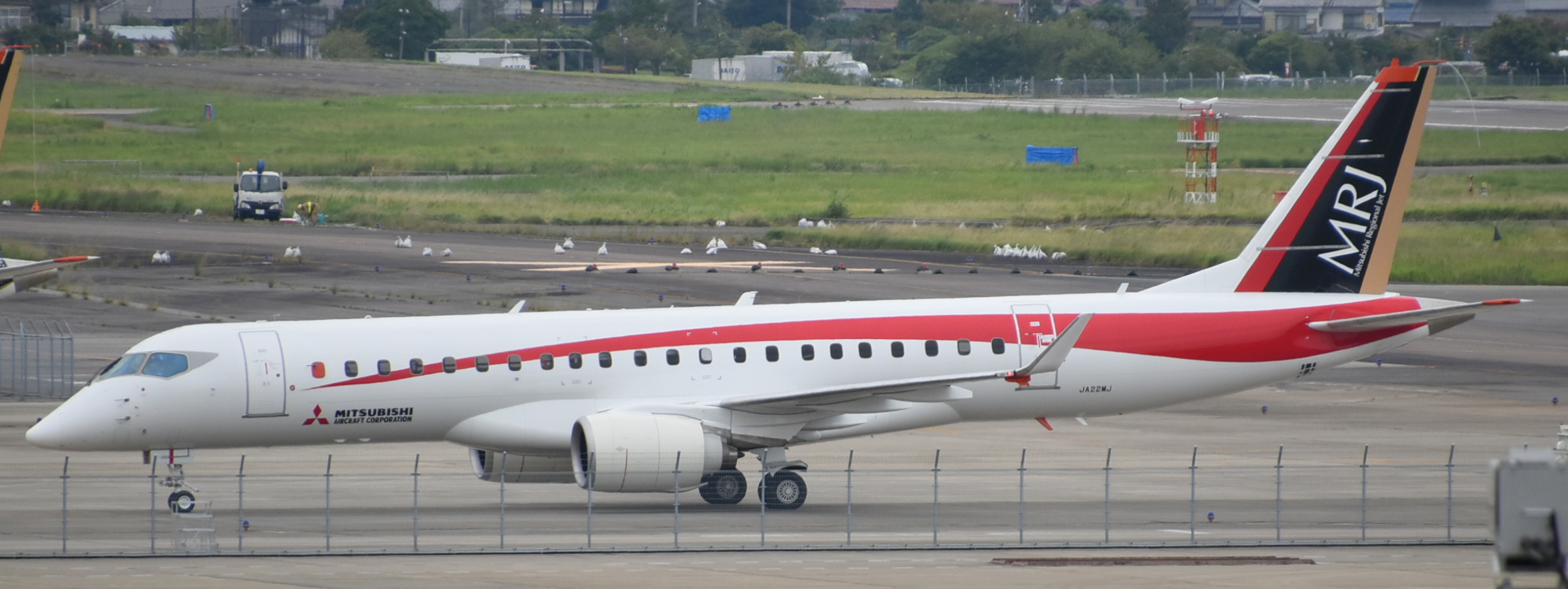
MRJ90 test aircraft JA22MJ

The second MRJ flight-test aircraft at Nagoya Komaki Airport on 15 September 2016.
The second MRJ flight-test aircraft at Nagoya Komaki Airport on 15 September 2016.Photo by Alec Wilson
Photo sourceCC BY-SA 2.0

Design & cabins

Technical notes

Design notes

  • The first MRJ flight test aircraft made its maiden flight from Nagoya Airport on 11 November 2015.
  • The 2014 design study described the MRJ70 as a shorter proposal alongside the MRJ90. In 2019 Mitsubishi introduced the separately proposed M100.

Limitations

  • The programme ended during development, before a type certificate or commercial service. Manufacturer design targets vary by proposal and publication date.
Family Technical Profile

Mitsubishi SpaceJet Family is one of Aircraft manufacturer's platforms in its market segment, balancing capacity, range, airport compatibility, maintenance economics, and mission flexibility.

Mitsubishi SpaceJet Family serves the narrowbody market with family commonality and multiple configurations.

Technical features

  • Mitsubishi SpaceJet Family: Single-aisle fuselage efficiency · structure. A narrow fuselage reduces structural weight and airport footprint for high-frequency short and medium routes.
  • Mitsubishi SpaceJet Family: High-cycle operating design · maintenance. Doors, landing gear, brakes, and systems are optimized for repeated daily sectors and quick turnarounds.
  • Mitsubishi SpaceJet Family: Wing and high-lift devices · aerodynamics. Flaps, slats, and wingtip devices balance runway performance with cruise efficiency.
  • Mitsubishi SpaceJet Family: Engine generation changes · engine. Engine nacelle, thrust rating, fuel burn, and noise standards define each production generation.
  • Mitsubishi SpaceJet Family: Fleet commonality · operational_efficiency. Common flight decks and maintenance practices reduce training and support cost across subfleets.

Advantages

  • One platform can cover several capacity and mission bands.
  • Family design reduces training, maintenance, and spares complexity.
  • Engine, wingtip, avionics, or structural upgrades can extend lifecycle value.

Weaknesses

  • Configuration identification complexity. Visually similar aircraft can differ materially by engine, weight standard, cabin layout, and conversion status.
  • Generation-dependent economics. Older generations usually trail newer designs in fuel burn, noise, avionics, or maintenance intervals.
  • Market-fit limits. Every variant has an ideal capacity and range band; outside it, load factor, range, or cost can become limiting.

Markets

  • Network airline trunk or feeder markets
  • Leasing and fleet replacement markets
  • Regional, domestic, or international airline markets

Operators

  • Full-service network airlines
  • Low-cost or leisure airlines
  • Cargo, government, or special-mission operators

Routes and missions

  • High-frequency short or medium-haul trunk routes
  • Medium-density long-haul or cross-regional routes
  • Fleet replacement, supplementation, or special missions
Development & service

  • The 2014 design study described the MRJ70 as a shorter proposal alongside the MRJ90. In 2019 Mitsubishi introduced the separately proposed M100.

Sources