Dornier 328-100

The 328-100 carries two turboprops on its high wing. Look for the propeller hubs ahead of the nacelles when comparing it with the otherwise similar 328JET.

Length
21.28 m
Wingspan
20.98 m

Identification

Propeller hubs
The 328-100 has two propeller-equipped nacelles on the high wing. Spot the hubs and individual blades in a side or front-quarter photograph.
High wing and T-tail
The two models have the same published length and wingspan. Use the powerplant rather than the airframe outline to distinguish them.

The PW119B and PW119C installation is best confirmed against the aircraft's modification records.

Select a circle to see the marked area up close.

Dornier 328-110 C-FHVX
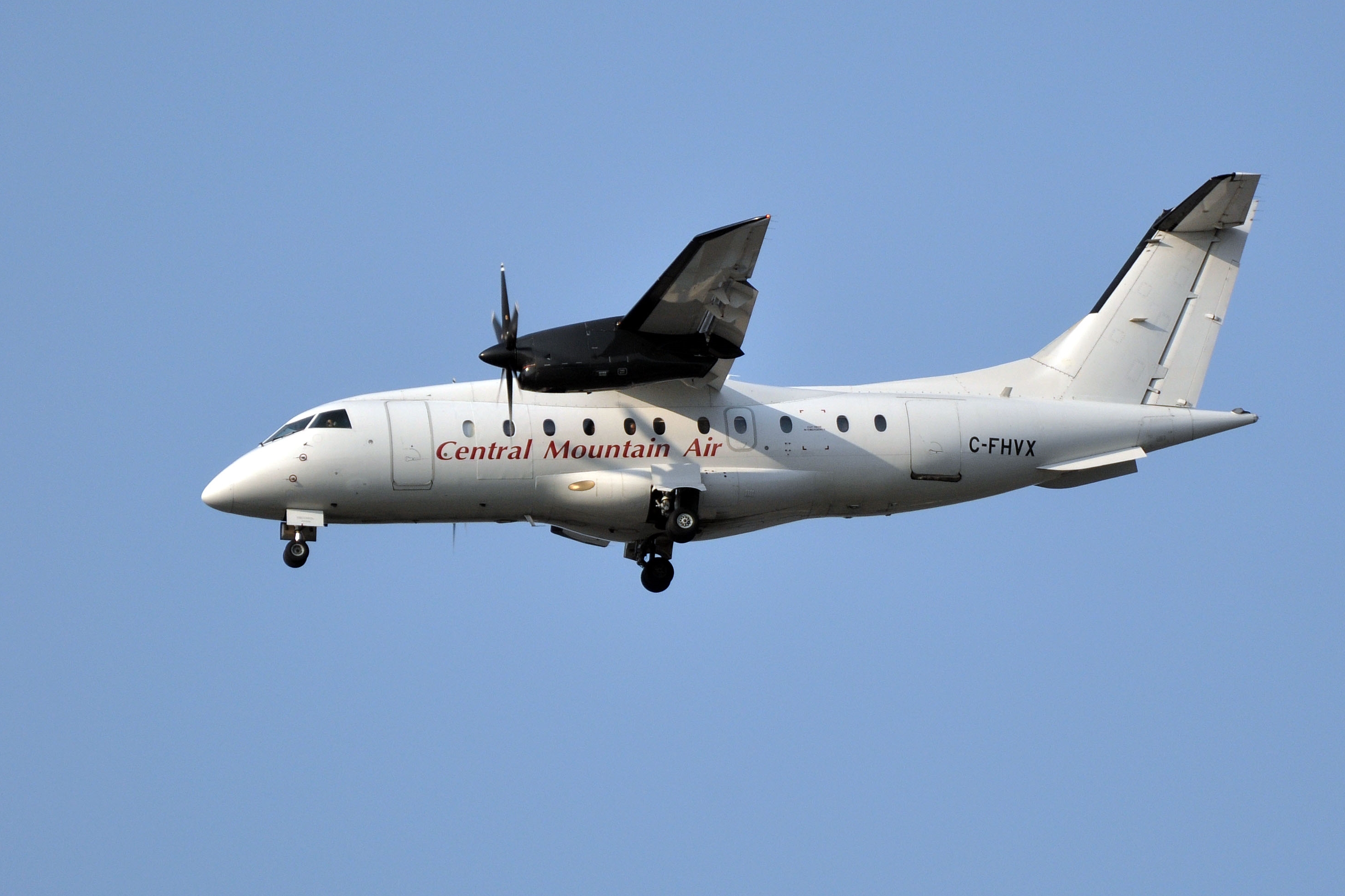
Central Mountain Air C-FHVX approaches Vancouver International Airport on 17 April 2015. The 328-110 belongs to the turboprop 328-100 model.
Central Mountain Air C-FHVX approaches Vancouver International Airport on 17 April 2015. The 328-110 belongs to the turboprop 328-100 model.Photo by Eric Salard
Photo sourceCC BY-SA 2.0

Compare models

Current aircraftDornier 328-100
Compare with

Comparing Dornier 328-100 with Dornier 328-300 / 328JET.

SpecificationDornier 328-100Dornier 328-300 / 328JET
Length21.28 m21.28 m
Wingspan20.98 m20.98 m
Maximum take-off weight13.99 tModifications 10, 20 and 30. Before modification 10, 13.64 t.15.2 tBasic and extended-range configuration. Modification 10 and extended range, 15.66 t.
Maximum payloadUnavailableUnavailable
Fuel tank capacityUnavailableUnavailable
Engine options2 × PW119B (modifications 00 and 10) · 2 × PW119C (modifications 20 and 30)2 × PW306B turbofans
Typical two-class seatsUnavailableUnavailable
Published rangeUnavailableUnavailable

A dash indicates that a verified figure is unavailable. Figures follow the configuration specified by each source.

Comparison sources

Design & cabins

Technical notes

Design notes

  • The type data sheet assigns PW119B to modifications 00 and 10 and PW119C to modifications 20 and 30. It records certification on 15 October 1993.
Variant Technical Profile

Dornier 328-100 is a specific configuration within Dornier 328 Family, developed to cover a defined capacity, range, payload, or mission requirement inside the wider family.

Dornier 328-100 is positioned as a capacity/range-specific solution within the narrowbody segment, serving routes better matched than sibling variants.

Technical features

  • Dornier 328-100: Single-aisle fuselage efficiency · structure. A narrow fuselage reduces structural weight and airport footprint for high-frequency short and medium routes.
  • Dornier 328-100: High-cycle operating design · maintenance. Doors, landing gear, brakes, and systems are optimized for repeated daily sectors and quick turnarounds.
  • Dornier 328-100: Wing and high-lift devices · aerodynamics. Flaps, slats, and wingtip devices balance runway performance with cruise efficiency.
  • Dornier 328-100: Engine generation changes · engine. Engine nacelle, thrust rating, fuel burn, and noise standards define each production generation.
  • Dornier 328-100: Fleet commonality · operational_efficiency. Common flight decks and maintenance practices reduce training and support cost across subfleets.

Advantages

  • Provides a more precise capacity or range match within the family.
  • Retains training, maintenance, and parts commonality with sibling variants.
  • Lets operators tune engine, cabin, and payload choices to route needs.

Weaknesses

  • Configuration identification complexity. Visually similar aircraft can differ materially by engine, weight standard, cabin layout, and conversion status.
  • Generation-dependent economics. Older generations usually trail newer designs in fuel burn, noise, avionics, or maintenance intervals.
  • Market-fit limits. Every variant has an ideal capacity and range band; outside it, load factor, range, or cost can become limiting.

Markets

  • Network airline trunk or feeder markets
  • Leasing and fleet replacement markets
  • Regional, domestic, or international airline markets

Operators

  • Full-service network airlines
  • Low-cost or leisure airlines
  • Cargo, government, or special-mission operators

Routes and missions

  • High-frequency short or medium-haul trunk routes
  • Medium-density long-haul or cross-regional routes
  • Fleet replacement, supplementation, or special missions

Sibling comparison

  • smaller sibling variants. Usually provides more seats, cargo volume, or thrust demand, but can be harder to fill on thinner routes.
  • larger or longer-range sibling variants. Usually has lower acquisition and operating exposure, but less range, payload, or growth margin.

Sources