ARJ21-700
The ARJ21-700 is the baseline production model of COMAC's ARJ21 regional jet programme. COMAC now markets the family as the C909.
- Length
- 33.46 m
- Wingspan
- 27.29 m
- Engine options
- CF34-10A
- Published range
- 1,200–2,000 nmiAdvertised variants
Identification
Use these features to recognise the COMAC C909 / ARJ21 Family. Check the aircraft or programme record for the ARJ21-700 designation.
- Rear-mounted engines
- Look for two turbofan nacelles attached to the rear fuselage, above the wing's trailing edge in a side view.
- T-tail
- Follow the vertical fin up to the horizontal stabilizer. Its high position and the low wing give the C909 its regional-jet silhouette.
C909 is the commercial name for the ARJ21. Other regional jets share a T-tail and rear engines. Confirm with the aircraft registration or operator's type record.
Compare models
Comparing ARJ21-700 ER with ARJ21-700 STD.
| Specification | ARJ21-700 ER | ARJ21-700 STD |
|---|---|---|
| Length | 33.46 m | 33.46 m |
| Wingspan | 27.29 m | 27.29 m |
| Maximum take-off weight | 43.5 tC909 ER planning weight | 40.5 tC909 STD planning weight |
| Maximum payload | 8.94 t | 8.94 t |
| Fuel tank capacity | 12,838 LUsable fuel · December 2025 planning manual | 12,838 LUsable fuel · December 2025 planning manual |
| Engine options | CF34-10A16 | CF34-10A16 |
| Typical two-class seats | 78COMAC ER mixed-class layout | 78COMAC STD mixed-class layout |
| Published range | 1,981 nmi8,165 kg payload · ISA, zero wind · 200 nm alternate and 45 min reserve | 1,258 nmi8,165 kg payload · ISA, zero wind · 200 nm alternate and 45 min reserve |
A dash indicates that a verified figure is unavailable. Figures follow the configuration specified by each source.
Comparison sources
- COMAC · ARJ21-700 airport planning manualIssue 003, §§02-01 and 02-02 · ER planning column and shared three-view drawing
- COMAC · C909 Airport Operations Guide, November 2025§1.1 · engine installation on C909 STD and ER
- COMAC · C909 Airport Planning Manual, §03-02 payload-range chart§03-02 Fig. 1 · ARJ21-700 ER payload-range curve
- COMAC C909 Airport Planning ManualIssue 003, §02-01 · ER weight, payload and usable fuel column
- COMAC C909 Airport Planning ManualIssue 003, §§02-01 and 02-02 · STD planning column and shared three-view drawing
- COMAC · C909 Airport Planning Manual, §03-02 payload-range chart§03-02 Fig. 1 · ARJ21-700 STD payload-range curve
Variants
ARJ21-700 ER
The ARJ21-700 ER is the extended-range passenger configuration of COMAC’s ARJ21-700. COMAC lists it as C909ER, with a maximum takeoff weight of 43,500 kg compared with 40,500 kg for the standard-range configuration.
ARJ21-700 STD
The ARJ21-700 STD is the standard-range passenger configuration of COMAC’s ARJ21-700, marketed as the C909. COMAC identifies this configuration as C909STD.
ARJ21-700B
ARJ21-700B engine configuration is recorded from the structured aircraft-engine dataset. Each line maps an engine sub-variant to its parent engine model and aircraft application.
ARJ21-700CCF
ARJ21-700CCF engine configuration is recorded from the structured aircraft-engine dataset. Each line maps an engine sub-variant to its parent engine model and aircraft application.
ARJ21-700E
ARJ21-700E engine configuration is recorded from the structured aircraft-engine dataset. Each line maps an engine sub-variant to its parent engine model and aircraft application.
ARJ21-700M
ARJ21-700M engine configuration is recorded from the structured aircraft-engine dataset. Each line maps an engine sub-variant to its parent engine model and aircraft application.
Design & cabins
CF34-10A installation
See the engine encyclopedia for ratings and aircraft applications.
Passenger seating
Explore airline cabin configurations. J denotes business class and Y denotes economy.
Featured components & design
Five-abreast cabin and lower holds
Economy seats are grouped 2–3 across a single aisle. Forward and aft lower holds carry baggage and cargo below the passenger deck.
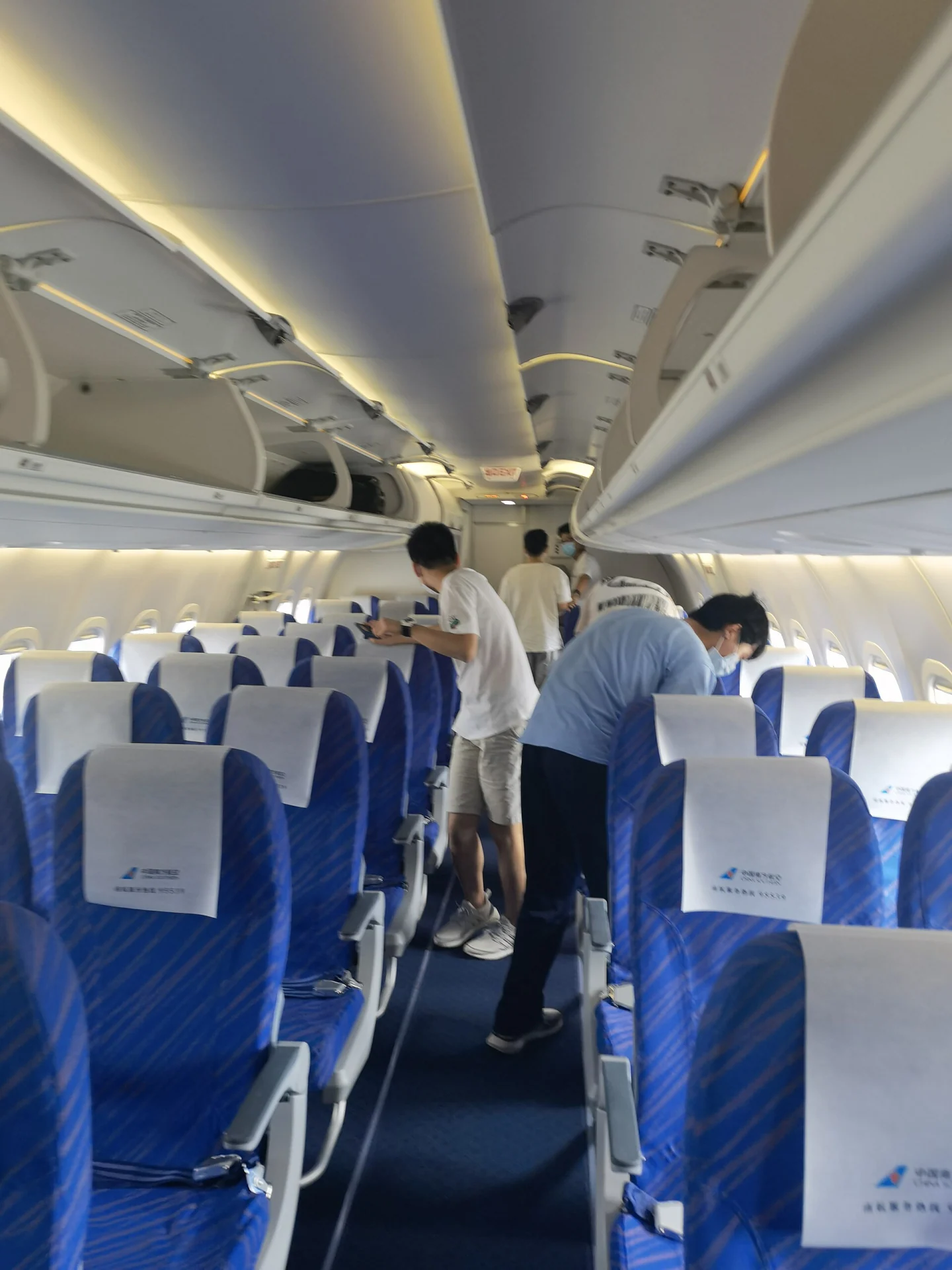
Five-abreast cabin · China Southern ARJ21-700Lhzss8 · resized for display · CC BY-SA 4.0

COMAC C909 / ARJ21 Family Fuselage and Cabin Architecture
COMAC C909 / ARJ21 Family fuselage design defines the usable cabin width, door layout, cargo volume, stretch potential, and airline cabin flexibility across C909 / ARJ21-700, ARJ21-700, C909.
COMAC C909 / ARJ21 Family Wing and High-Lift System
COMAC C909 / ARJ21 Family wing design is central to runway performance, cruise efficiency, fuel capacity, and the family improvement path across its variants.
COMAC C909 / ARJ21 Family Landing Gear and Braking System
COMAC C909 / ARJ21 Family landing gear and braking architecture support the aircraft's weight growth, field performance, pavement loading, and maintenance profile.
COMAC C909 / ARJ21 Family Flight Deck and Avionics
COMAC C909 / ARJ21 Family cockpit architecture reflects the manufacturer's operating philosophy, training commonality, display technology, and automation level.
COMAC C909 / ARJ21 Family Materials and Structural Design
COMAC C909 / ARJ21 Family structural design balances weight, fatigue life, corrosion resistance, repairability, production cost, and the technology level of its generation.
COMAC C909 / ARJ21 Family Cargo and Cabin Systems
COMAC C909 / ARJ21 Family cargo and cabin systems affect payload, turnaround, passenger comfort, conversion potential, and airline route economics.
Technical notes
Design notes
- Family context: The COMAC C909, originally known as the ARJ21, is a Chinese regional jet family designed for domestic trunk-feeder and regional operations. It uses rear-mounted engines and a T-tail layout, with airline cabin layouts currently concentrated among Chinese operators.
- Exact airline configuration can change seat count, galley arrangement, cargo capability, and operating range.
- Engine reference: ARJ21-700 uses CF34-10A.
- Cabin configuration should be treated as airline-specific: the same variant may be high-density, full-service, or premium-heavy.
Advantages
- Supports regional connectivity in China.
- Domestic support ecosystem is important for Chinese airline networks.
- C909 branding helps align the aircraft with COMAC's newer naming system.
Limitations
- International operator base is limited.
- Cabin and route economics are closer to regional jets than larger single-aisle aircraft.
Variant Technical Profile
ARJ21-700 is a specific configuration within COMAC C909 / ARJ21 Family, developed to cover a defined capacity, range, payload, or mission requirement inside the wider family.
ARJ21-700 is positioned as a capacity/range-specific solution within the regional_jet segment, serving routes better matched than sibling variants.
Technical features
- ARJ21-700: Right-sized cabin · cabin. Smaller cross-sections and lower trip cost support thin routes that cannot fill larger mainline jets.
- ARJ21-700: Regional engine thrust class · engine. Engines are sized for lower passenger counts and frequent short sectors rather than heavy long-haul payload.
- ARJ21-700: Airport access · airport_compatibility. Runway, ramp, and gate compatibility are optimized for secondary airports and regional networks.
- ARJ21-700: High-utilization systems · maintenance. Maintenance access and dispatch reliability are important because regional aircraft fly many cycles.
- ARJ21-700: Scope and network fit · operational_efficiency. Seat count and range often reflect airline scope clauses, feeder networks, and right-sizing strategy.
Advantages
- Provides a more precise capacity or range match within the family.
- Retains training, maintenance, and parts commonality with sibling variants.
- Lets operators tune engine, cabin, and payload choices to route needs.
Weaknesses
- Configuration identification complexity. Visually similar aircraft can differ materially by engine, weight standard, cabin layout, and conversion status.
- Generation-dependent economics. Older generations usually trail newer designs in fuel burn, noise, avionics, or maintenance intervals.
- Market-fit limits. Every variant has an ideal capacity and range band; outside it, load factor, range, or cost can become limiting.
Markets
- Network airline trunk or feeder markets
- Leasing and fleet replacement markets
- Regional, domestic, or international airline markets
Operators
- Full-service network airlines
- Low-cost or leisure airlines
- Cargo, government, or special-mission operators
Routes and missions
- High-frequency short or medium-haul trunk routes
- Medium-density long-haul or cross-regional routes
- Fleet replacement, supplementation, or special missions
Sibling comparison
- smaller sibling variants. Usually provides more seats, cargo volume, or thrust demand, but can be harder to fill on thinner routes.
- larger or longer-range sibling variants. Usually has lower acquisition and operating exposure, but less range, payload, or growth margin.
Key terms
- Engine configuration
The exact engine family and thrust standard installed on a specific model or production block.
- Connects model suffixes, airline maintenance strategy, and performance limits.
- Important for aircraft identification and fleet comparison.
Advantages. Helps explain range, payload, noise, and fuel-burn differences.
Limitations. Public data may omit thrust derates or later engine swaps.
- Cabin configuration
The airline-selected layout of cabins, seats, galleys, lavatories, crew rest, and monuments.
- Can change the same aircraft type from premium-heavy to high-density.
- Affects range, payload, passenger experience, and turnaround flow.
Advantages. Lets airlines tailor the aircraft to route economics.
Limitations. Seat-map examples vary over time and by subfleet.
- Fleet commonality
Boeing families often preserve handling, maintenance, and cockpit continuity across generations where practical.
- This system is part of the A330 operating architecture and interacts with flight-control, electrical, hydraulic, engine, or environmental systems.
- Exact configuration varies across A330ceo, A330neo, freighter, and military derivatives.
Advantages. Improves operational reliability, economics, or mission flexibility. Uses a mature wide-body systems architecture to reduce operational risk.
Limitations. System complexity increases maintenance, training, and troubleshooting demands. Airline configuration and engine choice can change real-world performance.
From the archive
Loading photographs…