Home/Encyclopedia/De Havilland Canada/Dash 8 / Q Series family

Dash 8 / Q Series family

Dash 8 / Q Series family covers regional turboprop passenger aircraft in the Bombardier portfolio. The entry is imported from the McDonnell Douglas / Lockheed / Bombardier technical workbook and organized by family and derivative variant.

Models at a glance

Dash 8-100

Dash 8-100 is a regional turboprop passenger derivative within Dash 8 / Q Series family. Market positioning: 30–40 seat regional turboprop.

Length
22.25 m
Wingspan
25.91 m
Published range
699 nmAir Canada Express Dash 8-100 example, 1,295 km
Maximum passenger seats
40Certified maximum with the approved cabin and exit arrangement
Engine options
PW120A · PW121UK-approved -102, -103 and -106 variants
Main landing gear
1 axle · 2 wheels per side
Sources

Q100

Q100 is a regional turboprop passenger derivative within Dash 8 / Q Series family. Market positioning: Noise-improved Dash 8-100.

Length
22.25 m
Wingspan
25.91 m
Published range
699 nmAir Canada Express Dash 8-100 example, 1,295 km
Maximum passenger seats
40Certified maximum with the approved cabin and exit arrangement
Engine options
PW120A · PW121UK-approved -102, -103 and -106 variants
Main landing gear
1 axle · 2 wheels per side
Sources

Dash 8-200

Dash 8-200 is a regional turboprop passenger derivative within Dash 8 / Q Series family. Market positioning: Higher-performance short Dash 8.

Length
22.25 m
Wingspan
25.91 m
Published range
1,004 nmCAAC lists 1,859 km for the standard Q200
Maximum passenger seats
40Certified maximum with the approved cabin and exit arrangement
Engine options
PW123C · PW123D · PW123 · PW123B · PW123E
Main landing gear
1 axle · 2 wheels per side

Q200

Q200 is a regional turboprop passenger derivative within Dash 8 / Q Series family. Market positioning: High-performance Q-series short model.

Length
22.25 m
Wingspan
25.91 m
Published range
1,004 nmCAAC lists 1,859 km for the standard Q200
Maximum passenger seats
40Certified maximum with the approved cabin and exit arrangement
Engine options
PW123C · PW123D · PW123 · PW123B · PW123E
Main landing gear
1 axle · 2 wheels per side

Dash 8-300

Dash 8-300 is a regional turboprop passenger derivative within Dash 8 / Q Series family. Market positioning: 50-seat stretched Dash 8.

Length
25.69 m
Wingspan
27.43 m
Published range
816 nmCAAC lists 1,511 km for the standard Q300
Maximum passenger seats
56Certified maximum with the approved cabin and exit arrangement
Engine options
PW123 · PW123B · PW123E
Main landing gear
1 axle · 2 wheels per side
Sources

Q300

Q300 is a regional turboprop passenger derivative within Dash 8 / Q Series family. Market positioning: 50-seat Q-series model.

Length
25.69 m
Wingspan
27.43 m
Published range
816 nmCAAC lists 1,511 km for the standard Q300
Maximum passenger seats
56Certified maximum with the approved cabin and exit arrangement
Engine options
PW123 · PW123B · PW123E
Main landing gear
1 axle · 2 wheels per side
Sources

Q400 / Dash 8-400

Q400 / Dash 8-400 is a regional turboprop passenger derivative within Dash 8 / Q Series family. Market positioning: High-speed 70–90 seat turboprop.

Length
32.86 m
Wingspan
28.44 m
Published range
1,100 nmManufacturer Design Weight Increase performance figure for full passengers, 102 kg per person
Typical two-class seats
74Manufacturer example of dual-class cabin
Published seating
8230-inch pitch
Maximum passenger seats
90DHC-8-402 with the approved 90-passenger configuration
Engine options
PW150A
Main landing gear
1 axle · 2 wheels per side
Sources
Q400 / Dash 8-400 variants

DHC-8-402

The DHC-8-402 is a certified model in the Dash 8 Series 400, also marketed as the Q400.

Length
32.83 m
Wingspan
28.42 m
Published range
862 nmEnhanced High Gross Weight at full passenger load, 102 kg per person
Typical two-class seats
74Manufacturer optional dual-class cabin
Engine options
PW150A
Main landing gear
Unavailable
Sources

Identification

High wing and T-tail
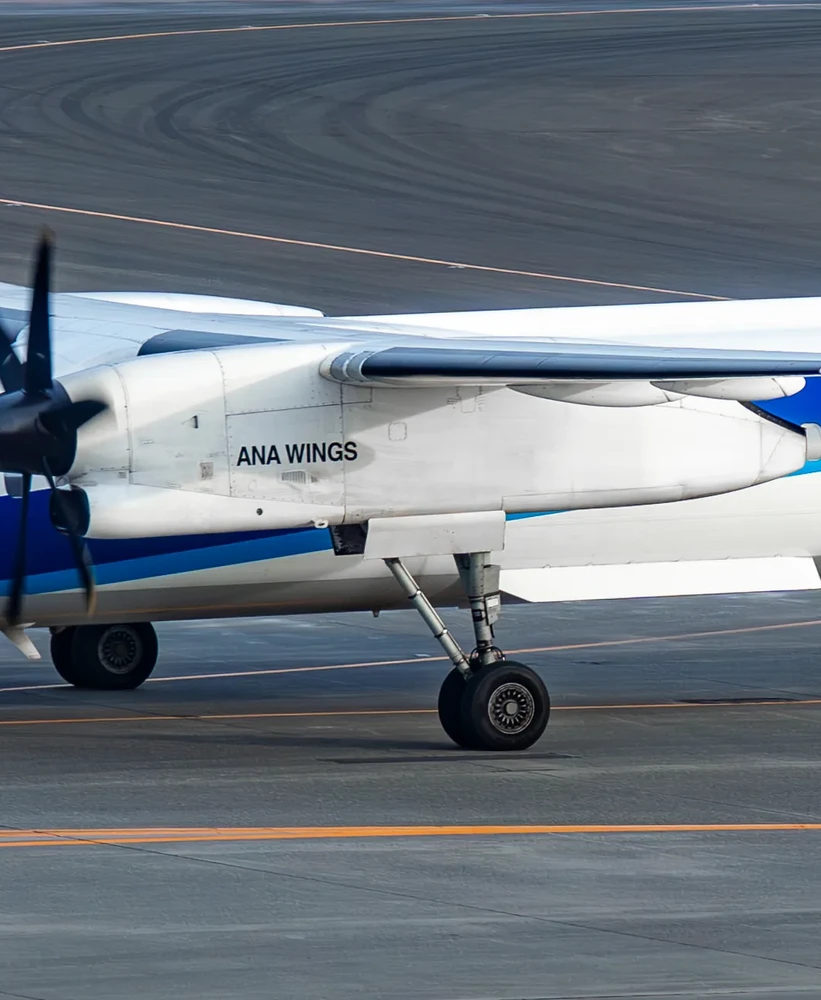
Look for the two propeller nacelles on a wing above the cabin. In a side view the tailplane sits at the top of the fin.
Propellers and cabin length
Combine a long cabin with six-blade propellers to recognize the Dash 8-400. The shorter 100, 200 and 300 series can be compared by fuselage length.

A high wing and T-tail also appear on ATRs. Cross-check the propeller, nacelle and fuselage shape.

Design & cabins

  • High-wing regional airframes from the -100 to -400

    The family spans several fuselage lengths and regional roles. The -400 is the largest of the listed production series.

  • PW100-series engines and the PW150A

    Earlier Dash 8 variants use PW100-series engines. The Dash 8-400 uses the PW150A and a distinct propeller installation.

  • Active Noise and Vibration Suppression

    ANVS counters cabin vibration on equipped Q Series aircraft. The equipment fit should be checked by model and modification.

More aircraft systems
  • Powerplant and fuel

    Propeller type and engine controls vary across the PW100 and PW150A branches.

  • Flight controls and avionics

    Flight-deck and avionics equipment should be matched to the individual Dash 8 series.

  • Cabin and cargo

    Passenger, baggage and cargo configurations depend on length and conversion standard.

  • Landing gear and braking

    Gear and braking support regional operations. Anti-skid and loading data are described for the relevant model.

  • Onboard systems

    Ice protection for the wing and propellers is an important regional operating system.

Engine configurations
Technical notes

Design notes

  • High-wing twin-turboprop regional design
  • Short-runway and regional-airport compatibility
  • Q Series active noise/vibration suppression
  • Q400 uses high-power PW150A and high cruise speed
  • Efficient on short sectors versus regional jets

Advantages

  • High-wing twin-turboprop regional design
  • Short-runway and regional-airport compatibility
  • Q Series active noise/vibration suppression

Limitations

  • Slower than jets
  • Turboprop cabin noise/vibration perception persists
  • Q400 maintenance complexity higher than smaller Dash 8
  • Limited long-route appeal
  • Premium-market acceptance lower than jets
Family Technical Profile

Dash 8 / Q Series family is one of Aircraft manufacturer's platforms in its market segment, balancing capacity, range, airport compatibility, maintenance economics, and mission flexibility.

Dash 8 / Q Series family serves the narrowbody market with family commonality and multiple configurations.

Technical features

  • Dash 8 / Q Series family: Single-aisle fuselage efficiency · structure. A narrow fuselage reduces structural weight and airport footprint for high-frequency short and medium routes.
  • Dash 8 / Q Series family: High-cycle operating design · maintenance. Doors, landing gear, brakes, and systems are optimized for repeated daily sectors and quick turnarounds.
  • Dash 8 / Q Series family: Wing and high-lift devices · aerodynamics. Flaps, slats, and wingtip devices balance runway performance with cruise efficiency.
  • Dash 8 / Q Series family: Engine generation changes · engine. Engine nacelle, thrust rating, fuel burn, and noise standards define each production generation.
  • Dash 8 / Q Series family: Fleet commonality · operational_efficiency. Common flight decks and maintenance practices reduce training and support cost across subfleets.

Advantages

  • One platform can cover several capacity and mission bands.
  • Family design reduces training, maintenance, and spares complexity.
  • Engine, wingtip, avionics, or structural upgrades can extend lifecycle value.

Weaknesses

  • Configuration identification complexity. Visually similar aircraft can differ materially by engine, weight standard, cabin layout, and conversion status.
  • Generation-dependent economics. Older generations usually trail newer designs in fuel burn, noise, avionics, or maintenance intervals.
  • Market-fit limits. Every variant has an ideal capacity and range band; outside it, load factor, range, or cost can become limiting.

Markets

  • Network airline trunk or feeder markets
  • Leasing and fleet replacement markets
  • Regional, domestic, or international airline markets

Operators

  • Full-service network airlines
  • Low-cost or leisure airlines
  • Cargo, government, or special-mission operators

Routes and missions

  • High-frequency short or medium-haul trunk routes
  • Medium-density long-haul or cross-regional routes
  • Fleet replacement, supplementation, or special missions
Sources