CRJ1000
CRJ1000 is a regional jet / business jet derivative within CRJ family. Market positioning: 100-seat largest CRJ.
- Length
- 39.1 m
- Wingspan
- 26.2 m
- Engine options
- CF34-8C5 · CF34-8C5A1 · CF34-8C5A2
- Published range
- 1,650 nmi102 kg per passenger
Identification
- Longest CRJ
- Compare the side profile with a CRJ900. The CRJ1000 adds about 2.9 m of fuselage and has a wider wingspan.
Compare models
Comparing CRJ1000 with Challenger 850.
| Specification | CRJ1000 | Challenger 850 |
|---|---|---|
| Length | 39.1 m | 26.77 mChallenger 850 uses the CL-600-2B19 airframe |
| Wingspan | 26.2 m | 21.21 mChallenger 850 uses the CL-600-2B19 airframe |
| Maximum take-off weight | 41.64 tHighest published Bombardier weight variant. | 24 tEASA option 0004 for eligible Challenger 850 airframes. |
| Maximum payload | 11.97 t | 4.18 tChallenger 850 manufacturer example: 44,000 lb maximum zero-fuel weight less 34,778 lb operating empty weight |
| Fuel tank capacity | 11,117 L | 8,082 LStandard CL-600-2B19 usable fuel. An individual executive completion may change tank capacity. |
| Engine options | CF34-8C5 · CF34-8C5A1 · CF34-8C5A2 | CF34-3B1 |
| Typical two-class seats | 97 | Unavailable |
| Published range | 1,650 nmi102 kg per passenger | 2,811 nmiChallenger 850 maximum published by Bombardier under specified operating conditions. |
A dash indicates that a verified figure is unavailable. Figures follow the configuration specified by each source.
Comparison sources
- MHIRJ · CRJ Series technical specificationsCRJ1000 dimensions and performance
- EASA · Bombardier CRJ type certificate data sheetIssue 3.0 · Section 6 §2
- Bombardier · CRJ series technical specificationsTechnical specifications and dual-class configurations
- EASA.IM.A.673 · Bombardier CRJ type certificateSection 6 §3 · Usable fuel capacity
- EASA · CRJ type designation and engine recordsCRD to NPA 2009-05, p. 35 · FOCA type-rating data
- Bombardier · Challenger 850 programme specificationsChallenger 850 aircraft range at long-range cruise speed
- Transport Canada Bombardier CRJ series operational evaluationAirplane dimensions · CL-600-2B19. The CAAC Challenger 850 evaluation identifies the 850 as a CL-600-2B19 derivative.
- EASA.IM.A.673 · Bombardier CRJ type certificateSection 2 §§3, 7, 21 · CL-600-2B19 green Challenger 850 / Special Edition
- Bombardier Challenger 850 Weight and Balance ManualSubject 01-90-15 table 1 · sample completed-aircraft OWE, paired with EASA.IM.A.673 issue 3 §II.7 MZFW
Design & cabins
CF34-8C5 installation
See the engine encyclopedia for ratings and aircraft applications.
CF34-8C5A1 installation
See the engine encyclopedia for ratings and aircraft applications.
CF34-8C5A2 installation
See the engine encyclopedia for ratings and aircraft applications.
Featured components & design
Stretched CRJ1000 fuselage
The CRJ1000 extends the CRJ900 airframe to a published 39.13 m overall length. The stretch is most apparent in a broadside view of the passenger cabin.
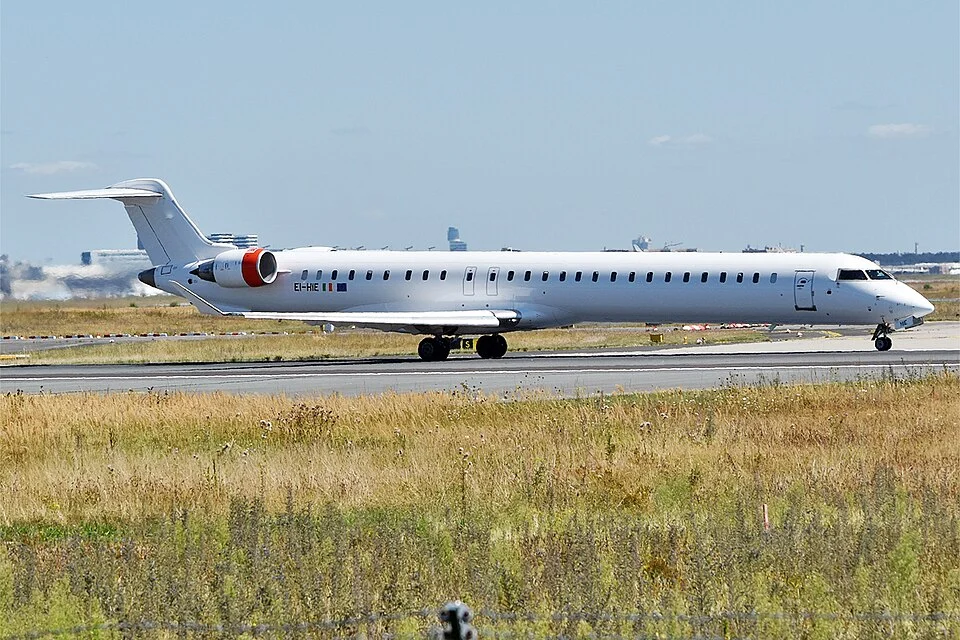
Stretched CRJ1000 fuselage · CityJet EI-HIEAnna Zvereva · resized for display · CC BY-SA 2.0

Technical notes
Design notes
- Engine configuration: 2 × GE CF34-8C5A1.
- Market positioning: 100-seat largest CRJ.
- Status: in service / limited.
Advantages
- Lower unit cost than smaller CRJ
- Higher capacity
Limitations
- Competes poorly with E190/A220
- Long narrow cabin
Variant Technical Profile
CRJ1000 is a specific configuration within CRJ family, developed to cover a defined capacity, range, payload, or mission requirement inside the wider family.
CRJ1000 is positioned as a capacity/range-specific solution within the narrowbody segment, serving routes better matched than sibling variants.
Technical features
- CRJ1000: Single-aisle fuselage efficiency · structure. A narrow fuselage reduces structural weight and airport footprint for high-frequency short and medium routes.
- CRJ1000: High-cycle operating design · maintenance. Doors, landing gear, brakes, and systems are optimized for repeated daily sectors and quick turnarounds.
- CRJ1000: Wing and high-lift devices · aerodynamics. Flaps, slats, and wingtip devices balance runway performance with cruise efficiency.
- CRJ1000: Engine generation changes · engine. Engine nacelle, thrust rating, fuel burn, and noise standards define each production generation.
- CRJ1000: Fleet commonality · operational_efficiency. Common flight decks and maintenance practices reduce training and support cost across subfleets.
Advantages
- Provides a more precise capacity or range match within the family.
- Retains training, maintenance, and parts commonality with sibling variants.
- Lets operators tune engine, cabin, and payload choices to route needs.
Weaknesses
- Configuration identification complexity. Visually similar aircraft can differ materially by engine, weight standard, cabin layout, and conversion status.
- Generation-dependent economics. Older generations usually trail newer designs in fuel burn, noise, avionics, or maintenance intervals.
- Market-fit limits. Every variant has an ideal capacity and range band; outside it, load factor, range, or cost can become limiting.
Markets
- Network airline trunk or feeder markets
- Leasing and fleet replacement markets
- Regional, domestic, or international airline markets
Operators
- Full-service network airlines
- Low-cost or leisure airlines
- Cargo, government, or special-mission operators
Routes and missions
- High-frequency short or medium-haul trunk routes
- Medium-density long-haul or cross-regional routes
- Fleet replacement, supplementation, or special missions
Sibling comparison
- smaller sibling variants. Usually provides more seats, cargo volume, or thrust demand, but can be harder to fill on thinner routes.
- larger or longer-range sibling variants. Usually has lower acquisition and operating exposure, but less range, payload, or growth margin.
From the archive
Loading photographs…