Boeing 717-200
The 717-200 is the production aircraft developed as the MD-95 before the Boeing merger. Its short cabin and tail-mounted BR715 engines suit high-frequency regional routes.
- Length
- 37.8 m
- Wingspan
- 28.44 m
- Engine options
- BR715
- Published range
- 1,430 nmiApproximate historical figure
Identification
Use these features to recognise the Boeing 717 Family. Check the aircraft or programme record for the Boeing 717-200 designation.
- Rear engines
- Look immediately ahead of the T-tail for a rounded engine pod on either side of the rear fuselage. The undersides of the wings are clear of engines.
- Short body
- Compare the compact cabin ahead of the wing and the relatively broad nacelles with the longer mainline MD-80 and its slimmer pods.
The compact DC-9 variants share the basic tail and engine arrangement. Confirm the 717 by its registration or model record.
Compare models
| Specification | 717-200 | Choose a family |
|---|---|---|
| Length | 37.8 m | |
| Wingspan | 28.44 m | |
| Maximum take-off weight | 54.88 tHigh-gross-weight option | |
| Maximum payload | 14.52 tHigh-gross-weight option | |
| Fuel tank capacity | 13,903 LStandard usable capacity · 16,665 L with auxiliary tanks | |
| Engine options | BR715 | |
| Typical two-class seats | 106 | |
| Published range | 1,430 nmiApproximate historical figure |
A dash indicates that a verified figure is unavailable. Figures follow the configuration specified by each source.
Comparison sources
- FAA Aircraft Characteristics Database · October 2024ACD_Data · B712 · Boeing 717-200
- Boeing · Historical aircraft technical specificationsPDF p. 4 · 717-200 historical snapshot
- Boeing 717 (4.2 MB) ACAP · D6-58330 Rev B§2.1, PDF p. 11, basic and high-gross-weight configurations
Design & cabins
BR715 installation
See the engine encyclopedia for ratings and aircraft applications.
Featured components & design
Engine installation · BR715
Published engine installation for the 717-200 is BR715.
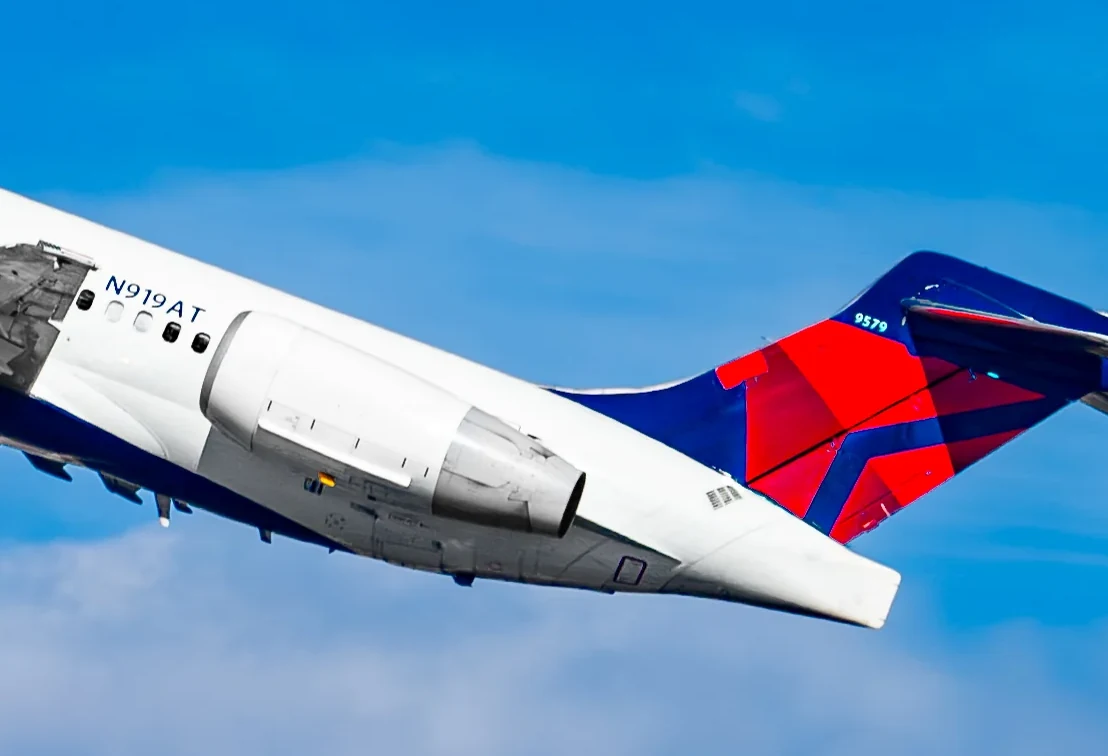
Delta 717-200 N919AT · aft-mounted BR715Admin · detail crop Cabin and exit configuration
The 717-200 is the production aircraft developed as the MD-95 before the Boeing merger. Its short cabin and tail-mounted BR715 engines suit high-frequency regional routes.
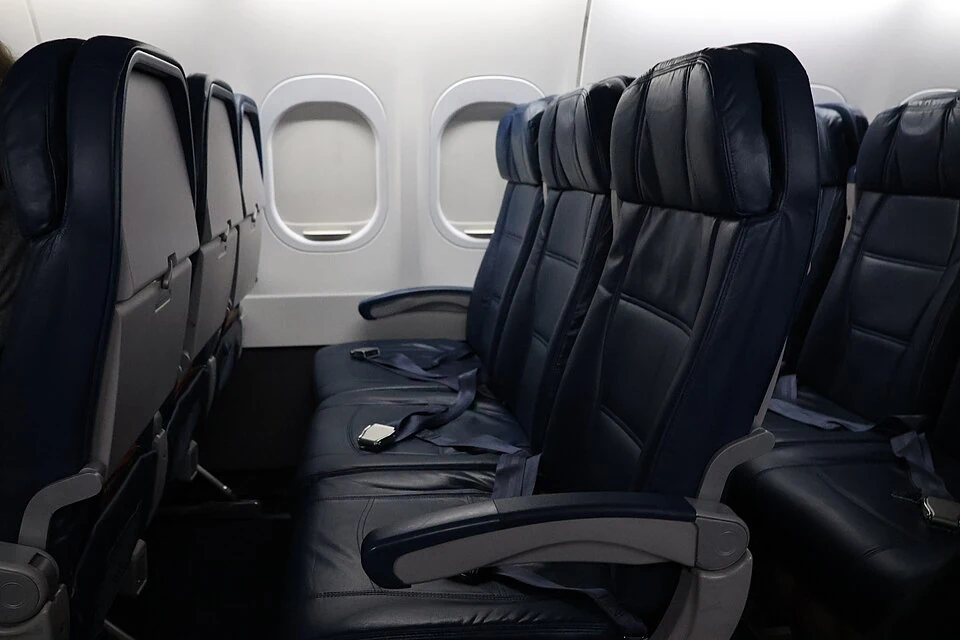
Delta Air Lines 717-200 · economy seatingDiscoA340 · resized · CC BY-SA 4.0

Boeing 717 Family Fuselage and Cabin Architecture
Boeing 717 Family fuselage design defines the usable cabin width, door layout, cargo volume, stretch potential, and airline cabin flexibility across 717-200.
Boeing 717 Family Wing and High-Lift System
Boeing 717 Family wing design is central to runway performance, cruise efficiency, fuel capacity, and the family improvement path across its variants.
Boeing 717 Family Landing Gear and Braking System
Boeing 717 Family landing gear and braking architecture support the aircraft's weight growth, field performance, pavement loading, and maintenance profile.
Boeing 717 Family Flight Deck and Avionics
Boeing 717 Family cockpit architecture reflects the manufacturer's operating philosophy, training commonality, display technology, and automation level.
Boeing 717 Family Materials and Structural Design
Boeing 717 Family structural design balances weight, fatigue life, corrosion resistance, repairability, production cost, and the technology level of its generation.
Boeing 717 Family Cargo and Cabin Systems
Boeing 717 Family cargo and cabin systems affect payload, turnaround, passenger comfort, conversion potential, and airline route economics.
Technical notes
Design notes
- Engine sub-variants can represent thrust rating, combustor standard, software standard, or installation differences rather than a fully separate hardware family.
- Use aircraft subtype, operator fleet data, and registration-level records before identifying a specific airframe engine.
Advantages
- Precise engine sub-variant lookup is available for this model.
Limitations
- Some planned, development, or military configurations may require certificate-level confirmation before operational use.
Variant Technical Profile
Boeing 717-200 is a specific configuration within Boeing 717 Family, developed to cover a defined capacity, range, payload, or mission requirement inside the wider family.
Boeing 717-200 is positioned as a capacity/range-specific solution within the narrowbody segment, serving routes better matched than sibling variants.
Technical features
- Boeing 717-200: Single-aisle fuselage efficiency · structure. A narrow fuselage reduces structural weight and airport footprint for high-frequency short and medium routes.
- Boeing 717-200: High-cycle operating design · maintenance. Doors, landing gear, brakes, and systems are optimized for repeated daily sectors and quick turnarounds.
- Boeing 717-200: Wing and high-lift devices · aerodynamics. Flaps, slats, and wingtip devices balance runway performance with cruise efficiency.
- Boeing 717-200: Engine generation changes · engine. Engine nacelle, thrust rating, fuel burn, and noise standards define each production generation.
- Boeing 717-200: Fleet commonality · operational_efficiency. Common flight decks and maintenance practices reduce training and support cost across subfleets.
Advantages
- Provides a more precise capacity or range match within the family.
- Retains training, maintenance, and parts commonality with sibling variants.
- Lets operators tune engine, cabin, and payload choices to route needs.
Weaknesses
- Configuration identification complexity. Visually similar aircraft can differ materially by engine, weight standard, cabin layout, and conversion status.
- Generation-dependent economics. Older generations usually trail newer designs in fuel burn, noise, avionics, or maintenance intervals.
- Market-fit limits. Every variant has an ideal capacity and range band; outside it, load factor, range, or cost can become limiting.
Markets
- Network airline trunk or feeder markets
- Leasing and fleet replacement markets
- Regional, domestic, or international airline markets
Operators
- Full-service network airlines
- Low-cost or leisure airlines
- Cargo, government, or special-mission operators
Routes and missions
- High-frequency short or medium-haul trunk routes
- Medium-density long-haul or cross-regional routes
- Fleet replacement, supplementation, or special missions
Sibling comparison
- smaller sibling variants. Usually provides more seats, cargo volume, or thrust demand, but can be harder to fill on thinner routes.
- larger or longer-range sibling variants. Usually has lower acquisition and operating exposure, but less range, payload, or growth margin.
From the archive
Loading photographs…