Home/Encyclopedia/Other manufacturers/AVIC AG600 Kunlong Family

AVIC AG600 Kunlong Family

The AG600 Kunlong is AVIC's large amphibian. A boat-shaped hull and underwing floats serve water operations, and a retractable landing gear allows runway operations. Four turboprops are carried on a high wing.

Models at a glance

AG600 development demonstrator

The early AG600 demonstrator was the prototype for the amphibian's land and water flight programme. It preceded the full-configuration firefighting aircraft developed as the AG600M.

First flight
24 December 2017 (land)
Length
Unavailable
Wingspan
Unavailable
Published range
Unavailable
Engine options
4 × turboprops
Main landing gear
Unavailable

AG600M firefighting configuration

AG600M is the development designation used for the full-configuration firefighting aircraft. The 2025 Chinese approval announcements identify the large amphibious firefighting aircraft as the AG600.

First flight
Unavailable
Length
Unavailable
Wingspan
Unavailable
Published range
2,430 nm4,500 km, rounded to nautical miles. CAAC table gives no payload condition.
Engine options
4 × turboprops
Main landing gear
Unavailable
Sources

Identification

Boat hull and stabilising floats
The deep fuselage is shaped for contact with the water. The smaller outboard floats keep the aircraft stable laterally on the surface.
Four propellers on a high wing
Count four propellers and look for the T-tail. The Canadair CL-215 and CL-415 have two engines and different tail geometry.
Retractable runway gear
Look for the wheels when the aircraft is operating on land. They retract for water operations.
B-002A on land and water
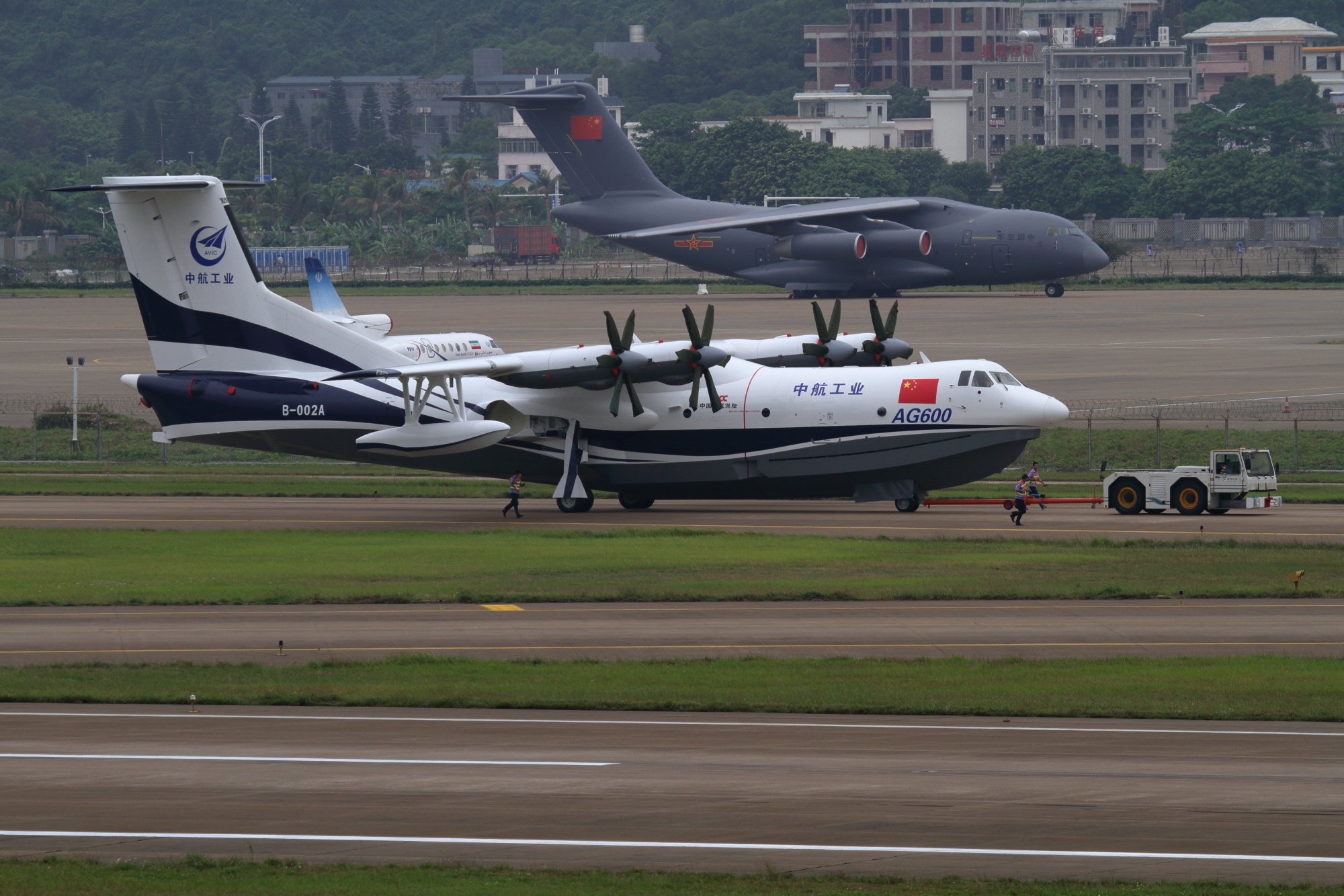
At Zhuhai the blue-and-white demonstrator rests on its wheels. In the Zhanghe Reservoir video and photographs, the boat hull touches the surface and leaves a wake. The separate floats sit beneath the outer wing.

The pictured 2016 aircraft is the earlier demonstrator. Confirm the configuration in the aircraft record.

Select a circle to see the marked area up close.

AG600 demonstrator B-002A

The early AG600 development aircraft on land at the China International Aviation & Aerospace Exhibition, Zhuhai, 30 October 2016.
The early AG600 development aircraft on land at the China International Aviation & Aerospace Exhibition, Zhuhai, 30 October 2016.Photo by Alert5
Photo sourceCC BY-SA 4.0

Design & cabins

Technical notes

Design notes

  • The original development aircraft made its first flight from a runway at Zhuhai on 24 December 2017.
  • CAAC granted the firefighting AG600 type certificate on 20 April 2025. The separate production certificate was issued on 11 June 2025.

Limitations

  • The 2025 certification milestone applies to the firefighting type described by MIIT. The family name also covers development aircraft.
Family Technical Profile

AVIC AG600 Kunlong Family is one of Aircraft manufacturer's platforms in its market segment, balancing capacity, range, airport compatibility, maintenance economics, and mission flexibility.

AVIC AG600 Kunlong Family serves the narrowbody market with family commonality and multiple configurations.

Technical features

  • AVIC AG600 Kunlong Family: Single-aisle fuselage efficiency · structure. A narrow fuselage reduces structural weight and airport footprint for high-frequency short and medium routes.
  • AVIC AG600 Kunlong Family: High-cycle operating design · maintenance. Doors, landing gear, brakes, and systems are optimized for repeated daily sectors and quick turnarounds.
  • AVIC AG600 Kunlong Family: Wing and high-lift devices · aerodynamics. Flaps, slats, and wingtip devices balance runway performance with cruise efficiency.
  • AVIC AG600 Kunlong Family: Engine generation changes · engine. Engine nacelle, thrust rating, fuel burn, and noise standards define each production generation.
  • AVIC AG600 Kunlong Family: Fleet commonality · operational_efficiency. Common flight decks and maintenance practices reduce training and support cost across subfleets.

Advantages

  • One platform can cover several capacity and mission bands.
  • Family design reduces training, maintenance, and spares complexity.
  • Engine, wingtip, avionics, or structural upgrades can extend lifecycle value.

Weaknesses

  • Configuration identification complexity. Visually similar aircraft can differ materially by engine, weight standard, cabin layout, and conversion status.
  • Generation-dependent economics. Older generations usually trail newer designs in fuel burn, noise, avionics, or maintenance intervals.
  • Market-fit limits. Every variant has an ideal capacity and range band; outside it, load factor, range, or cost can become limiting.

Markets

  • Network airline trunk or feeder markets
  • Leasing and fleet replacement markets
  • Regional, domestic, or international airline markets

Operators

  • Full-service network airlines
  • Low-cost or leisure airlines
  • Cargo, government, or special-mission operators

Routes and missions

  • High-frequency short or medium-haul trunk routes
  • Medium-density long-haul or cross-regional routes
  • Fleet replacement, supplementation, or special missions
Development & service

  • The original development aircraft made its first flight from a runway at Zhuhai on 24 December 2017.

Sources