A340-541

The A340-541 is the A340-500 model using Trent 500 engines. It was developed for very long routes with a fuselage shorter than the A340-600.

At a glance

A340-541

Length
67.94 m
Wingspan
63.46 m
Published range
8,650 nmApproximate Airbus range at maximum passenger payload · Trent 553 chart
Typical two-class seats
181Singapore Airlines’ 2004 cabin · 64 Raffles + 117 Executive Economy
Engine options
Trent 553-61 · Trent 553A2-61
Main landing gear
4 wheels per side + 4-wheel centre gear
Sources
A340-500 model line

Compare models

Current aircraftA340-500
Compare with

Comparing A340-541 with A340-500.

SpecificationA340-541A340-500
Length67.94 m67.94 m
Wingspan63.46 m63.46 m
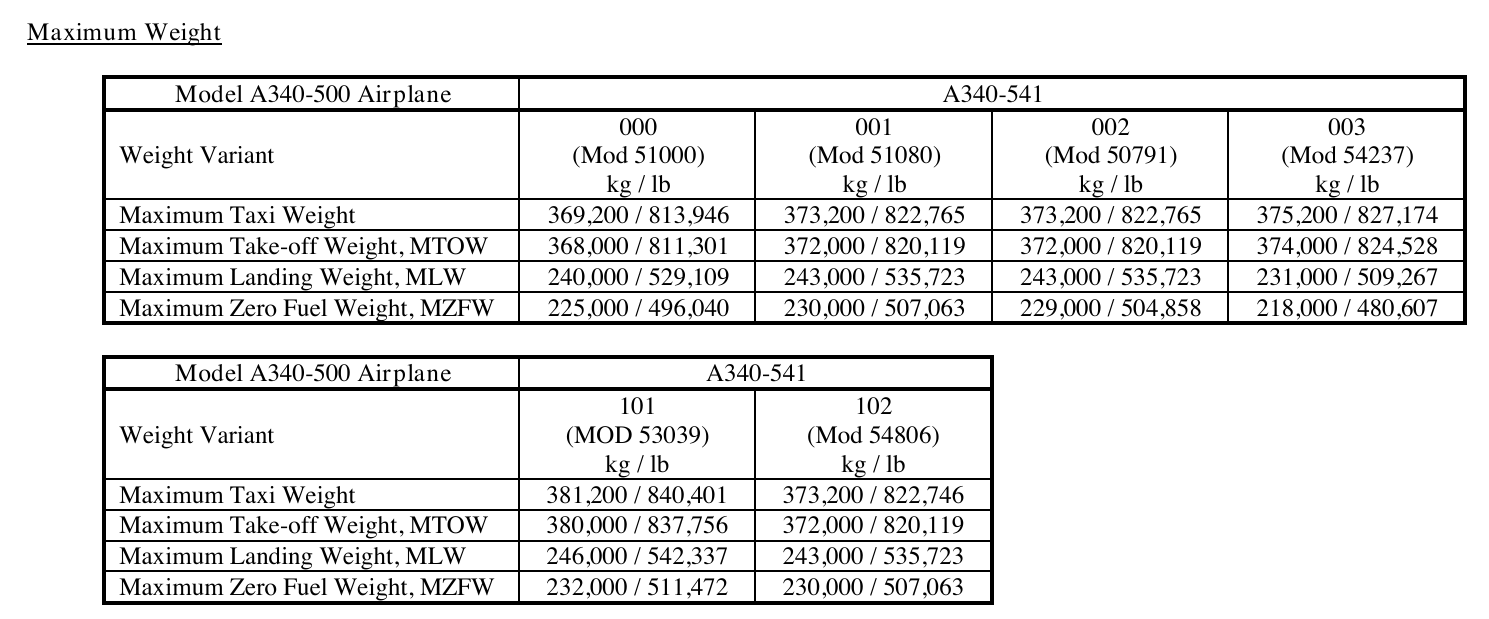
Maximum take-off weight372 tWV001/WV002 with standard rear centre tank380 tWeight variant WV101
Maximum payload54 tApproximate Airbus planning limit · Trent 553 chart54 tApproximate structural limit from Airbus’s Trent 553 chart
Fuel tank capacity215,108 LAirbus planning configuration · WV001/WV002 with standard rear centre tank214,066 LWV101 standard rear centre tank · 222,036 L with the optional larger tank
Engine optionsTrent 553-61 · Trent 553A2-61Trent 553-61 · Trent 553A2-61 · Trent 556A2-61
Typical two-class seats181Singapore Airlines’ 2004 cabin · 64 Raffles + 117 Executive Economy181Singapore Airlines’ 2004 long-range layout · 64 Raffles + 117 Executive Economy
Published range8,650 nmiApproximate Airbus range at maximum passenger payload · Trent 553 chart8,640 nmi2003 published maximum · approximately 16,000 km

A dash indicates that a verified figure is unavailable. Figures follow the configuration specified by each source.

Comparison sources

Identification

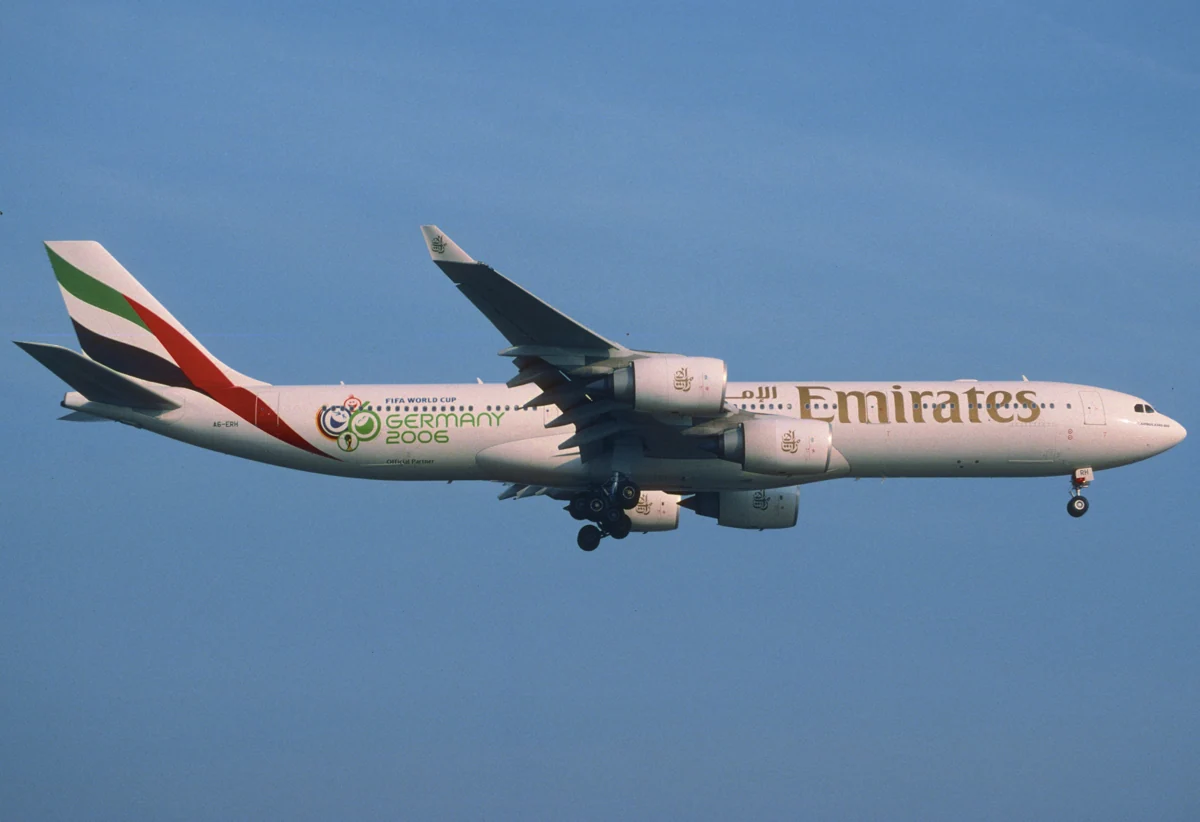
Use these features to recognise the A340-500. Check the aircraft or programme record for the A340-541 designation.

Two-axle centre gear
Count axles on the gear unit under the fuselage centreline, between the wing gear units. The -500 and -600 both have two there.
Shorter late-model fuselage
Compare the cabin length in profile. The -500 is about 68 m long and the -600 about 75 m, despite sharing the larger Trent 500 nacelles.

Design & cabins

Engine reference
Trent 500
Technical notes

Design notes

  • Engine sub-variants can represent thrust rating, combustor standard, software standard, or installation differences rather than a fully separate hardware family.
  • Use aircraft subtype, operator fleet data, and registration-level records before identifying a specific airframe engine.

Advantages

  • Precise engine sub-variant lookup is available for this model.

Limitations

  • Some planned, development, or military configurations may require certificate-level confirmation before operational use.
Variant Technical Profile

A340-541 is a specific configuration within A340-500, developed to cover a defined capacity, range, payload, or mission requirement inside the wider family.

A340-541 is positioned as a capacity/range-specific solution within the widebody segment, serving routes better matched than sibling variants.

Technical features

  • A340-541: Wide-body fuselage · structure. Twin-aisle cabin and lower-deck cargo volume support long-haul passenger comfort and belly-freight revenue.
  • A340-541: High-bypass turbofan integration · engine. Large engines are matched to long-range payload needs, ETOPS rules, and airline maintenance strategy.
  • A340-541: Long-range fuel and payload balance · range_payload. Wing fuel capacity, MTOW growth, and cabin density determine whether the aircraft favors range, seats, or cargo.
  • A340-541: Advanced flight deck · avionics. Glass-cockpit avionics and modern flight-management systems reduce crew workload on long sectors.
  • A340-541: Cabin systems for long sectors · cabin. Pressurization, air conditioning, galleys, crew rest, and cargo holds are sized for extended missions.

Advantages

  • Provides a more precise capacity or range match within the family.
  • Retains training, maintenance, and parts commonality with sibling variants.
  • Lets operators tune engine, cabin, and payload choices to route needs.

Weaknesses

  • Configuration identification complexity. Visually similar aircraft can differ materially by engine, weight standard, cabin layout, and conversion status.
  • Generation-dependent economics. Older generations usually trail newer designs in fuel burn, noise, avionics, or maintenance intervals.
  • Market-fit limits. Every variant has an ideal capacity and range band; outside it, load factor, range, or cost can become limiting.

Markets

  • Network airline trunk or feeder markets
  • Leasing and fleet replacement markets
  • Regional, domestic, or international airline markets

Operators

  • Full-service network airlines
  • Low-cost or leisure airlines
  • Cargo, government, or special-mission operators

Routes and missions

  • High-frequency short or medium-haul trunk routes
  • Medium-density long-haul or cross-regional routes
  • Fleet replacement, supplementation, or special missions

Sibling comparison

  • smaller sibling variants. Usually provides more seats, cargo volume, or thrust demand, but can be harder to fill on thinner routes.
  • larger or longer-range sibling variants. Usually has lower acquisition and operating exposure, but less range, payload, or growth margin.
Sources