727 freighter conversions
Passenger 727s were converted for cargo service by adapting the main deck for freight. Conversion standards and installed engines vary by airframe.
- Length
- 40.59 mShort-fuselage 727-100QF example · 133 ft 2 in
- Wingspan
- 32.92 mStandard span · 727-100C/727-200 freighter airframes
- Engine options
- Rolls-Royce Tay 651727-100QF Tay conversion example
Identification
Use these features to recognise the Boeing 727 Family. Check the aircraft or programme record for the 727 freighter conversions designation.
- Centre intake
- Find the inlet at the foot of the tall T-tail, above the aft fuselage. It feeds the centre engine, giving the 727 three intakes in the tail area.
- Side pods
- Check the second and third intakes on either side of the rear fuselage. The wings carry no engines, a quick difference from the 737.
Compare models
Comparing 727 freighter conversions with 727 Freighter.
| Specification | 727 freighter conversions | 727 Freighter |
|---|---|---|
| Length | 40.59 mShort-fuselage 727-100QF example · 133 ft 2 in | 46.68 mBoeing factory 727-200F example |
| Wingspan | 32.92 mStandard span · 727-100C/727-200 freighter airframes | 32.92 mBoeing factory 727-200F example |
| Maximum take-off weight | 76.66 tUPS 727-100QF Tay conversion example · 169,000 lb | 92.13 tBoeing factory 727-200F example |
| Maximum payload | 24.67 tFedEx 727-232F conversion example · zero-fuel limit less basic operating weight | 29.49 tBoeing factory 727-200F example |
| Fuel tank capacity | Unavailable | 30,681 LBoeing factory 727-200F example · converted from U.S. gallons |
| Engine options | Rolls-Royce Tay 651727-100QF Tay conversion example | JT8D-17ABoeing factory 727-200F example |
| Typical two-class seats | Unavailable | Unavailable |
| Published range | Unavailable | 1,597 nmiBoeing factory 727-200F example · maximum zero-fuel-weight payload · nautical scale |
A dash indicates that a verified figure is unavailable. Figures follow the configuration specified by each source.
Comparison sources
- Transport Canada · Boeing 727 MMEL, revision 49aATA Chapter 73, 727-100QF with Tay 651
- Boeing · 2007 Freighter Reference Guide, 727 general arrangementGeneral arrangement drawing TBC-CA-2019 for 727-100C donor geometry · FAA STC SA8472SW identifies the -100 with the Dee Howard Tay installation
- French Civil Aviation Technical Service · Aircraft type and takeoff weightAircraft noise and performance dataset, ANP entry 727QF · UPS 727-100 refit
- NTSB · FedEx 727-232F, N497FE weight and balanceDCA02MA054 Operations Attachment E PDF p. 22 · N497FE converted 727-232F · 150,000 lb MZFW less 95,616 lb basic operating weight
- Boeing archive · 727 FreighterGeneral arrangement, PDF p. 1, 727-200F
- Boeing archive · 727 FreighterPerformance summary and payload–range chart, PDF pp. 5–6, 727-200F column
Design & cabins
Rolls-Royce Tay 651
Featured components & design
Engine installation · Rolls-Royce Tay 651
Published engine installation for the 727 freighter conversions is Rolls-Royce Tay 651. 727-100QF Tay conversion example.
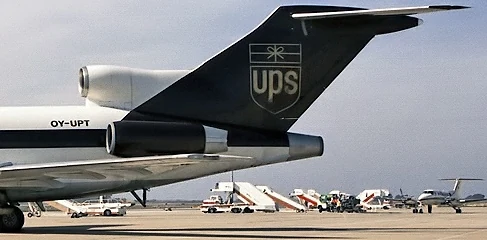
Star Air for UPS 727-22C(QF) OY-UPT · Rolls-Royce Tay conversionPedro Aragão · detail crop · CC BY-SA 3.0 Fuselage length · 40.59 m
Overall length for the 727 freighter conversions is 40.59 m. Short-fuselage 727-100QF example · 133 ft 2 in.
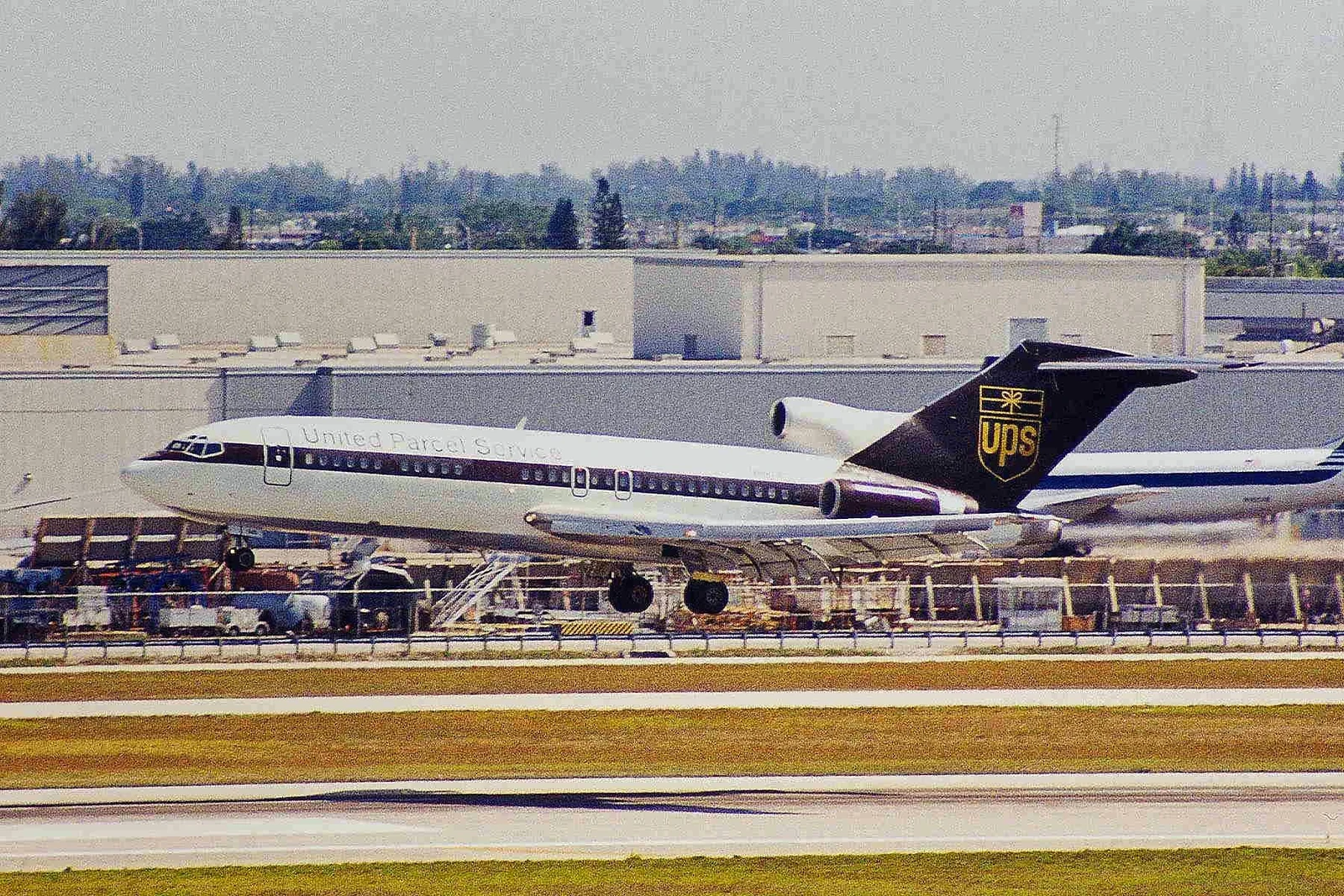
Short fuselage · UPS 727-25C Quiet Freighter N946UPKen Fielding · resized · WebP · CC BY-SA 3.0


Boeing 727 Family Fuselage and Cabin Architecture
Boeing 727 Family fuselage design defines the usable cabin width, door layout, cargo volume, stretch potential, and airline cabin flexibility across 727-100, 727-200, 727-200 Advanced, 727 Freighter.
Boeing 727 Family Wing and High-Lift System
Boeing 727 Family wing design is central to runway performance, cruise efficiency, fuel capacity, and the family improvement path across its variants.
Boeing 727 Family Landing Gear and Braking System
Boeing 727 Family landing gear and braking architecture support the aircraft's weight growth, field performance, pavement loading, and maintenance profile.
Boeing 727 Family Flight Deck and Avionics
Boeing 727 Family cockpit architecture reflects the manufacturer's operating philosophy, training commonality, display technology, and automation level.
Boeing 727 Family Materials and Structural Design
Boeing 727 Family structural design balances weight, fatigue life, corrosion resistance, repairability, production cost, and the technology level of its generation.
Boeing 727 Family Cargo and Cabin Systems
Boeing 727 Family cargo and cabin systems affect payload, turnaround, passenger comfort, conversion potential, and airline route economics.
Technical notes
Design notes
- Engine sub-variants can represent thrust rating, combustor standard, software standard, or installation differences rather than a fully separate hardware family.
- Use aircraft subtype, operator fleet data, and registration-level records before identifying a specific airframe engine.
Advantages
- Precise engine sub-variant lookup is available for this model.
Limitations
- Some planned, development, or military configurations may require certificate-level confirmation before operational use.
Variant Technical Profile
727 freighter conversions is a specific configuration within Boeing 727 Family, developed to cover a defined capacity, range, payload, or mission requirement inside the wider family.
727 freighter conversions is positioned as a capacity/range-specific solution within the freighter segment, serving routes better matched than sibling variants.
Technical features
- 727 freighter conversions: Cargo door and floor loading · structure. Main-deck doors, reinforced floors, and cargo loading systems define usable freight capability.
- 727 freighter conversions: Payload-volume balance · range_payload. The aircraft must balance container volume, structural payload, and range for express or general cargo.
- 727 freighter conversions: Freighter conversion economics · maintenance. Passenger-to-freighter variants depend on feedstock price, engine life, and structural condition.
- 727 freighter conversions: Belly and main-deck logistics · operational_efficiency. ULD compatibility, loading height, and turnaround flow shape cargo network efficiency.
- 727 freighter conversions: Engine maintenance sensitivity · engine. Cargo operators often prioritize durable engines and predictable maintenance cost over passenger cabin features.
Advantages
- Provides a more precise capacity or range match within the family.
- Retains training, maintenance, and parts commonality with sibling variants.
- Lets operators tune engine, cabin, and payload choices to route needs.
Weaknesses
- Configuration identification complexity. Visually similar aircraft can differ materially by engine, weight standard, cabin layout, and conversion status.
- Generation-dependent economics. Older generations usually trail newer designs in fuel burn, noise, avionics, or maintenance intervals.
- Market-fit limits. Every variant has an ideal capacity and range band; outside it, load factor, range, or cost can become limiting.
Markets
- Network airline trunk or feeder markets
- Leasing and fleet replacement markets
- Regional, domestic, or international airline markets
Operators
- Full-service network airlines
- Low-cost or leisure airlines
- Cargo, government, or special-mission operators
Routes and missions
- High-frequency short or medium-haul trunk routes
- Medium-density long-haul or cross-regional routes
- Express and general air-cargo networks
Sibling comparison
- smaller sibling variants. Usually provides more seats, cargo volume, or thrust demand, but can be harder to fill on thinner routes.
- larger or longer-range sibling variants. Usually has lower acquisition and operating exposure, but less range, payload, or growth margin.
From the archive
Loading photographs…