Home/Encyclopedia/Lockheed/C-5 Galaxy family

C-5 Galaxy family

C-5 Galaxy family covers military strategic transport aircraft in the Lockheed portfolio. The entry is imported from the McDonnell Douglas / Lockheed / Bombardier technical workbook and organized by family and derivative variant.

Models at a glance

C-5A/B/C

C-5A/B/C is a military strategic transport derivative within C-5 Galaxy family. Market positioning: Outsize strategic airlift.

Entered service
1970C-5A
Length
75.54 m
Wingspan
67.89 m
Published range
6,320 nmUSAF published empty range
Range at stated payload
Unavailable
Maximum cargo payload
122.47 tC-5A / B
Engine options
TF39Published C-5A and C-5B powerplant ratings
Main landing gear
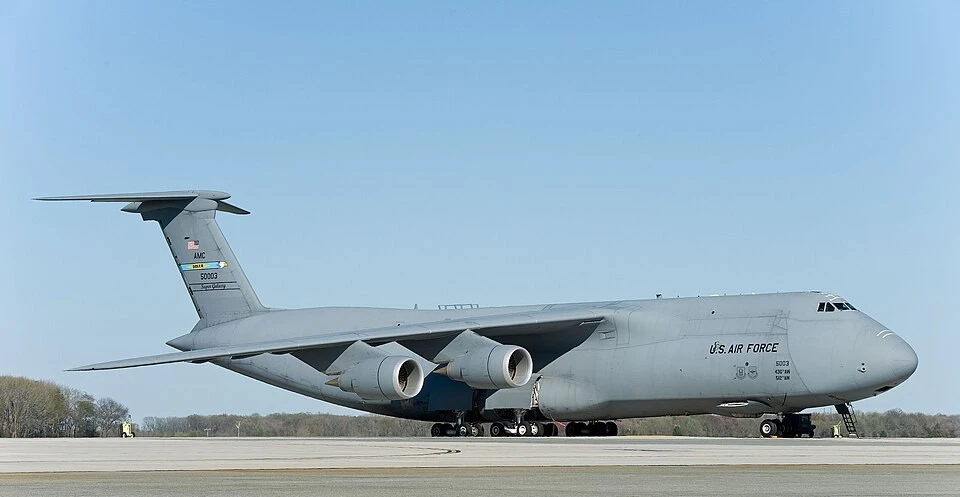
Four 6-wheel main bogies

C-5M Super Galaxy

C-5M Super Galaxy is a military strategic transport derivative within C-5 Galaxy family. Market positioning: Modernized C-5.

Entered service
Unavailable
Length
75.54 m
Wingspan
67.89 m
Published range
2,150 nmUSAF example with 127.46 t before offload
Range at stated payload
2,150 nmWith 127.46 t before offload
Maximum cargo payload
127.46 t
Engine options
F138-GE-100
Main landing gear
Four 6-wheel main bogies

Identification

Main bogies
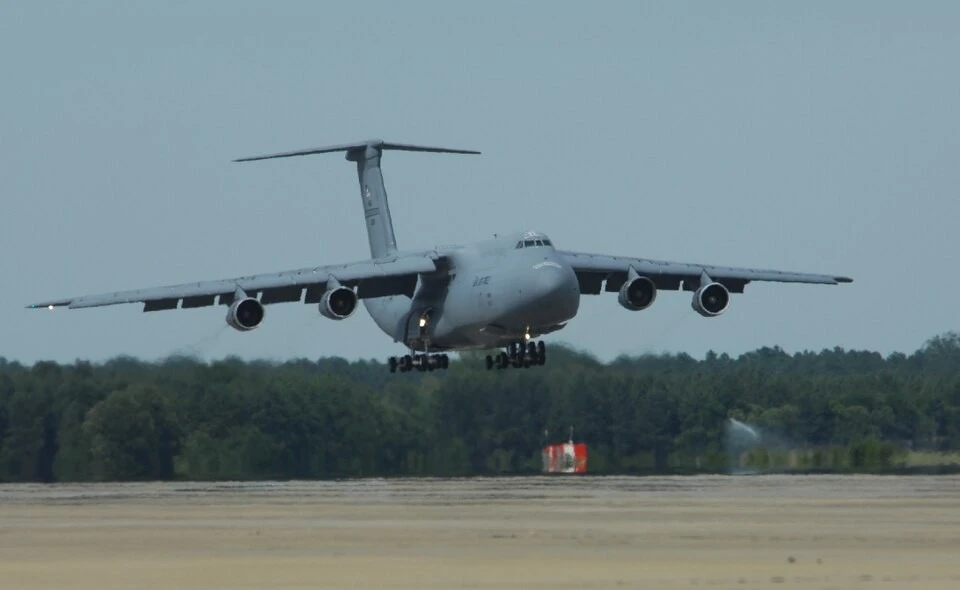
With the wheels down, look for two main bogies along the near side of the fuselage. Each of the four main bogies carries six wheels.
Nose visor
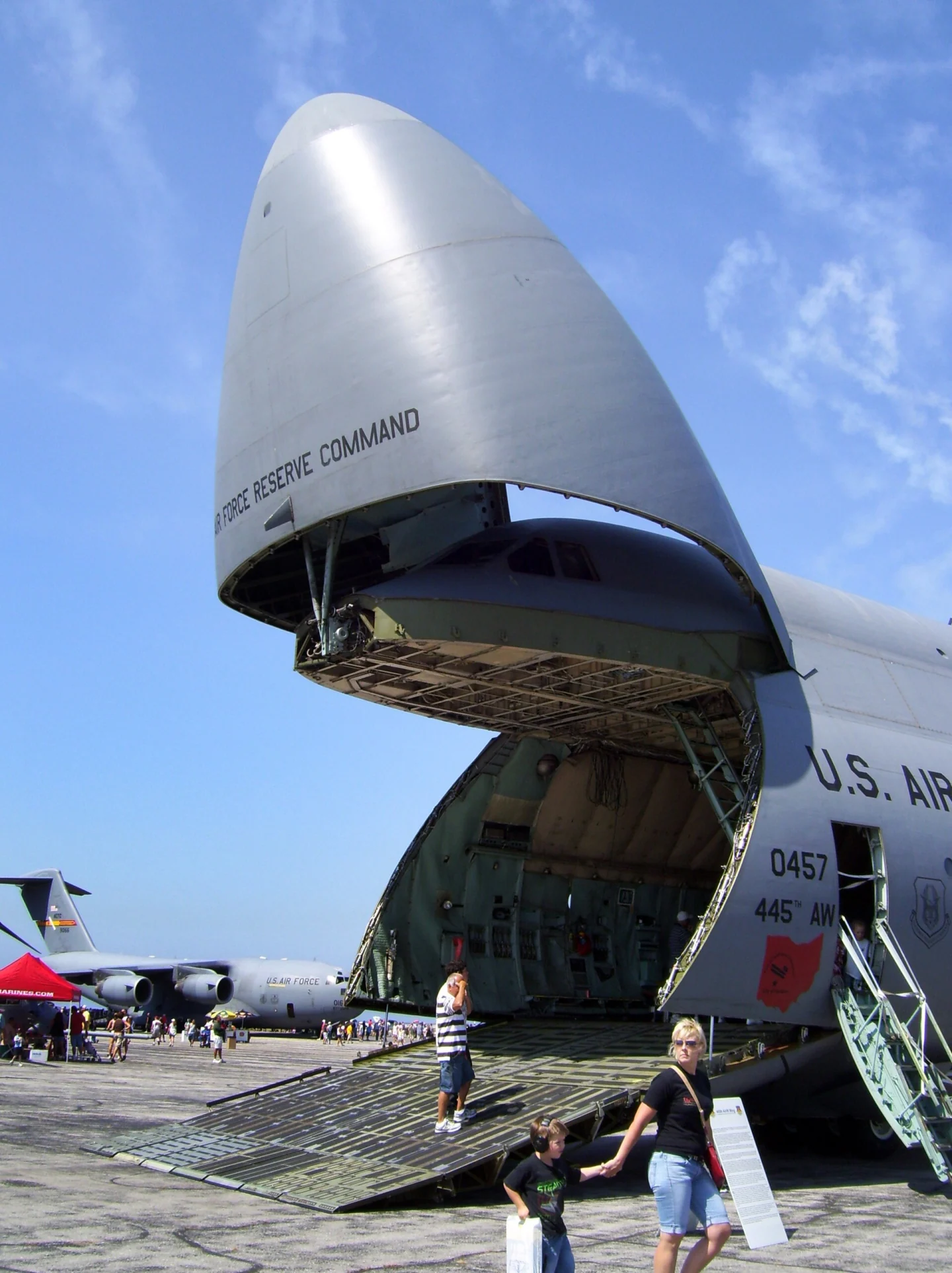
From a forward quarter on the ramp, look for the join of the hinged nose below the cockpit. The C-5 opens its nose and rear cargo door, so a raised nose is a strong clue.

Design & cabins

  • Front and rear cargo access

    The C-5's nose and rear cargo doors allow loading from either end of the main deck.

  • Kneeling multi-wheel landing gear

    The multi-wheel gear can lower the airframe for ground loading and distributes the aircraft's weight.

  • TF39 to C-5M CF6/F138 re-engining

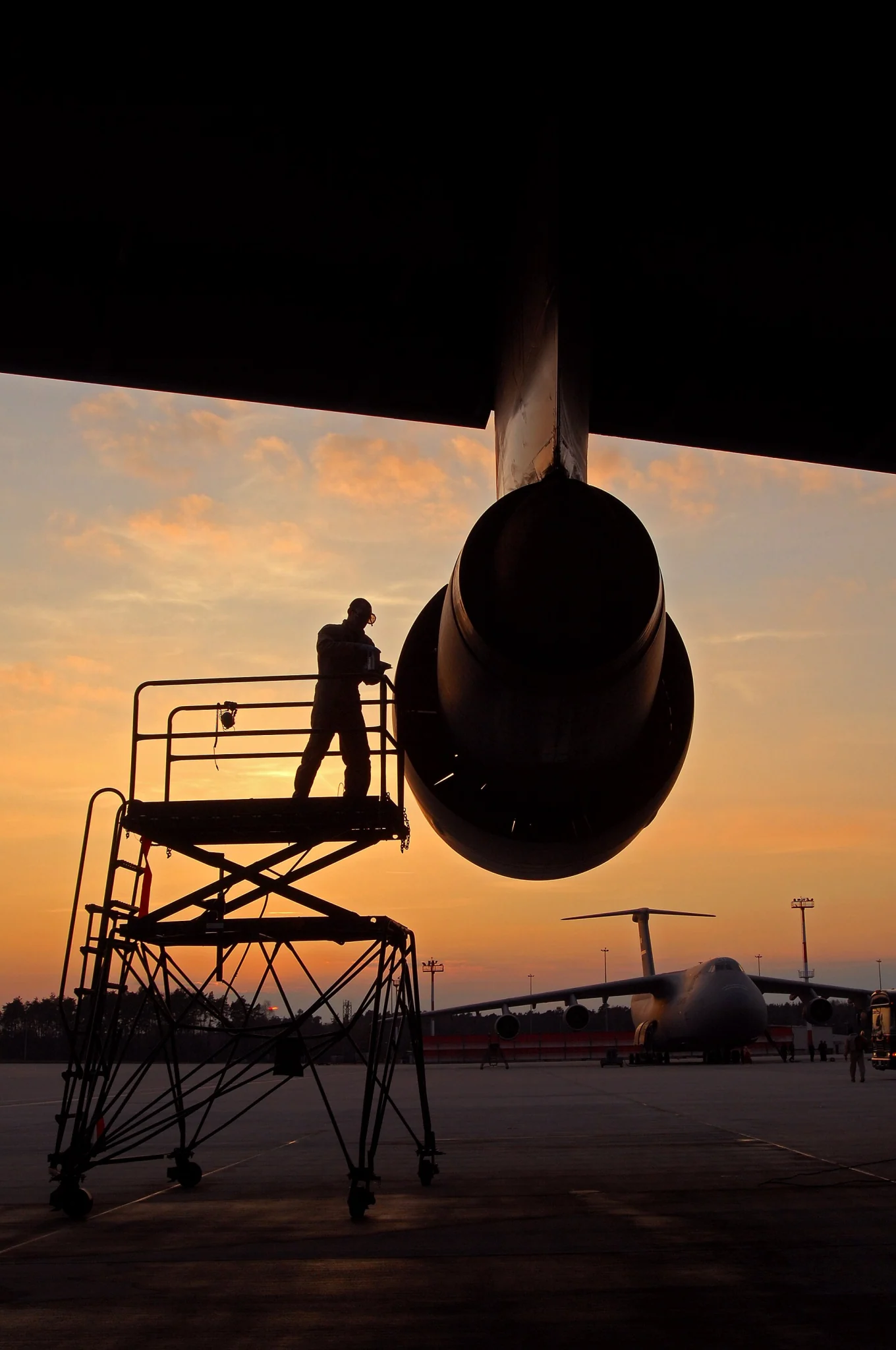
    The C-5M uses F138 engines derived from the GE CF6, replacing the original TF39 installation as part of the modernisation programme.

More aircraft systems
  • Flight controls and avionics

    The modernisation programme introduced avionics and maintenance diagnostics to upgraded aircraft.

  • Cabin and cargo

    The cargo deck, floor loading and passenger provisions depend on the transport layout.

  • Landing gear and braking

    The model-specific gear and brake arrangements are documented alongside aircraft weight and servicing.

  • Onboard systems

    Hydraulic and electrical systems support the large airframe, landing gear and cargo equipment.

Engine references
4 × GE TF39 · 4 × GE CF6-80C2 · F138-GE-100
Technical notes

Design notes

  • Very large high-wing strategic airlifter
  • Nose and tail cargo doors for drive-through loading
  • Four large high-bypass turbofans
  • C-5M re-engined with CF6/F138 and avionics upgrades
  • Outsize cargo transport capability

Advantages

  • Very large high-wing strategic airlifter
  • Nose and tail cargo doors for drive-through loading
  • Four large high-bypass turbofans

Limitations

  • Complex and expensive maintenance
  • High airport infrastructure requirements
  • Early reliability problems
  • Very high operating cost
  • Military-only mission economics
Family Technical Profile

C-5 Galaxy family is one of Aircraft manufacturer's platforms in its market segment, balancing capacity, range, airport compatibility, maintenance economics, and mission flexibility.

C-5 Galaxy family serves the narrowbody market with family commonality and multiple configurations.

Technical features

  • C-5 Galaxy family: Single-aisle fuselage efficiency · structure. A narrow fuselage reduces structural weight and airport footprint for high-frequency short and medium routes.
  • C-5 Galaxy family: High-cycle operating design · maintenance. Doors, landing gear, brakes, and systems are optimized for repeated daily sectors and quick turnarounds.
  • C-5 Galaxy family: Wing and high-lift devices · aerodynamics. Flaps, slats, and wingtip devices balance runway performance with cruise efficiency.
  • C-5 Galaxy family: Engine generation changes · engine. Engine nacelle, thrust rating, fuel burn, and noise standards define each production generation.
  • C-5 Galaxy family: Fleet commonality · operational_efficiency. Common flight decks and maintenance practices reduce training and support cost across subfleets.

Advantages

  • One platform can cover several capacity and mission bands.
  • Family design reduces training, maintenance, and spares complexity.
  • Engine, wingtip, avionics, or structural upgrades can extend lifecycle value.

Weaknesses

  • Configuration identification complexity. Visually similar aircraft can differ materially by engine, weight standard, cabin layout, and conversion status.
  • Generation-dependent economics. Older generations usually trail newer designs in fuel burn, noise, avionics, or maintenance intervals.
  • Market-fit limits. Every variant has an ideal capacity and range band; outside it, load factor, range, or cost can become limiting.

Markets

  • Network airline trunk or feeder markets
  • Leasing and fleet replacement markets
  • Regional, domestic, or international airline markets

Operators

  • Full-service network airlines
  • Low-cost or leisure airlines
  • Cargo, government, or special-mission operators

Routes and missions

  • High-frequency short or medium-haul trunk routes
  • Medium-density long-haul or cross-regional routes
  • Fleet replacement, supplementation, or special missions
Sources