KC-767
The KC-767 is Boeing's early international tanker and transport derived from the 767. Italy and Japan received variants of the program before the later KC-46A entered service.
- Length
- 48.5 m
- Wingspan
- 47.6 m
- Engine options
- CF6-80C2
- Published range
- 3,888 nmiJapan Air Self-Defense Force · about 7,200 km at 30 t payload
Identification
Use these features to recognise the Boeing 767 Family. Check the aircraft or programme record for the KC-767 designation.
- Main landing gear
- In a side view with the gear down, count two axles on the main truck nearest the camera. A 777 main truck has three.
- Cabin and tips
- Compare the slim widebody and its two underwing engines with the single-aisle 757. The long 767-400ER has swept-back raked tips. Some other 767s have upright retrofit winglets.
Winglets alone do not establish which 767 variant you are seeing.
Compare models
Comparing KC-767 with KC-46.
| Specification | KC-767 | KC-46 |
|---|---|---|
| Length | 48.5 m | 50.44 m |
| Wingspan | 47.6 m | 47.57 m |
| Maximum take-off weight | 176 tApproximate Japanese service figure | 188.24 t |
| Maximum payload | 30 tPublished KC-767A cargo configuration example | 29.48 tPublished maximum cargo capacity |
| Fuel tank capacity | Unavailable | 118,180 LBoeing published design-era tank volume · 31,220 US gal |
| Engine options | CF6-80C2 | PW4062 |
| Typical two-class seats | Unavailable | Unavailable |
| Published range | 3,888 nmiJapan Air Self-Defense Force · about 7,200 km at 30 t payload | 6,385 nmi |
A dash indicates that a verified figure is unavailable. Figures follow the configuration specified by each source.
Comparison sources
- Japan Air Self-Defense Force · KC-767 equipment specificationsKC-767 equipment · dimensions, engines and performance
- Japan Air Self-Defense Force · 1st Tactical Airlift WingEquipment · KC-767 row
- Joint Air Power Competence Centre · NATO Air Transport Capability, KC-767ANATO Air Transport Capability, p. 47 · KC-767A payload row
- US Air Force · Airlift aircraft informationTable A3.8 · KC-46
- U.S. Air Force · KC-46A Pegasus fact sheetGeneral characteristics · Pegasus powerplant
- U.S. Air Mobility Command · KC-46A Pegasus fact sheetGeneral Characteristics · KC-46A Pegasus
- Boeing Frontiers · KC-46A design overview, December 2013–January 2014Boeing Frontiers Vol. XII Issue VIII, p. 30 · Total fuel capacity infographic
Design & cabins
CF6-80C2 installation
See the engine encyclopedia for ratings and aircraft applications.
Featured components & design
Engine installation · CF6-80C2
Published engine installation for the KC-767 is CF6-80C2.
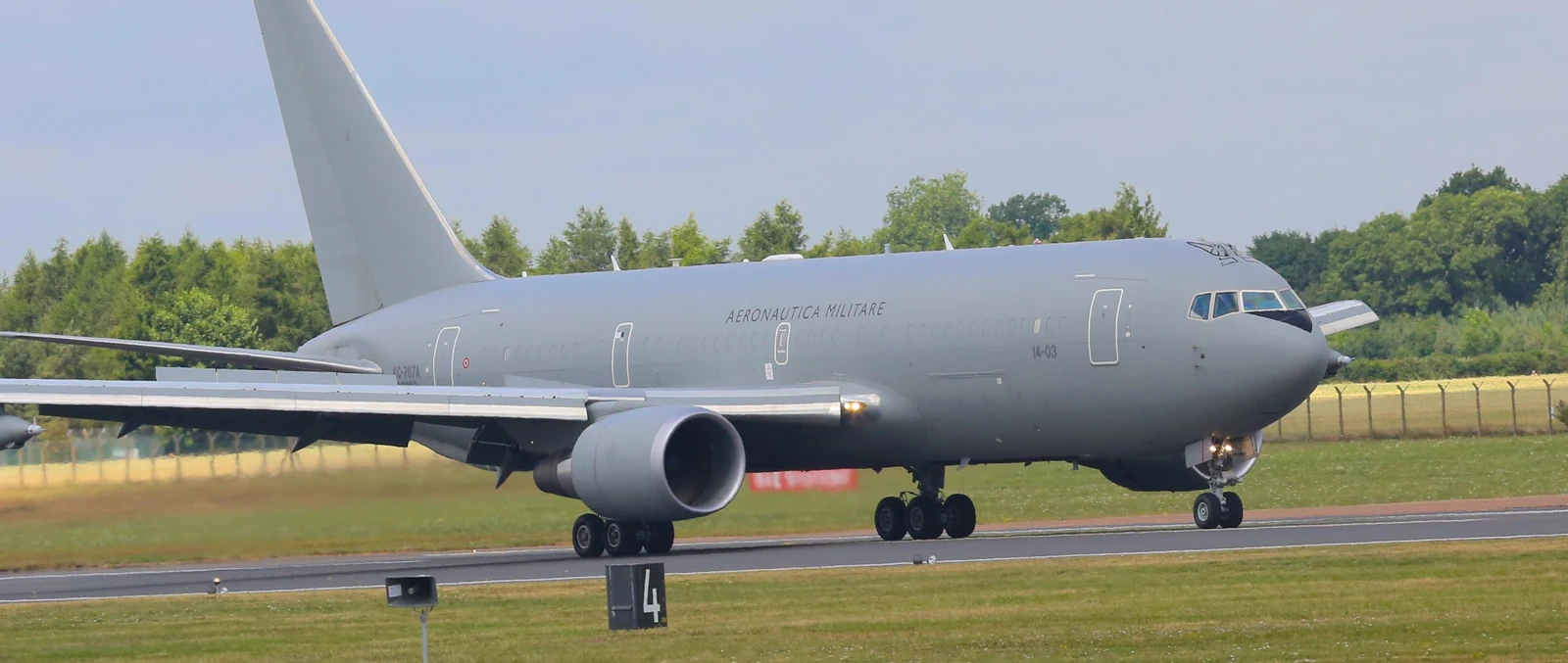
GE CF6-80C2 underwing installation · Italian Air Force KC-767ARonnie Macdonald · detail crop · WebP · CC BY 2.0 Landing gear configuration · KC-767A
Boeing identifies the Italian KC-767A as a 767-200ER-based tanker. Tanker wheel and brake ratings require the applicable documentation.
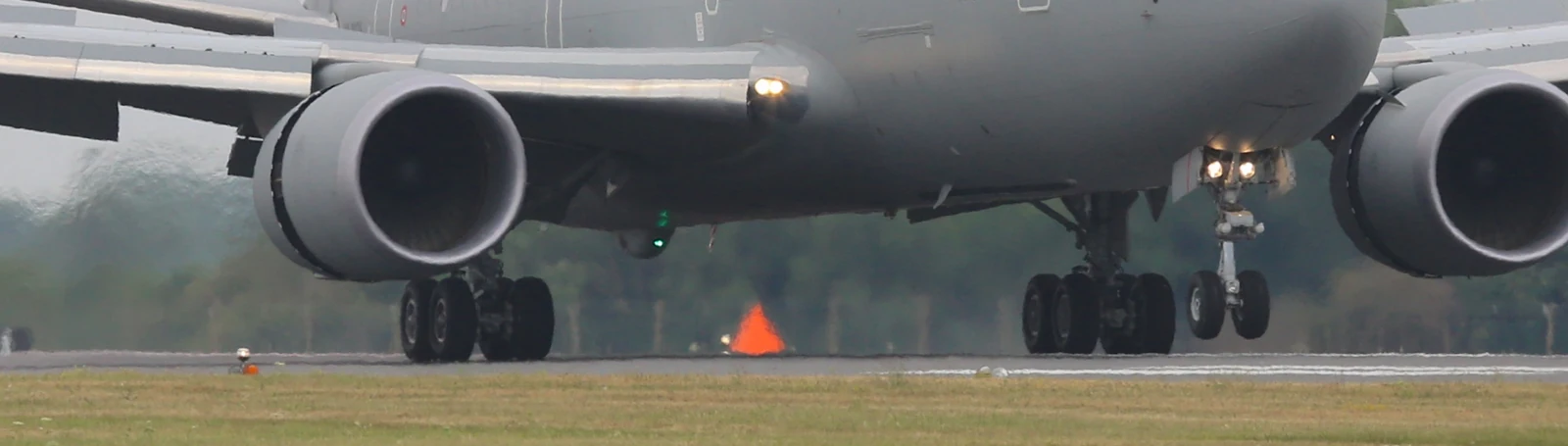
Main landing gear · Italian Air Force KC-767ARonnie Macdonald · detail crop · WebP · CC BY 2.0


Boeing 767 Family Fuselage and Cabin Architecture
Boeing 767 Family fuselage design defines the usable cabin width, door layout, cargo volume, stretch potential, and airline cabin flexibility across 767-200, 767-200ER, 767-300, 767-300ER, 767-300F, 767-400ER, KC-46.
Boeing 767 Family Wing and High-Lift System
Boeing 767 Family wing design is central to runway performance, cruise efficiency, fuel capacity, and the family improvement path across its variants.
Boeing 767 Family Landing Gear and Braking System
Boeing 767 Family landing gear and braking architecture support the aircraft's weight growth, field performance, pavement loading, and maintenance profile.
Boeing 767 Family Flight Deck and Avionics
Boeing 767 Family cockpit architecture reflects the manufacturer's operating philosophy, training commonality, display technology, and automation level.
Boeing 767 Family Materials and Structural Design
Boeing 767 Family structural design balances weight, fatigue life, corrosion resistance, repairability, production cost, and the technology level of its generation.
Boeing 767 Family Cargo and Cabin Systems
Boeing 767 Family cargo and cabin systems affect payload, turnaround, passenger comfort, conversion potential, and airline route economics.
Technical notes
Design notes
- Engine sub-variants can represent thrust rating, combustor standard, software standard, or installation differences rather than a fully separate hardware family.
- Use aircraft subtype, operator fleet data, and registration-level records before identifying a specific airframe engine.
Advantages
- Precise engine sub-variant lookup is available for this model.
Limitations
- Some planned, development, or military configurations may require certificate-level confirmation before operational use.
Variant Technical Profile
KC-767 is a specific configuration within Boeing 767 Family, developed to cover a defined capacity, range, payload, or mission requirement inside the wider family.
KC-767 is positioned as a capacity/range-specific solution within the tanker segment, serving routes better matched than sibling variants.
Technical features
- KC-767: Fuel offload system · engine. Booms, hose-and-drogue pods, and fuel-management systems define refueling capability.
- KC-767: Wide-body or transport base · structure. Tanker derivatives use existing airliner or transport structures to reduce development risk.
- KC-767: Mission avionics · avionics. Operator consoles, cameras, communications, and navigation systems support refueling operations.
- KC-767: Cargo and passenger flexibility · operational_efficiency. Many tankers retain pallet, troop, medical evacuation, or VIP transport capability.
- KC-767: Long endurance · range_payload. Fuel capacity and efficient cruise performance support distant deployments and loiter time.
Advantages
- Provides a more precise capacity or range match within the family.
- Retains training, maintenance, and parts commonality with sibling variants.
- Lets operators tune engine, cabin, and payload choices to route needs.
Weaknesses
- Configuration identification complexity. Visually similar aircraft can differ materially by engine, weight standard, cabin layout, and conversion status.
- Generation-dependent economics. Older generations usually trail newer designs in fuel burn, noise, avionics, or maintenance intervals.
- Market-fit limits. Every variant has an ideal capacity and range band; outside it, load factor, range, or cost can become limiting.
Markets
- Network airline trunk or feeder markets
- Leasing and fleet replacement markets
- Military transport, tanker, and special-mission markets
Operators
- Full-service network airlines
- Low-cost or leisure airlines
- Cargo, government, or special-mission operators
Routes and missions
- High-frequency short or medium-haul trunk routes
- Medium-density long-haul or cross-regional routes
- Fleet replacement, supplementation, or special missions
Sibling comparison
- smaller sibling variants. Usually provides more seats, cargo volume, or thrust demand, but can be harder to fill on thinner routes.
- larger or longer-range sibling variants. Usually has lower acquisition and operating exposure, but less range, payload, or growth margin.
From the archive
Loading photographs…