
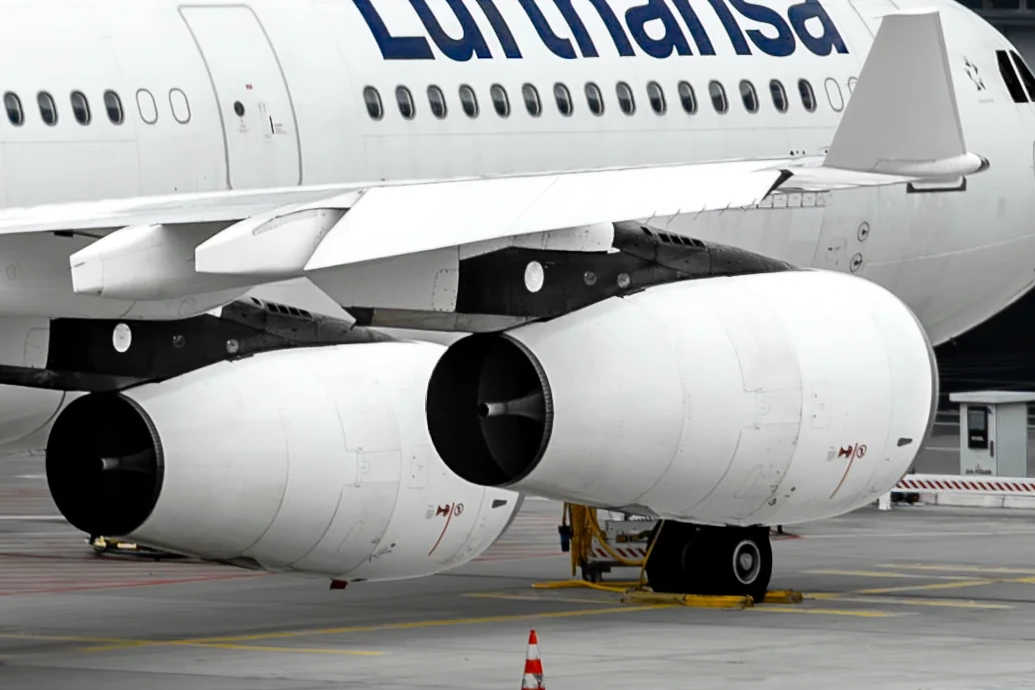
D-AIGX · Lufthansa
Airbus A340-300 · FRA/EDDF ·
CFM56-5C4 belongs to the CFM56-5C branch. Published aircraft certification records pair this rating with A340-213 and A340-313.
Pound-force values from SI ratings are rounded to the nearest whole unit.
| Model | Thrust | Aircraft listed |
|---|---|---|
| CFM56-5C2 | 31,203 lbf = 138.8 kNICAO reference rated thrust · ICAO Engine Emissions Databank · Issue 32B | A340-211 · A340-311 |
| CFM56-5C3 | 32,507 lbf = 144.6 kNICAO reference rated thrust · ICAO Engine Emissions Databank · Issue 32B | A340-312 (related build) |
| CFM56-5C3/F | 32,501 lbf = 144.57 kNTakeoff thrust (5 min) · flat-rated below 30 °C · EASA E.003 · Issue 06 · p. 11 | A340-312 |
| CFM56-5C4 | 34,000 lbf = 151.24 kNTakeoff thrust · EASA E.003 · p. 12 | A340-213 · A340-313 |
| CFM56-5C4/P | 34,000 lbf = 151.24 kNTakeoff thrust · EASA E.003 · p. 12 | A340-213 · A340-313 |
The CFM56-5C was developed for the original four-engine Airbus A340-200 and A340-300.
The flattened inlet is especially apparent on the 737 Classic and Next Generation. These generations use distinct -3 and -7B installations. CFM International CFM56 programme and history
Use the engine data plate or the aircraft’s configuration records to confirm the exact suffix.
Different branches adapt the fan, core and nacelle to the aircraft. The -3 is closely packaged under the 737 Classic wing and the -5C is the A340 branch. CFM International CFM56 programme and history
The CFM56-2 entered commercial service in 1982. The -3 followed with the 737 Classic, and the family later expanded to the A320 and 737 Next Generation. CFM International CFM56 programme and history
The engine type data sheet lists the approved designation and the applicable type design. EASA E.003 · p. 1
Aircraft certification records distinguish ratings, combustor configurations and modifications. The full suffix, including slashes, matters when comparing variants. CFM International CFM56 programme and history
Certification test data are per engine and use the ICAO reference cycle. Fuel-flow values refer to individual test points.
Each example gives lateral, flyover and approach levels for a specific aircraft and engine configuration at its listed maximum takeoff mass.
1 photo tagged CFM56-5C4