Home/Encyclopedia/Embraer/Embraer EMB 110 Bandeirante

Embraer EMB 110 Bandeirante

The EMB 110 Bandeirante is Embraer's early twin-turboprop transport. Its compact airframe served regional airlines and utility operators with PT6A power.

Models at a glance

EMB 110 Bandeirante

The EMB 110 Bandeirante is Embraer's early twin-turboprop transport. Its compact airframe served regional airlines and utility operators with PT6A power.

Entered service
1973
First flight
1972Production EMB 110
Length
15.08 mEmbraer historical specification
Wingspan
15.32 m
Published range
999 nmEmbraer published 1,850 km
Published seating
12Initial EMB 110 configuration
Maximum passenger seats
21EMB 110P2 quick-change passenger configuration
Engine options
PT6A-27 · PT6A-34Fit varies by EMB 110 variant
Main landing gear
1 axle · 1 wheel per side
Sources

Identification

Conventional tail
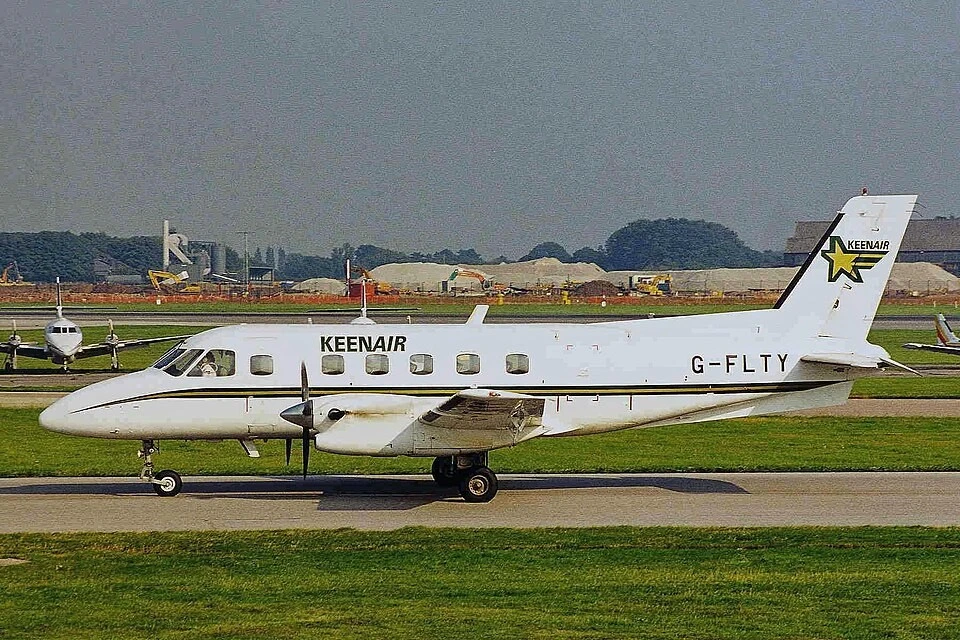
Check the horizontal tailplane near the base of the fin. The later EMB 120 Brasília carries its tailplane high in a T-tail.
Low-wing propeller nacelles
Look for the compact straight-wing airframe and the two turboprop nacelles that house the main gear. Compare the full side view with Embraer's restored examples.

Design & cabins

  • PT6A twin-turboprop installation

    Wing-mounted Pratt & Whitney Canada PT6A engines and tractor propellers power the Bandeirante regional transport.

  • Light regional and utility airframe

    The low-wing EMB 110 was developed into passenger, executive and utility versions, with cabins and doors adapted to each role.

More aircraft systems
  • Powerplant and fuel

    Propeller and engine variants should be compared against the specific EMB 110 model and its documentation.

  • Flight controls and avionics

    The flight-deck reference follows the original regional transport and the equipment fit of individual derivatives.

  • Cabin and cargo

    Passenger and freight layouts use different interior fittings and access. The EMB 111 is a specialised branch of the design.

  • Landing gear and braking

    The retractable tricycle gear and pavement requirements belong to the aircraft's light regional role.

Technical notes

Design notes

  • The production EMB 110 developed from the Bandeirante prototypes and served both civil and military operators.
  • Configuration and capacity differ among the many transport, survey, and patrol versions.

Advantages

  • A compact aircraft suited to lower-demand regional routes and utility work.

Limitations

  • Historic equipment and operating economics should not be compared directly with current regional aircraft.
Family Technical Profile

Embraer EMB 110 Bandeirante is one of Embraer's platforms in its market segment, balancing capacity, range, airport compatibility, maintenance economics, and mission flexibility.

Embraer EMB 110 Bandeirante serves the narrowbody market with family commonality and multiple configurations.

Technical features

  • Embraer EMB 110 Bandeirante: Single-aisle fuselage efficiency · structure. A narrow fuselage reduces structural weight and airport footprint for high-frequency short and medium routes.
  • Embraer EMB 110 Bandeirante: High-cycle operating design · maintenance. Doors, landing gear, brakes, and systems are optimized for repeated daily sectors and quick turnarounds.
  • Embraer EMB 110 Bandeirante: Wing and high-lift devices · aerodynamics. Flaps, slats, and wingtip devices balance runway performance with cruise efficiency.
  • Embraer EMB 110 Bandeirante: Engine generation changes · engine. Engine nacelle, thrust rating, fuel burn, and noise standards define each production generation.
  • Embraer EMB 110 Bandeirante: Fleet commonality · operational_efficiency. Common flight decks and maintenance practices reduce training and support cost across subfleets.

Advantages

  • One platform can cover several capacity and mission bands.
  • Family design reduces training, maintenance, and spares complexity.
  • Engine, wingtip, avionics, or structural upgrades can extend lifecycle value.

Weaknesses

  • Configuration identification complexity. Visually similar aircraft can differ materially by engine, weight standard, cabin layout, and conversion status.
  • Generation-dependent economics. Older generations usually trail newer designs in fuel burn, noise, avionics, or maintenance intervals.
  • Market-fit limits. Every variant has an ideal capacity and range band; outside it, load factor, range, or cost can become limiting.

Markets

  • Network airline trunk or feeder markets
  • Leasing and fleet replacement markets
  • Regional, domestic, or international airline markets

Operators

  • Full-service network airlines
  • Low-cost or leisure airlines
  • Cargo, government, or special-mission operators

Routes and missions

  • High-frequency short or medium-haul trunk routes
  • Medium-density long-haul or cross-regional routes
  • Fleet replacement, supplementation, or special missions
Sources