Home/Encyclopedia/Other manufacturers/Aérospatiale/BAC Concorde

Aérospatiale/BAC Concorde

Concorde was a Franco-British supersonic airliner developed by Sud Aviation, later Aérospatiale, and the British Aircraft Corporation. Its ogival delta wing, movable nose and four Rolls-Royce/SNECMA Olympus 593 turbojets defined the production aircraft.

Models at a glance

Concorde Type 1

Type 1 is the production Concorde described in the airworthiness records. The French and British records distinguish Version 101 and Variant 102.

Length
62.18 m204 ft · museum airframe G-BOAG
Wingspan
25.55 m83 ft 10 in · museum airframe G-BOAG
Engine options
Olympus 593 Mk 610
Main landing gear
Unavailable
Sources
Concorde Type 1 variants

Concorde Type 1 Variant 102

The UK CAA uses Type 1 Variant 102 for the BAC/SNIAS production Concorde covered by its British airworthiness directive.

Length
Unavailable
Wingspan
Unavailable
Engine options
Unavailable
Main landing gear
Unavailable

Concorde Type 1 Version 101

The French investigation identifies Air France production airframe F-BTSC as Concorde Type 1, Version 101.

Length
Unavailable
Wingspan
Unavailable
Engine options
Unavailable
Main landing gear
Unavailable

Identification

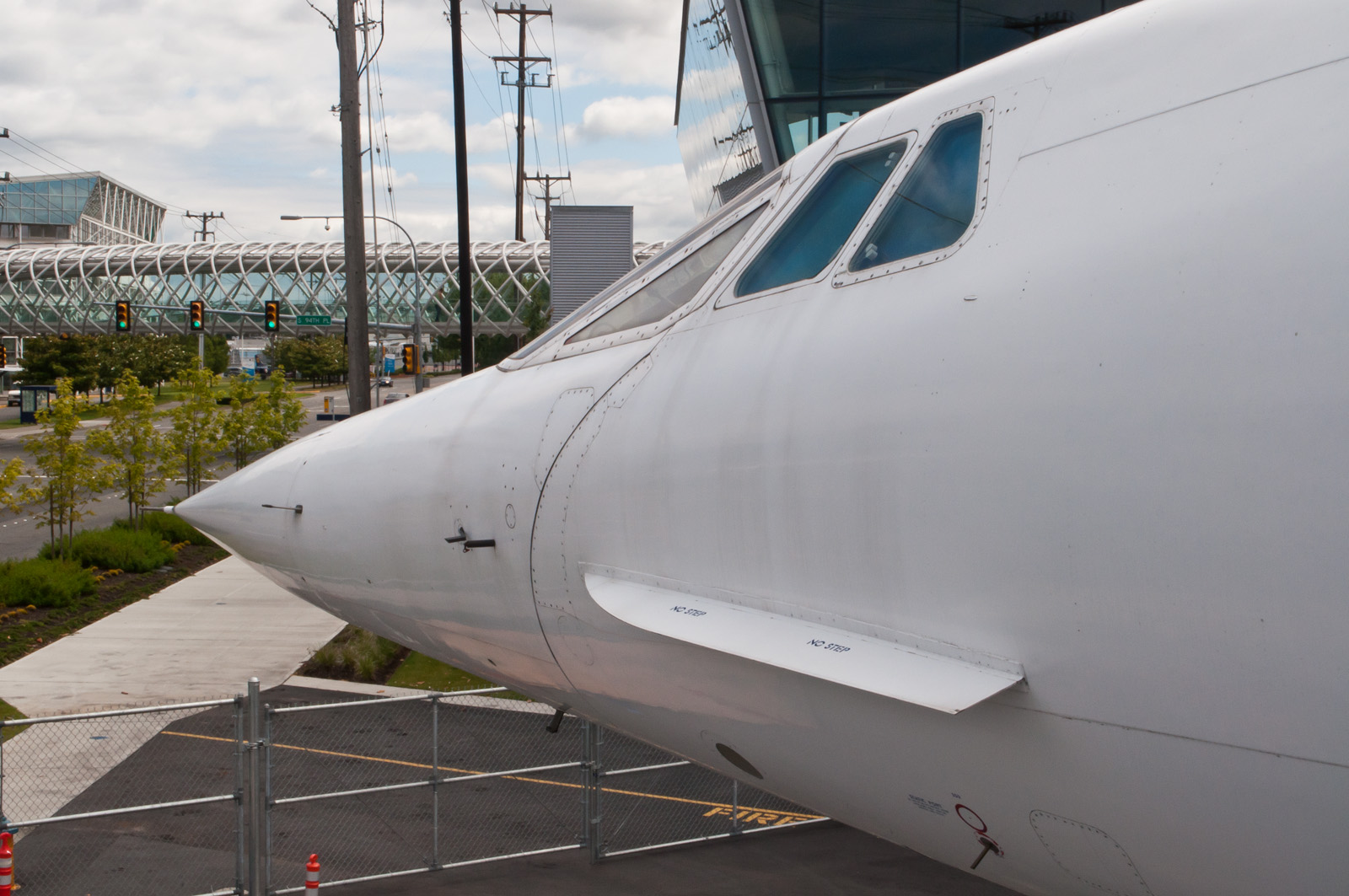
Movable nose and visor
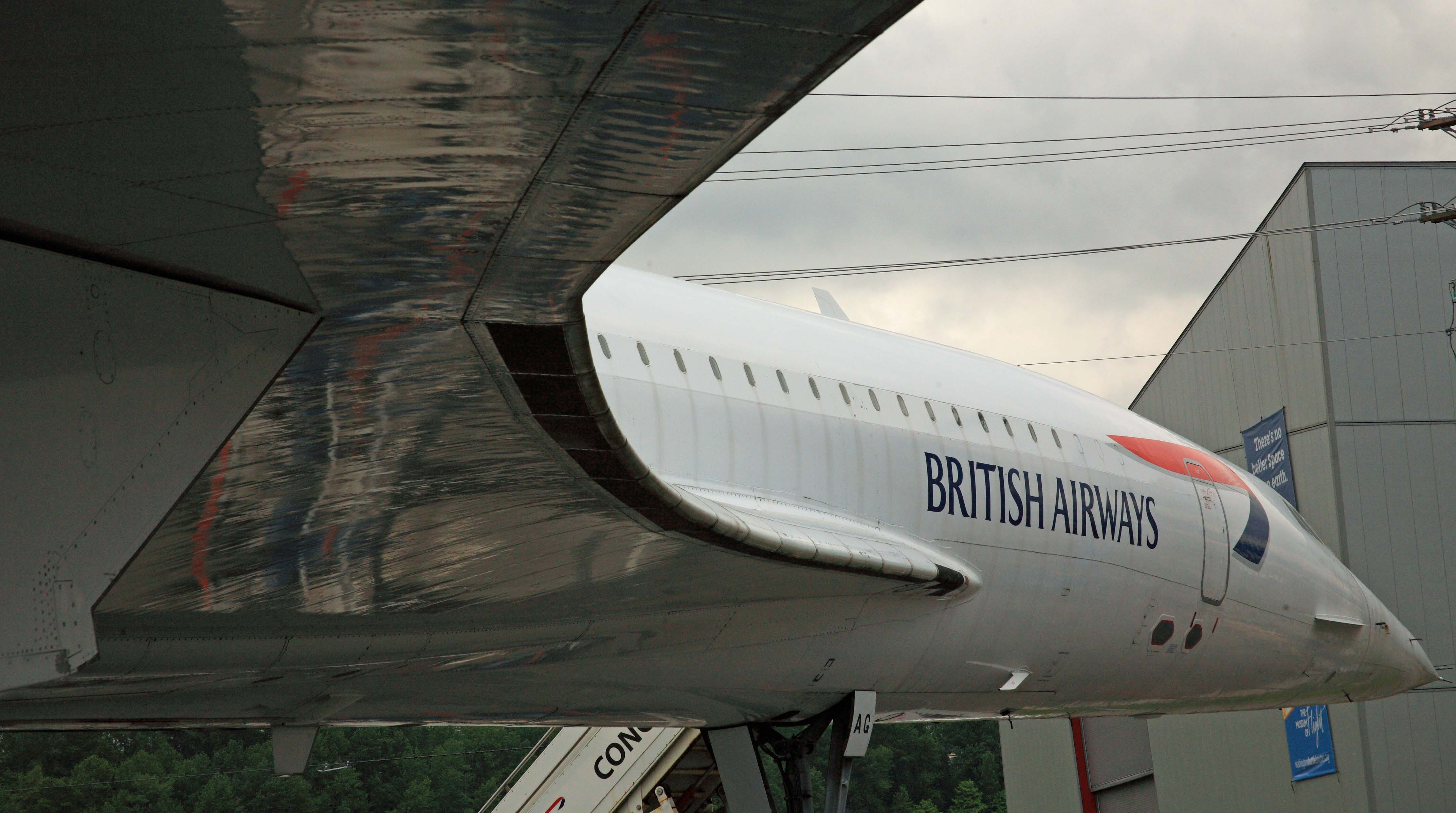
Find the angled joint ahead of the cockpit windows. The hinge lets the pointed nose lower for the crew’s view during take-off and landing. The museum photograph shows the nose raised.
Ogival delta wing
Follow the long curved leading edge toward the fuselage. Its sweep changes continuously along the span, forming the distinctive ogival delta.

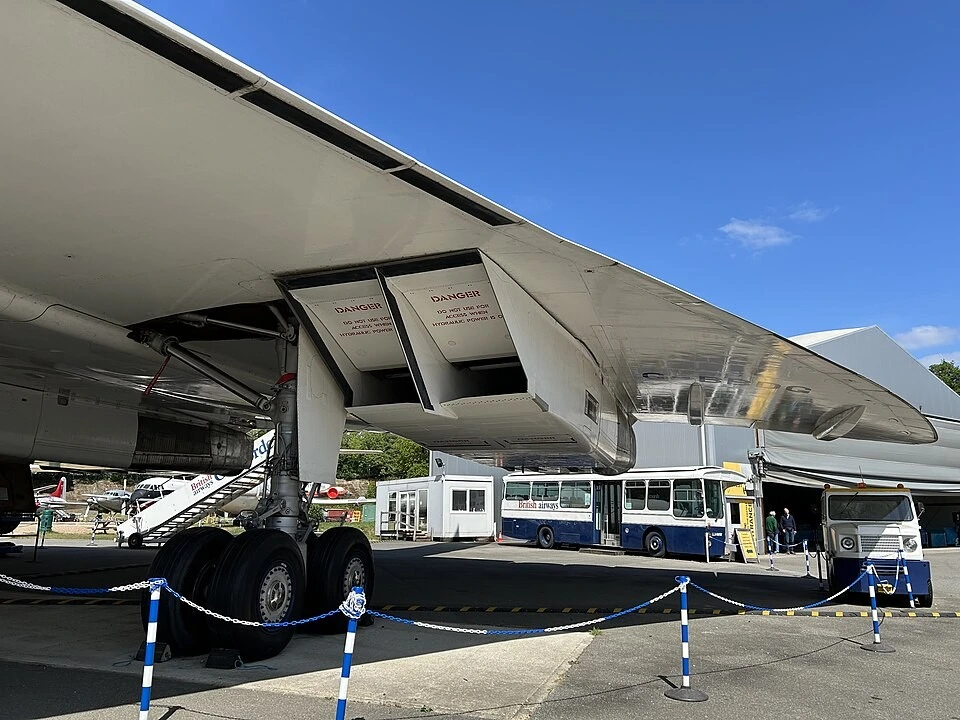
These photographs show G-BOAG, airframe 214, preserved at the Museum of Flight. The wing and nose identify the type. Use airframe records for the exact Type 1 variant.

Select a circle to see the marked area up close.

G-BOAG movable nose

G-BOAG · Museum of Flight, Boeing Field, Seattle · 28 July 2012
G-BOAG · Museum of Flight, Boeing Field, Seattle · 28 July 2012Photo by InSapphoWeTrust
Photo sourceCC BY-SA 2.0

G-BOAG ogival delta

G-BOAG · Museum of Flight, Boeing Field, Seattle · 23 May 2011
G-BOAG · Museum of Flight, Boeing Field, Seattle · 23 May 2011Photo by Frank Kovalchek
Photo sourceCC BY 2.0

Design & cabins

Technical notes

Design notes

  • The slender nose could be lowered for forward visibility during take-off and landing, then raised to restore the streamlined profile.
  • The curved leading edge of the ogival delta wing forms lift-generating vortices at low speeds. The wing has no conventional high-lift flap system.
  • The Museum of Flight preserves British Airways G-BOAG, serial 214, in Seattle. It is a production aircraft and is known as Alpha Golf.

Advantages

  • The production aircraft cruised at about Mach 2.

Limitations

  • The nose setting visible in a photograph depends on the operation or display position.
Family Technical Profile

Aérospatiale/BAC Concorde is one of Aircraft manufacturer's platforms in its market segment, balancing capacity, range, airport compatibility, maintenance economics, and mission flexibility.

Aérospatiale/BAC Concorde serves the narrowbody market with family commonality and multiple configurations.

Technical features

  • Aérospatiale/BAC Concorde: Single-aisle fuselage efficiency · structure. A narrow fuselage reduces structural weight and airport footprint for high-frequency short and medium routes.
  • Aérospatiale/BAC Concorde: High-cycle operating design · maintenance. Doors, landing gear, brakes, and systems are optimized for repeated daily sectors and quick turnarounds.
  • Aérospatiale/BAC Concorde: Wing and high-lift devices · aerodynamics. Flaps, slats, and wingtip devices balance runway performance with cruise efficiency.
  • Aérospatiale/BAC Concorde: Engine generation changes · engine. Engine nacelle, thrust rating, fuel burn, and noise standards define each production generation.
  • Aérospatiale/BAC Concorde: Fleet commonality · operational_efficiency. Common flight decks and maintenance practices reduce training and support cost across subfleets.

Advantages

  • One platform can cover several capacity and mission bands.
  • Family design reduces training, maintenance, and spares complexity.
  • Engine, wingtip, avionics, or structural upgrades can extend lifecycle value.

Weaknesses

  • Configuration identification complexity. Visually similar aircraft can differ materially by engine, weight standard, cabin layout, and conversion status.
  • Generation-dependent economics. Older generations usually trail newer designs in fuel burn, noise, avionics, or maintenance intervals.
  • Market-fit limits. Every variant has an ideal capacity and range band; outside it, load factor, range, or cost can become limiting.

Markets

  • Network airline trunk or feeder markets
  • Leasing and fleet replacement markets
  • Regional, domestic, or international airline markets

Operators

  • Full-service network airlines
  • Low-cost or leisure airlines
  • Cargo, government, or special-mission operators

Routes and missions

  • High-frequency short or medium-haul trunk routes
  • Medium-density long-haul or cross-regional routes
  • Fleet replacement, supplementation, or special missions
Key terms
Droop nose

The pointed, hinged nose section lowers to improve the crew's forward view at low speeds.

  • This system is part of the A330 operating architecture and interacts with flight-control, electrical, hydraulic, engine, or environmental systems.
  • Exact configuration varies across A330ceo, A330neo, freighter, and military derivatives.

Advantages. Improves operational reliability, economics, or mission flexibility. Uses a mature wide-body systems architecture to reduce operational risk.

Limitations. System complexity increases maintenance, training, and troubleshooting demands. Airline configuration and engine choice can change real-world performance.

Ogival delta wing

A delta planform with smoothly changing leading-edge sweep.

  • This system is part of the A330 operating architecture and interacts with flight-control, electrical, hydraulic, engine, or environmental systems.
  • Exact configuration varies across A330ceo, A330neo, freighter, and military derivatives.

Advantages. Improves operational reliability, economics, or mission flexibility. Uses a mature wide-body systems architecture to reduce operational risk.

Limitations. System complexity increases maintenance, training, and troubleshooting demands. Airline configuration and engine choice can change real-world performance.

Sources