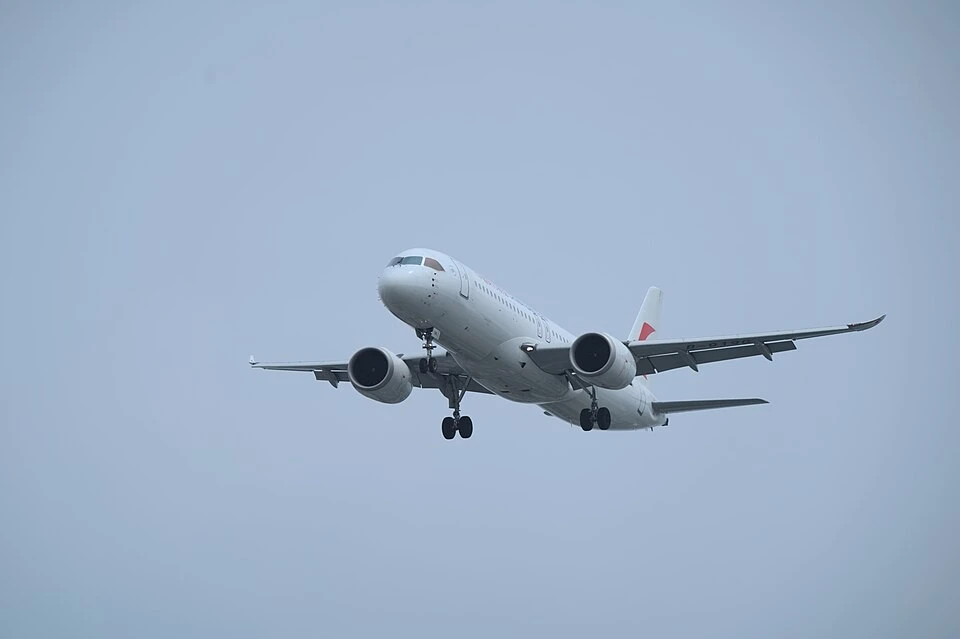
C919
The C919 is COMAC's single-aisle passenger aircraft, positioned above the C909 in capacity. The baseline commercial aircraft uses CFM LEAP-1C engines.
- Entered service
- 2023
- First flight
- 5 May 2017
- Length
- 38.9 m
- Wingspan
- 35.8 m
- Published range
- 2,200–3,000 nmAdvertised variants
- Typical two-class seats
- 158Manufacturer mixed-class layout.
- Published seating
- 158–192
- Engine options
- LEAP-1C
- Main landing gear
- 1 axle · 2 wheels per side
Sources
- COMAC product briefing · Paris Air Show, June 2025Paris 2025 · C919 basic configuration
- COMAC · C919 airport planning manual, Issue 003§02-02 · STD and ER airframe
- COMAC · C919 first commercial flight and programme chronologyChina Eastern MU9191 · Commercial service entry
- COMAC Jetliner · C919 first flight, May 2017C919 programme chronology
- COMAC · C919 airport planning manual, Issue 003§02-09 · Landing gear
- COMAC · C919 airport planning manual, Issue 003§02-01, Issue 002, pp. 1–2 and cabin arrangements
C919 variants
C919 development
The C919 development entry covers proposed engine alternatives to its original LEAP-1C installation, including the Chinese CJ-1000A development programme.
- Length
- Unavailable
- Wingspan
- Unavailable
- Published range
- Unavailable
- Range at stated payload
- Unavailable
- Typical two-class seats
- Unavailable
- Engine options
- CJ-1000AProposed C919 powerplant under development
- Main landing gear
- Unavailable
Sources
- Shanghai municipal portal, 2023 Shanghai airshow engine programme reportCJ-1000A proposed C919 powerplant at the Shanghai airshow
C919 ER
The extended-range configuration raises the C919's maximum design take-off weight to 78,900 kg. COMAC's airport planning manual gives 3,011 nmi with the same 15,010 kg standard payload used for the STD figure.
- Length
- 38.9 m
- Wingspan
- 35.8 m
- Published range
- 3,011 nm15,010 kg payload, standard day, still air.
- Range at stated payload
- 2,118 nm18,900 kg maximum payload, same planning conditions.
- Typical two-class seats
- 158Manufacturer mixed-class layout.
- Engine options
- LEAP-1C
- Main landing gear
- Unavailable
Sources
- COMAC · C919 airport planning manual, Issue 003§02-01 Issue 002, p. 2 and §02-02 three-view drawing
- COMAC · C919 airport planning manual, Issue 003§03-02 Issue 001, p. 1, table 1 and fig. 1
C919 high-thrust
This label groups higher-thrust LEAP-1C ratings discussed for the C919 single-aisle platform. C919 remains the aircraft family designation.
- Length
- Unavailable
- Wingspan
- Unavailable
- Engine options
- LEAP-1C30Engine rating group
- Main landing gear
- Unavailable
Sources
- EASA.E.110 LEAP-1A and LEAP-1C engine type certificate, Issue 13LEAP-1C30 engine rating, C919 catalogue engine installation group
C919 later certification
The C919 is COMAC's single-aisle aircraft with a LEAP-1C installation in commercial service. The later-certification label refers to engine or installation records within the aircraft programme.
- Length
- Unavailable
- Wingspan
- Unavailable
- Engine options
- LEAP-1C30B1Engine certification group
- Main landing gear
- Unavailable
Sources
- EASA.E.110 LEAP-1A and LEAP-1C engine type certificate, Issue 13LEAP-1C30B1 engine rating, C919 catalogue engine installation group
C919 STD
COMAC's standard-range C919 configuration has a 75,100 kg maximum design take-off weight. Its airport planning manual gives a range of 2,235 nmi with the standard 15,010 kg payload.
- Length
- 38.9 m
- Wingspan
- 35.8 m
- Published range
- 2,235 nm15,010 kg payload, standard day, still air.
- Range at stated payload
- 1,420 nm18,900 kg maximum payload, same planning conditions.
- Typical two-class seats
- 158Manufacturer mixed-class layout.
- Engine options
- LEAP-1C
- Main landing gear
- Unavailable
Sources
- COMAC · C919 airport planning manual, Issue 003§02-01 Issue 002, p. 2 and §02-02 three-view drawing
- COMAC · C919 airport planning manual, Issue 003§03-02 Issue 001, p. 1, table 1 and fig. 1