Home/Encyclopedia/Other manufacturers/BAe 146 / Avro RJ Family

BAe 146 / Avro RJ Family

British Aerospace's BAe 146 and the later Avro RJ share a high wing, four underwing engines and a T-tail. Both series use three matching fuselage lengths.

Models at a glance

Avro RJ70

The RJ70 is the short Avro 146-RJ. It has the same 26.19 m overall length as the BAe 146-100 and uses four LF507-1F turbofans.

Length
26.19 m
Wingspan
26.34 m
Engine options
4 × LF507-1F
Main landing gear
Unavailable
Sources

Avro RJ85

The RJ85 is the middle-length Avro 146-RJ at 28.55 m. Its dimensions overlap the BAe 146-200, while its certified engine is the LF507-1F.

Length
28.55 m
Wingspan
26.34 m
Engine options
4 × LF507-1F
Main landing gear
Unavailable
Sources

Avro RJ100

The RJ100 uses the 31.00 m Avro 146-RJ airframe and four LF507-1F turbofans. The RJ115 has the same external dimensions, with different approved exits and seating.

Length
31 m
Wingspan
26.34 m
Engine options
4 × LF507-1F
Main landing gear
Unavailable
Sources
Avro RJ100 variants

Avro RJ115

The separately certified RJ115 shares the 31.00 m fuselage and LF507-1F installation of the RJ100. EASA lists a Type III exit under each wing and a higher approved seating limit for the RJ115.

Length
31 m
Wingspan
26.34 m
Engine options
4 × LF507-1F
Main landing gear
Unavailable
Sources

BAe 146-100

The 26.19 m Series 100 is the shortest BAe 146. It shares the basic high-wing and four-engine layout with the longer -200 and -300.

Length
26.19 m
Wingspan
26.34 m
Engine options
4 × ALF502 R-3 · R-3A · R-5
Main landing gear
Unavailable
Sources

BAe 146-200

The Series 200 has a 28.55 m fuselage. EASA documents a Quick Change option for this length, allowing passenger or freight operation with the appropriate fit.

Length
28.55 m
Wingspan
26.34 m
Engine options
4 × ALF502 R-3A · R-5
Main landing gear
Unavailable
Sources

BAe 146-300

The Series 300 is the longest BAe 146 at 31.00 m. Its certificate allows LF507-1H engines as well as the ALF502 configurations.

Length
31 m
Wingspan
26.34 m
Engine options
4 × ALF502 R-3A · R-5 · 4 × LF507-1H
Main landing gear
Unavailable
Sources

Identification

High wing, four nacelles
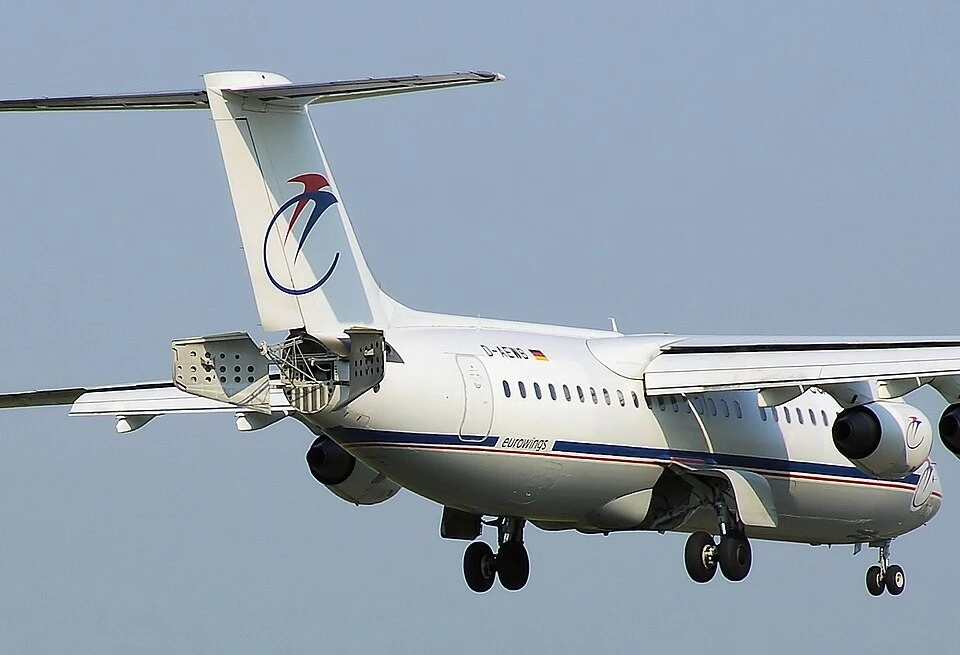
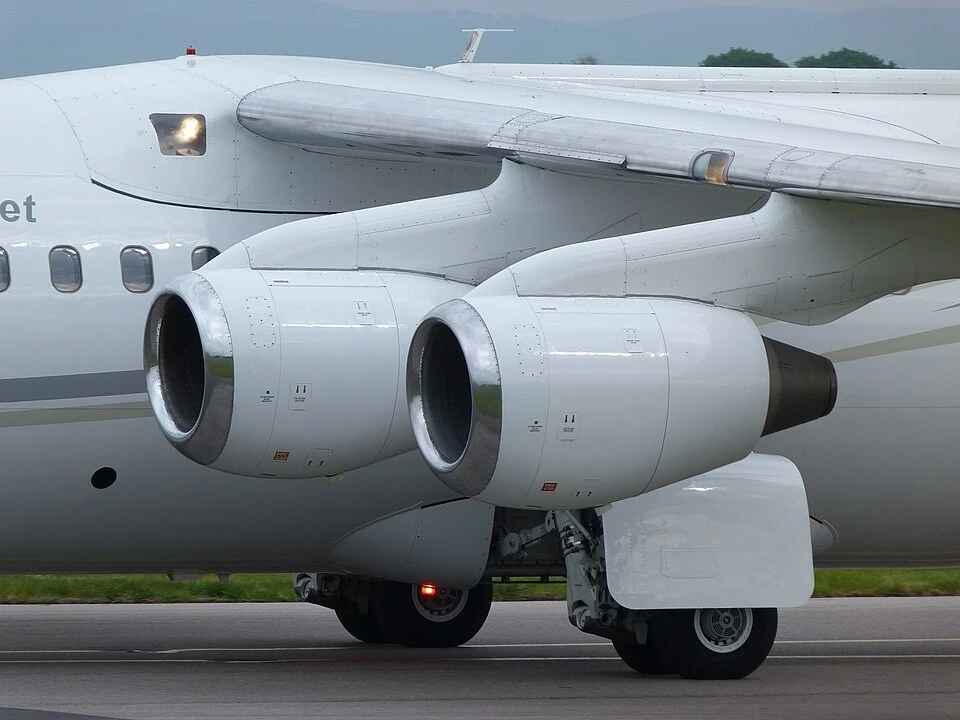
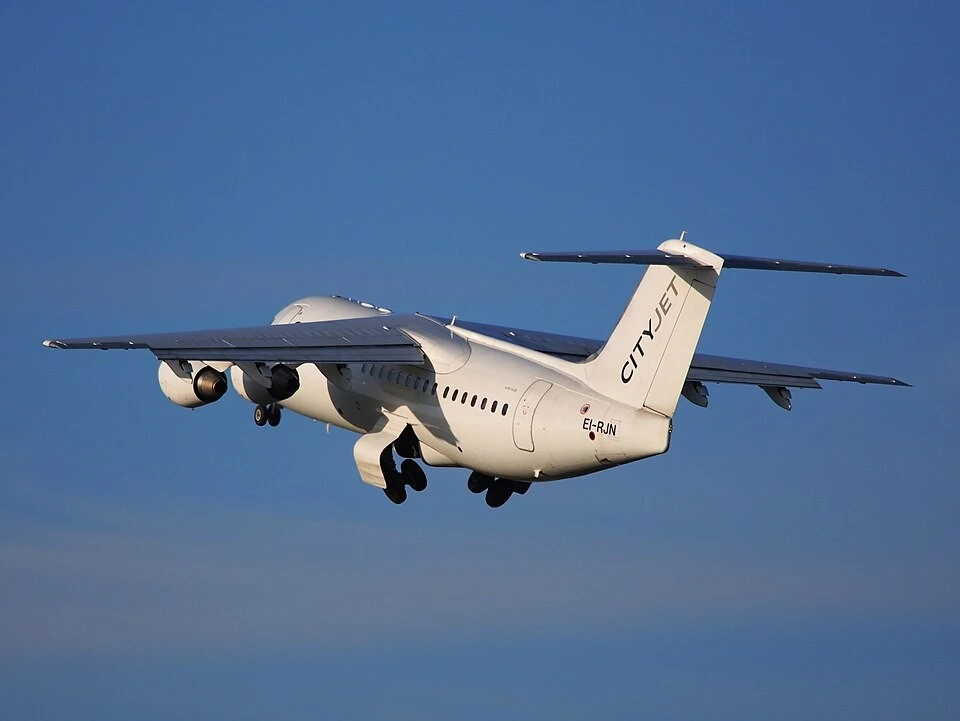
Count two engine nacelles per wing. They sit below a wing mounted high on the fuselage. The CRJ uses two engines mounted beside the tail.
T-tail and airbrakes
The horizontal tailplane crosses the top of the fin. When deployed, the airbrakes open beside the tail cone.
Three fuselage lengths
In a broadside view compare the passenger fuselage. The BAe 146-100 and RJ70 measure 26.19 m, the -200 and RJ85 28.55 m, and the -300, RJ100 and RJ115 31.00 m.

Equivalent fuselage lengths occur in both generations. Confirm the exact type from the registration and aircraft record.

Design & cabins

Technical notes

Design notes

  • EASA lists BAe 146 Series 100, 200 and 300 separately from the Avro 146-RJ70, RJ85, RJ100 and RJ115 under the same certificate.
  • The two generations are easy to confuse in profile. Their decisive differences include certified engine fit and airframe records.
  • EASA documents Quiet Trader freighter configurations and the Series 200 Quick Change layout in the BAe 146 series.
Family Technical Profile

BAe 146 / Avro RJ Family is one of Embraer's platforms in its market segment, balancing capacity, range, airport compatibility, maintenance economics, and mission flexibility.

BAe 146 / Avro RJ Family serves the narrowbody market with family commonality and multiple configurations.

Technical features

  • BAe 146 / Avro RJ Family: Single-aisle fuselage efficiency · structure. A narrow fuselage reduces structural weight and airport footprint for high-frequency short and medium routes.
  • BAe 146 / Avro RJ Family: High-cycle operating design · maintenance. Doors, landing gear, brakes, and systems are optimized for repeated daily sectors and quick turnarounds.
  • BAe 146 / Avro RJ Family: Wing and high-lift devices · aerodynamics. Flaps, slats, and wingtip devices balance runway performance with cruise efficiency.
  • BAe 146 / Avro RJ Family: Engine generation changes · engine. Engine nacelle, thrust rating, fuel burn, and noise standards define each production generation.
  • BAe 146 / Avro RJ Family: Fleet commonality · operational_efficiency. Common flight decks and maintenance practices reduce training and support cost across subfleets.

Advantages

  • One platform can cover several capacity and mission bands.
  • Family design reduces training, maintenance, and spares complexity.
  • Engine, wingtip, avionics, or structural upgrades can extend lifecycle value.

Weaknesses

  • Configuration identification complexity. Visually similar aircraft can differ materially by engine, weight standard, cabin layout, and conversion status.
  • Generation-dependent economics. Older generations usually trail newer designs in fuel burn, noise, avionics, or maintenance intervals.
  • Market-fit limits. Every variant has an ideal capacity and range band; outside it, load factor, range, or cost can become limiting.

Markets

  • Network airline trunk or feeder markets
  • Leasing and fleet replacement markets
  • Regional, domestic, or international airline markets

Operators

  • Full-service network airlines
  • Low-cost or leisure airlines
  • Cargo, government, or special-mission operators

Routes and missions

  • High-frequency short or medium-haul trunk routes
  • Medium-density long-haul or cross-regional routes
  • Fleet replacement, supplementation, or special missions
Sources