A300-600
The A300-600 updated the A300B4 with a redesigned rear fuselage, a two-crew flight deck and improvements drawn from the A310. It carried more passengers and underfloor cargo within the A300 platform.
- Length
- 54.07 m
- Wingspan
- 44.84 m
- Engine options
- CF6-80C2A1 · CF6-80C2A3 · JT9D-7R4H1 · PW4158
- Published range
- 3,500 nmiApproximate Airbus planning range. 165 t CF6-80C2A1 configuration with 285 passengers.
Identification
- Tip fences
- Look for the small vertical plates at the wingtips that were introduced on the A300-600.
- Fuselage length
- A broadside view shows a longer airframe than the A310, which can share a similar wingtip fence.
Compare models
Comparing A300-600 with A300-600F.
| Specification | A300-600 | A300-600F |
|---|---|---|
| Length | 54.07 m | 54.07 m |
| Wingspan | 44.84 m | 44.84 m |
| Maximum take-off weight | 165 tBasic Airbus weight variant WV000. | 170.5 tBasic Airbus WV000; listed payload maximum applies to the separate WV009. |
| Maximum payload | 43.27 tAirbus planning estimate with the CF6-80C2 installation. | 54.79 tAirbus planning estimate, WV009 with a PW4000 installation. |
| Fuel tank capacity | 62,000 LBasic tanks. 76,400 L with additional centre tanks. | 68,160 L |
| Engine options | CF6-80C2A1 · CF6-80C2A3 · JT9D-7R4H1 · PW4158 | CF6-80C2A5 · CF6-80C2A5F · PW4158 |
| Typical two-class seats | 266Manufacturer two-class reference for the later passenger A300 family. | Unavailable |
| Published range | 3,500 nmiApproximate Airbus planning range. 165 t CF6-80C2A1 configuration with 285 passengers. | 2,620 nmi2007 published maximum · approximately 4,850 km |
A dash indicates that a verified figure is unavailable. Figures follow the configuration specified by each source.
Comparison sources
- FAA Aircraft Characteristics Database · October 2024ACD_Data · A306 · Airbus A300 B4-600
- Airbus · A300 history and derivativesA300 derivatives · A300-600 first flight
- EASA.A.172 type-certificate data sheet · Issue 08p. 46 §15.2 · A300 B4-600 powerplants
- EADS · 2001 Reference DocumentA300/A310 technical features
- Airbus A300-600/-600R · aircraft characteristicsChapter 3.2 · Payload and range, PDF p. 53
- Airbus A300-600/-600R · aircraft characteristics§2-1-1 and airplane description · A300B4-600
- EADS 2007 Annual Review · A300-600F technical featuresA300-600F technical features · Production freighter service entry
- EASA.A.172 type-certificate data sheet · Issue 08p. 52 §18.2 · A300 F4-600R powerplants
- Airbus A300F4-600 · aircraft characteristics§2-1-0 · A300F4-600R weights and usable fuel
Design & cabins
CF6-80C2A1 installation
See the engine encyclopedia for ratings and aircraft applications.
CF6-80C2A3 installation
See the engine encyclopedia for ratings and aircraft applications.
JT9D-7R4H1 installation
See the engine encyclopedia for ratings and aircraft applications.
PW4158 installation
See the engine encyclopedia for ratings and aircraft applications.
Featured components & design
Fuselage length
A broadside view shows a longer airframe than the A310, which can share a similar wingtip fence.
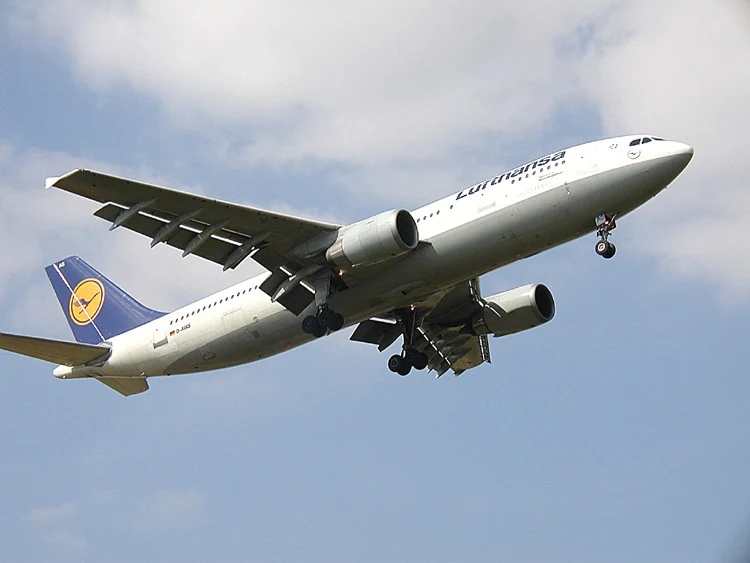
Lufthansa A300B4-603 D-AIAS · early A300-600 fuselageAdrian Pingstone (Arpingstone) · resized · Public domain Engine installation · CF6-80C2A1 / CF6-80C2A3 / JT9D-7R4H1 / PW4158
Published engine installation for the A300-600 is CF6-80C2A1, CF6-80C2A3, JT9D-7R4H1, PW4158.
Lufthansa A300B4-603 D-AIAS · GE CF6-80C2 exampleAdrian Pingstone (Arpingstone) · resized · Public domain

Airbus A300 Family Fuselage and Cabin Architecture
Airbus A300 Family fuselage design defines the usable cabin width, door layout, cargo volume, stretch potential, and airline cabin flexibility across A300B2, A300B4, A300-600, A300-600R, A300-600F.
Airbus A300 Family Wing and High-Lift System
Airbus A300 Family wing design is central to runway performance, cruise efficiency, fuel capacity, and the family improvement path across its variants.
Airbus A300 Family Landing Gear and Braking System
Airbus A300 Family landing gear and braking architecture support the aircraft's weight growth, field performance, pavement loading, and maintenance profile.
Airbus A300 Family Flight Deck and Avionics
Airbus A300 Family cockpit architecture reflects the manufacturer's operating philosophy, training commonality, display technology, and automation level.
Airbus A300 Family Materials and Structural Design
Airbus A300 Family structural design balances weight, fatigue life, corrosion resistance, repairability, production cost, and the technology level of its generation.
Airbus A300 Family Cargo and Cabin Systems
Airbus A300 Family cargo and cabin systems affect payload, turnaround, passenger comfort, conversion potential, and airline route economics.
Technical notes
Design notes
- Family context: The Airbus A300 was the first twin-engine wide-body airliner and established Airbus in the commercial aircraft market with a medium-range high-capacity platform.
- Exact airline configuration can change seat count, galley arrangement, cargo capability, and operating range.
- Engine reference: A300-600 uses CF6-80C2; A300-600 uses PW4000-94.
- Cabin configuration should be treated as airline-specific: the same variant may be high-density, full-service, or premium-heavy.
Advantages
- Pioneering twin-engine wide-body economics.
- Useful freighter volume and payload.
- Important foundation for later Airbus wide-bodies.
Limitations
- Older systems and airframes compared with A330 and newer types.
- Passenger operation is now limited.
Variant Technical Profile
A300-600 is a specific configuration within Airbus A300 Family, developed to cover a defined capacity, range, payload, or mission requirement inside the wider family.
A300-600 is positioned as a capacity/range-specific solution within the widebody segment, serving routes better matched than sibling variants.
Technical features
- A300-600: Wide-body fuselage · structure. Twin-aisle cabin and lower-deck cargo volume support long-haul passenger comfort and belly-freight revenue.
- A300-600: High-bypass turbofan integration · engine. Large engines are matched to long-range payload needs, ETOPS rules, and airline maintenance strategy.
- A300-600: Long-range fuel and payload balance · range_payload. Wing fuel capacity, MTOW growth, and cabin density determine whether the aircraft favors range, seats, or cargo.
- A300-600: Advanced flight deck · avionics. Glass-cockpit avionics and modern flight-management systems reduce crew workload on long sectors.
- A300-600: Cabin systems for long sectors · cabin. Pressurization, air conditioning, galleys, crew rest, and cargo holds are sized for extended missions.
Advantages
- Provides a more precise capacity or range match within the family.
- Retains training, maintenance, and parts commonality with sibling variants.
- Lets operators tune engine, cabin, and payload choices to route needs.
Weaknesses
- Configuration identification complexity. Visually similar aircraft can differ materially by engine, weight standard, cabin layout, and conversion status.
- Generation-dependent economics. Older generations usually trail newer designs in fuel burn, noise, avionics, or maintenance intervals.
- Market-fit limits. Every variant has an ideal capacity and range band; outside it, load factor, range, or cost can become limiting.
Markets
- Network airline trunk or feeder markets
- Leasing and fleet replacement markets
- Regional, domestic, or international airline markets
Operators
- Full-service network airlines
- Low-cost or leisure airlines
- Cargo, government, or special-mission operators
Routes and missions
- High-frequency short or medium-haul trunk routes
- Medium-density long-haul or cross-regional routes
- Fleet replacement, supplementation, or special missions
Sibling comparison
- smaller sibling variants. Usually provides more seats, cargo volume, or thrust demand, but can be harder to fill on thinner routes.
- larger or longer-range sibling variants. Usually has lower acquisition and operating exposure, but less range, payload, or growth margin.
Key terms
- Engine configuration
The exact engine family and thrust standard installed on a specific model or production block.
- Connects model suffixes, airline maintenance strategy, and performance limits.
- Important for aircraft identification and fleet comparison.
Advantages. Helps explain range, payload, noise, and fuel-burn differences.
Limitations. Public data may omit thrust derates or later engine swaps.
- Cabin configuration
The airline-selected layout of cabins, seats, galleys, lavatories, crew rest, and monuments.
- Can change the same aircraft type from premium-heavy to high-density.
- Affects range, payload, passenger experience, and turnaround flow.
Advantages. Lets airlines tailor the aircraft to route economics.
Limitations. Seat-map examples vary over time and by subfleet.
- Fly-by-wire commonality
Airbus families use a common cockpit philosophy that helps reduce training differences across related aircraft.
- This system is part of the A330 operating architecture and interacts with flight-control, electrical, hydraulic, engine, or environmental systems.
- Exact configuration varies across A330ceo, A330neo, freighter, and military derivatives.
Advantages. Improves operational reliability, economics, or mission flexibility. Uses a mature wide-body systems architecture to reduce operational risk.
Limitations. System complexity increases maintenance, training, and troubleshooting demands. Airline configuration and engine choice can change real-world performance.
From the archive
Loading photographs…