Airbus A330 MRTT
The A330 MRTT is a multi-role tanker and transport based on the A330-200. The widebody cabin also lends itself to passenger, cargo and medical transport.
- Length
- 58.8 m
- Wingspan
- 60.3 m
- Engine options
- CF6-80E1A3 · Trent 772B
- Published range
- 8,700 nmiAirbus published maximum
Identification
Use these features to recognise the Airbus A330 Family. Check the aircraft or programme record for the Airbus A330 MRTT designation.
- One engine per wing
- Start by counting nacelles under both wings. The A330 shares the general outline of the early A340, which carries two engines on each wing.
- Wingtips and fuselage length
- Look for long, swept, curved tips on the A330neo and shorter tip devices on the ceo. In side view the -200 and -800 are the short pair, while the -300 and -900 are the long pair.
Compare models
Comparing Airbus A330 MRTT with Airbus A330-800.
| Specification | Airbus A330 MRTT | Airbus A330-800 |
|---|---|---|
| Length | 58.8 m | 58.82 m |
| Wingspan | 60.3 m | 64 m |
| Maximum take-off weight | 233 t | 251 t251 t weight option |
| Maximum payload | 37 tPublished cargo payload · Cargo only · 45 t total payload | 46 tApproximate Airbus planning figure. 251 t MTOW, Trent 7000. |
| Fuel tank capacity | 139,090 LStandard A330-200 three-tank system retained on the MRTT. Airbus publishes approximately 111 tonnes | 139,090 L |
| Engine options | CF6-80E1A3 · Trent 772B | Trent 7000 |
| Typical two-class seats | Unavailable | 257 |
| Published range | 8,700 nmiAirbus published maximum | 8,100 nmi251 t weight variant |
A dash indicates that a verified figure is unavailable. Figures follow the configuration specified by each source.
Comparison sources
- Airbus A330 MRTT · SpecificationsTransport configuration
- Airbus A330 MRTT · SpecificationsSpecifications · More range
- Airbus · A330 MRTT specifications2023 brochure · Specifications and dimensions
- Airbus A330 MRTT specification brochureSpecifications and dimensions · Maximum weights
- Airbus · Spanish A330 MRTT order and basic fuel capacityBasic 111 t fuel capacity retained from the unmodified A330-200 tank system
- EASA.A.004 · Airbus A330 type certificateIssue 70, A330-200 §7.1 · standard three-tank usable fuel (111,272 kg before rounding)
- FAA Aircraft Characteristics Database · October 2024ACD_Data · A338 · Airbus A330-800
- Airbus A330 Family Facts & Figures · November 2025Programme dates and aircraft characteristics
- EASA.A.004 type-certificate data sheet · Issue 70Issue 70 §5.1 · A330neo
- Airbus A330 Family Facts & Figures · November 2025pp. 4–5 · 251 t A330-800 range and programme dates
- Airbus Annual Report 2022 · A330 family technical featuresA330 family technical features · Entry into service
- Airbus A330 aircraft characteristics · December 2025§2-1-1, A330-200 and A330-800 standard two-class seating
- Airbus A330 Family Facts & Figures · April 2026Specifications and weight options
- Airbus A330 · aircraft characteristics§3-2-1, ISA payload-range chart, PDF pp. 275
Design & cabins
CF6-80E1A3 installation
See the engine encyclopedia for ratings and aircraft applications.
Trent 772B installation
See the engine encyclopedia for ratings and aircraft applications.
Featured components & design
Engine installation · CF6-80E1A3 / Trent 772B
Published engine installation for the Airbus A330 MRTT is CF6-80E1A3, Trent 772B.
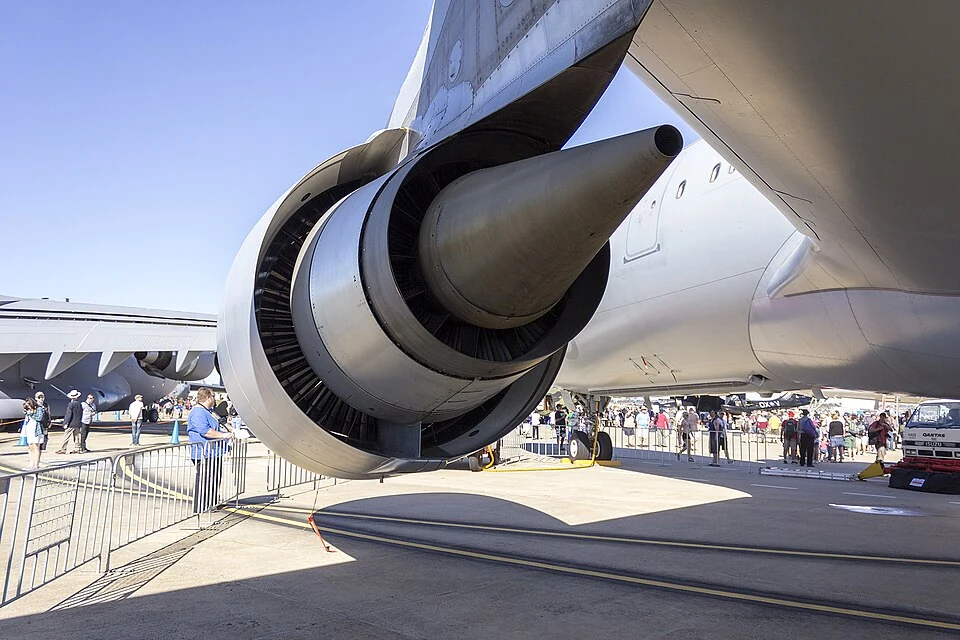
RAAF KC-30A A39-002 · GE CF6-80E1A3Bidgee · resized · CC BY-SA 3.0 au 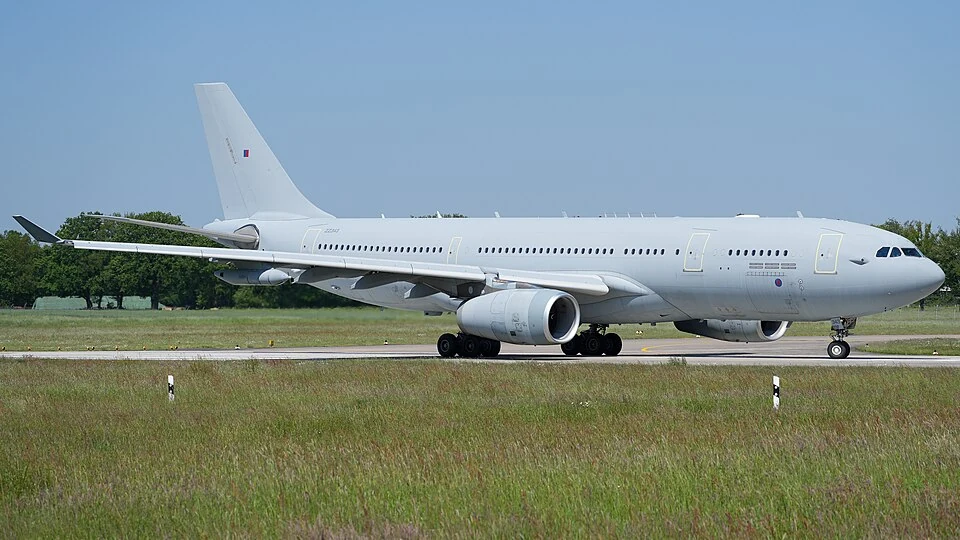
RAF KC2 Voyager ZZ343 · Rolls-Royce Trent 700MarcelX42 · resized · CC BY-SA 4.0


A330 Fuselage
The A330 fuselage is a twin-aisle wide-body pressure vessel whose length, door layout, cargo volume, window spacing, and cabin interior can vary significantly between the A330-200, A330-300, freighter, tanker, and A330neo derivatives.
A330 Wings
The A330 wing is a major structural and aerodynamic component that carries fuel, supports high-lift devices, engine pylons, and landing-gear loads, and strongly influences cruise efficiency, payload-range performance, and airport compatibility.
A330 Landing Gear
The A330 landing gear system supports wide-body weights while preserving ground handling compatibility at major airports. The freighter version is notable because its nose-gear arrangement helps level the cargo floor for loading.
A330 Passenger-to-Freighter Structure
A330 passenger-to-freighter conversion is not a single part, but a package of structural and systems changes. The most visible change is the main-deck cargo door, supported by floor, loading, smoke detection, and cargo barrier modifications.
Engine configurations
A330ceo
- A330-200 Engine Options
Model configurations
- A330-223 · Pratt & Whitney PW4000
EASA lists PW4168A, PW4168A-1D and PW4170 options for this model.
PW4164 (A330-321, A330-221)
PW4168 (A330-322, A330-222)
PW4168A (A330-323, A330-223, A330-300 high-thrust)
PW4170 (A330-223, A330-323, A330-200F)
- A330-203 · General Electric CF6-80E1
EASA lists the CF6-80E1A3 for this model.
CF6-80E1A2 (A330-201, A330-301, A330-302)
CF6-80E1A3 (A330-203, A330-303, A330 MRTT)
CF6-80E1A4 (A330-202, A330-302)
CF6-80E1A4/B (A330-202, A330-302)
- A330-243 · Rolls-Royce Trent 700
EASA lists Trent 772B-60 and Trent 772C-60 options for this model.
Trent 768-60 (A330-341, A330-343)
Trent 772-60 (A330-342, A330-242)
Trent 772B-60 (A330-343, A330-243, A330-200F, BelugaXL)
Trent 772C-60 (A330-243, A330-343, A330 MRTT)
- A330-223 · Pratt & Whitney PW4000
- A330 Model Designations and Engine Options
Technical notes
Design notes
- Can be equipped with refueling boom and/or hose-and-drogue systems depending on customer configuration.
- Retains wide-body transport capacity for personnel, cargo, and medical evacuation missions.
- Military mission systems and refueling equipment make it substantially different from a civil A330-200 in operation.
- Major users include Australia, France, NATO MMF, Saudi Arabia, Singapore, South Korea, the United Kingdom, the United Arab Emirates, Spain, Brazil, and Canada.
- Typical mission equipment can include under-wing hose-and-drogue pods, a centerline hose-and-drogue unit, an aerial refueling boom, military communications, mission consoles, palletized cargo, passenger seating, and aeromedical evacuation kits.
Advantages
- Combines tanker and strategic transport roles in one platform.
- Large fuel and cabin capacity make it useful for expeditionary air forces.
Limitations
- Military conversion complexity, mission equipment, and support requirements increase cost and maintenance burden.
- Runway and infrastructure needs remain those of a large wide-body aircraft.
Variant Technical Profile
Airbus A330 MRTT is a specific configuration within Airbus A330 Family, developed to cover a defined capacity, range, payload, or mission requirement inside the wider family.
Airbus A330 MRTT is positioned as a capacity/range-specific solution within the tanker segment, serving routes better matched than sibling variants.
Technical features
- Airbus A330 MRTT: Fuel offload system · engine. Booms, hose-and-drogue pods, and fuel-management systems define refueling capability.
- Airbus A330 MRTT: Wide-body or transport base · structure. Tanker derivatives use existing airliner or transport structures to reduce development risk.
- Airbus A330 MRTT: Mission avionics · avionics. Operator consoles, cameras, communications, and navigation systems support refueling operations.
- Airbus A330 MRTT: Cargo and passenger flexibility · operational_efficiency. Many tankers retain pallet, troop, medical evacuation, or VIP transport capability.
- Airbus A330 MRTT: Long endurance · range_payload. Fuel capacity and efficient cruise performance support distant deployments and loiter time.
Advantages
- Provides a more precise capacity or range match within the family.
- Retains training, maintenance, and parts commonality with sibling variants.
- Lets operators tune engine, cabin, and payload choices to route needs.
Weaknesses
- Configuration identification complexity. Visually similar aircraft can differ materially by engine, weight standard, cabin layout, and conversion status.
- Generation-dependent economics. Older generations usually trail newer designs in fuel burn, noise, avionics, or maintenance intervals.
- Market-fit limits. Every variant has an ideal capacity and range band; outside it, load factor, range, or cost can become limiting.
Markets
- Network airline trunk or feeder markets
- Leasing and fleet replacement markets
- Military transport, tanker, and special-mission markets
Operators
- Full-service network airlines
- Low-cost or leisure airlines
- Cargo, government, or special-mission operators
Routes and missions
- High-frequency short or medium-haul trunk routes
- Medium-density long-haul or cross-regional routes
- Fleet replacement, supplementation, or special missions
Sibling comparison
- smaller sibling variants. Usually provides more seats, cargo volume, or thrust demand, but can be harder to fill on thinner routes.
- larger or longer-range sibling variants. Usually has lower acquisition and operating exposure, but less range, payload, or growth margin.
From the archive
Loading photographs…